Factors that Influence Diffusion
Factors that Influence Diffusionvideo
Factors that Influence Diffusion
There are four key factors that influence diffusion of particles
Surface area to volume ratio
Distance
Temperature
Concentration gradient
Surface area to volume ratio
The bigger a cell or structure is, the smaller its surface area to volume ratio is, slowing down the rate at which substances can move across its surface
Many cells which are adapted for diffusion have increased surface area in some way - e.g. root hair cells in plants (which absorb water and mineral ions) and cells lining the ileum in animals (which absorb the products of digestion)
Diffusion and surface area to volume ratio diagram
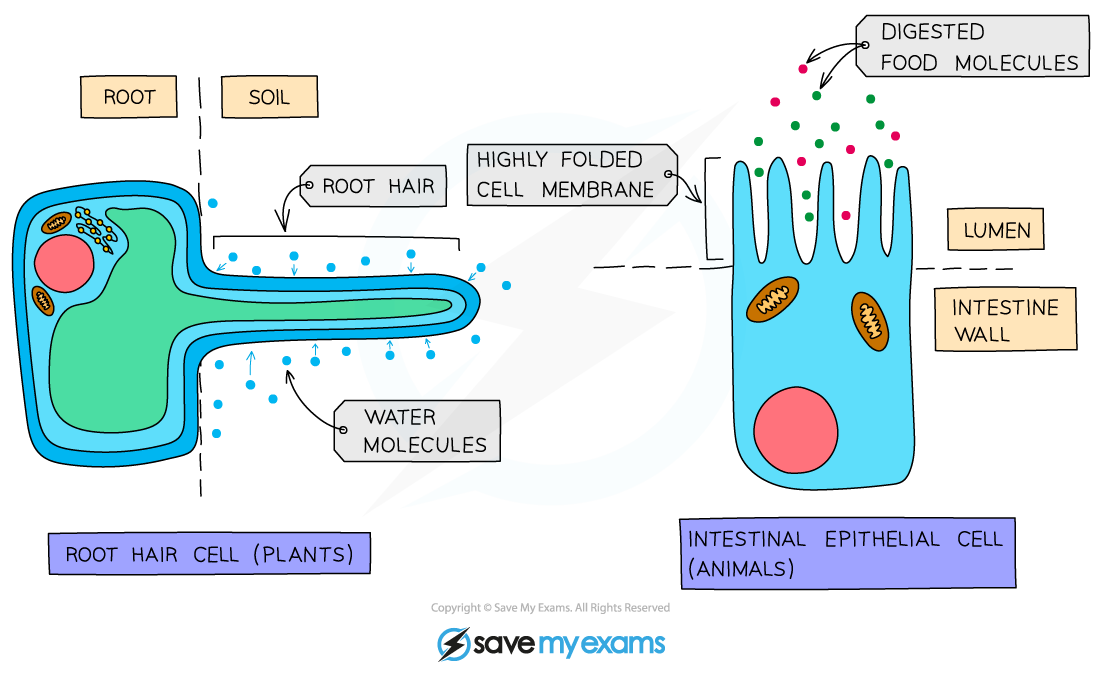
Cell adaptations for diffusion
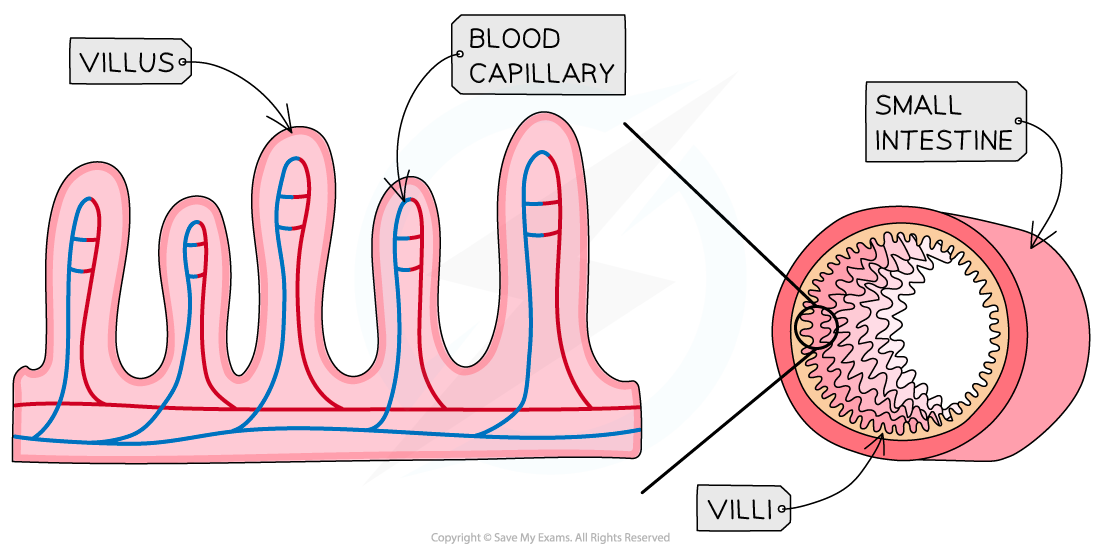
The highly folded surface of the small intestine increases its surface area
Distance
The shorter the distance molecules have to travel, the faster diffusion will occur
This is why blood capillaries and alveoli have walls which are only one cell thick, ensure the rate of diffusion across them is as fast as possible
Temperature
The higher the temperature, the faster molecules move
This is because they have more kinetic energy
This results in more collisions against the cell membrane and therefore a faster rate of movement across them
Concentration Gradient
The greater the difference in concentration on either side of the membrane, the faster movement across it will occur
This is because on the side with the higher concentration, more random collisions against the membrane will occur