Xylem & Phloem
The Xylem & Phloem
The Xylem & Phloem
Plants contain vascular tissue for transport of substances, including:
Xylem vessels (pronounced: zy-lem) transport water and minerals from the roots to the stem and leaves
Phloem vessels transport sucrose and amino acids from sources to sinks
These vessels are arranged throughout the root, stem and leaves in groups called vascular bundles
In stems vascular bundles are arranged around the outer edge, with phloem vessels closer to the outside of the stem, and xylem vessels closer to the inside
In roots there is a single vascular bundle in the centre of the root, inside which the xylem forms an 'x' shape and phloem are arranged around the outside of the xylem
Stems and roots also contain a region of tissue known as the cortex; this is a layer of tissue that lies between the vascular tissue ands the outer surface of the plant
In stems the cortex is a narrow band of tissue, as the vascular tissue is close to the surface of the stem
In roots the cortex is wide and takes up most of the root
Functions of the cortex include:
Transport, e.g. of water towards the vascular tissue
Storage, e.g. of starch
Distribution of xylem and phloem diagram
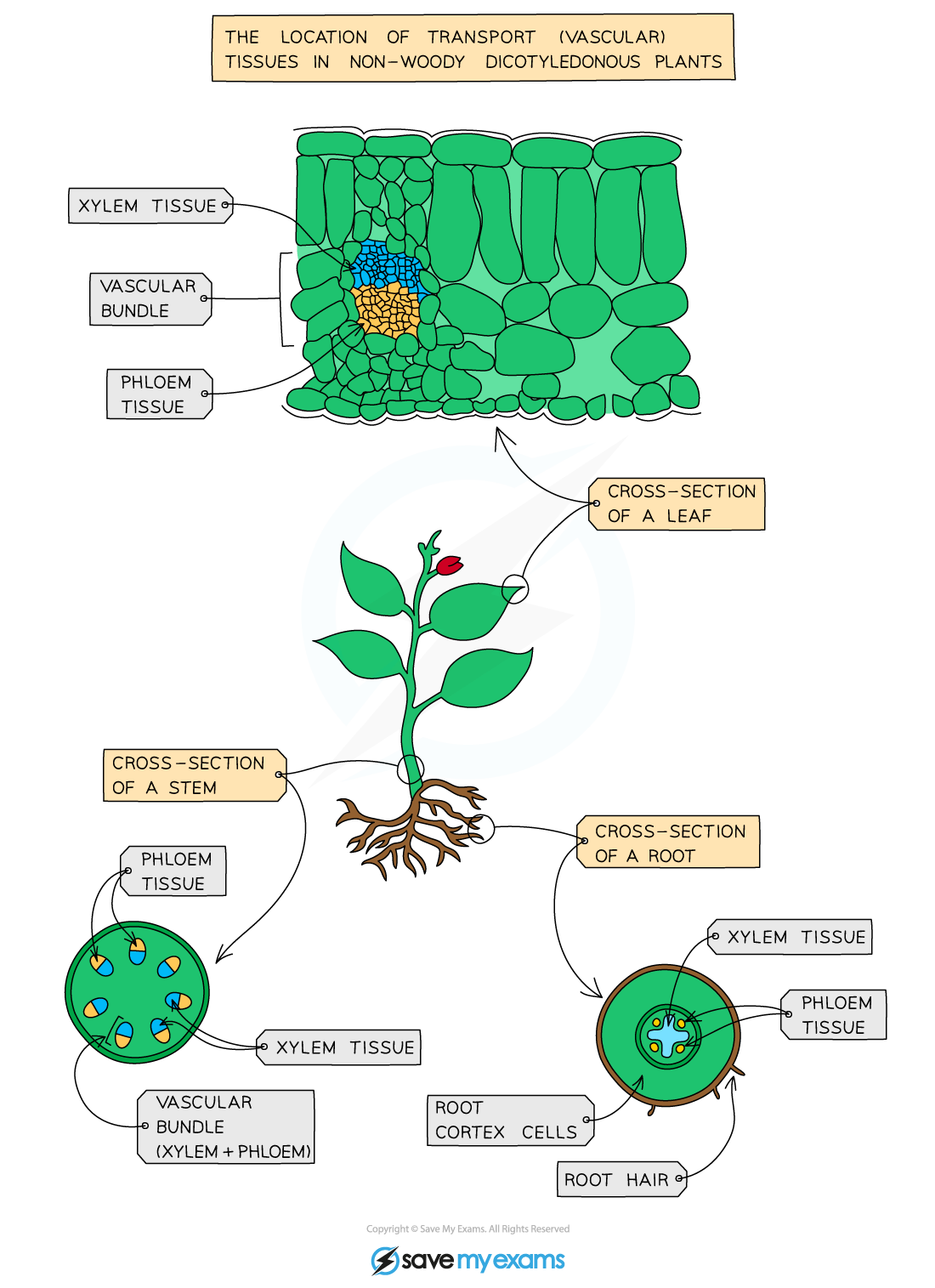
Vascular tissue is distributed differently in different parts of a plant
Adaptations of Xylem Vessels
Adaptations of Xylem Vessels
Xylem vessels are adapted to allow them to carry out the following functions:
Transport of water and minerals from roots to leaves
Structural support of plant stems
The features of xylem vessels that enable them to carry out these functions include:
The outer walls of xylem vessels are thickened with a substance called lignin
Lignin strengthens the tubes, reducing the chance of breakages which might impede the flow of water
Lignin provides structural support to the plant stem
Xylem cells are dead and contain no cell contents
The xylem tubes are hollow, allowing free passage of water
Xylem cells are joined end-to-end with no cross walls
This means that a continuous tube is formed, through which water and dissolved minerals can flow
Xylem adaptations diagram
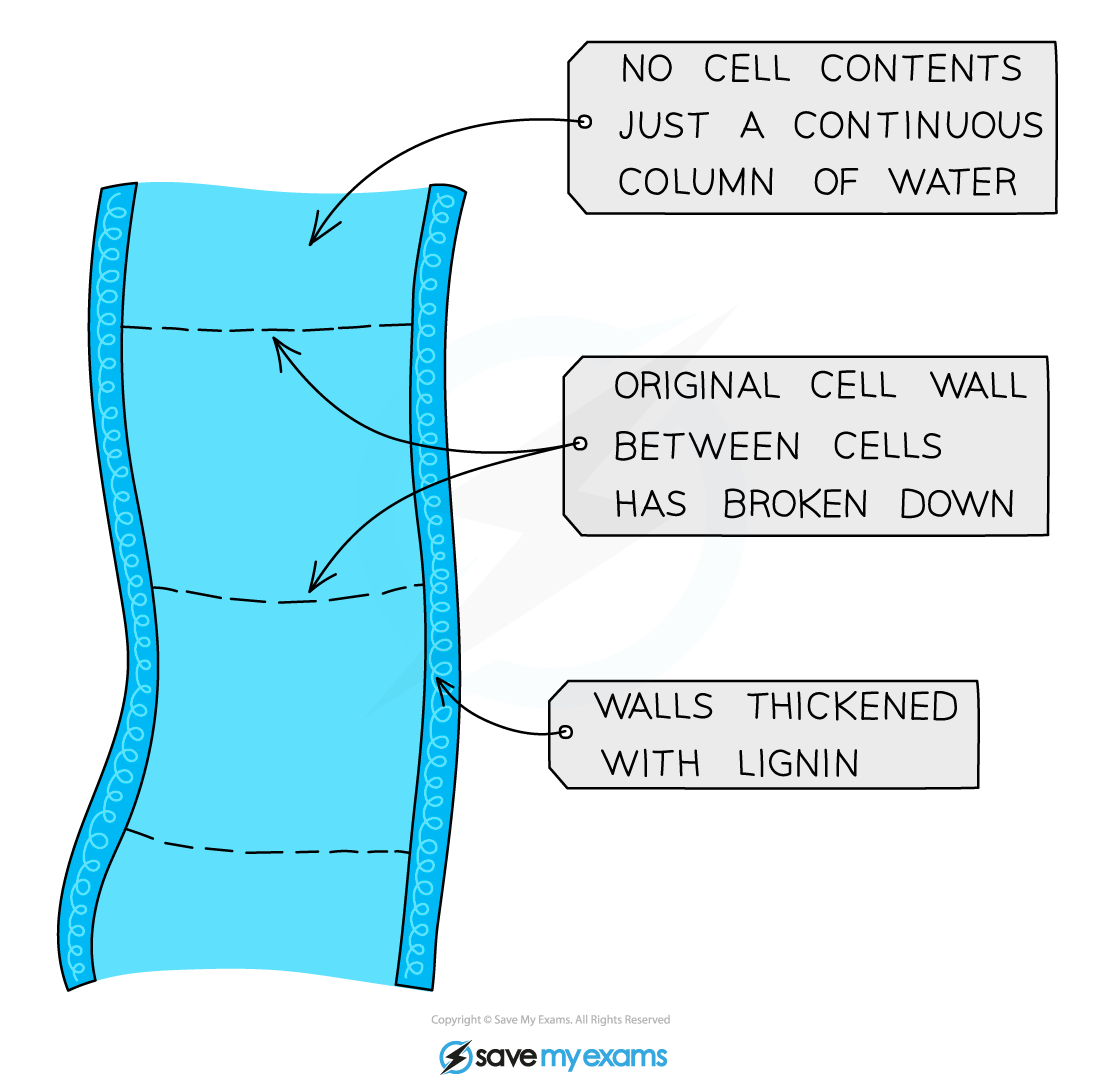
Xylem cells lose their top and bottom walls to form a continuous tube through which water and dissolved minerals can flow