Bond Breaking & Bond Forming
Bond Breaking & Bond Formingvideo
Bond Breaking & Bond Forming
Whether a reaction is endothermic or exothermic depends on the difference between the energy needed to break existing bonds and the energy released when the new bonds are formed
Bond breaking is always an endothermic process as energy needs to be taken in from the surroundings to break the chemical bonds
Bond making is always an exothermic process as energy is transferred to the surroundings as the new bond is formed
Exothermic reactions
If more energy is released than is absorbed, then the reaction is exothermic
More energy is released when new bonds are formed than energy required to break the bonds in the reactants
The change in energy is negative since the products have less energy than the reactants
Therefore an exothermic reaction has a negative ΔH value
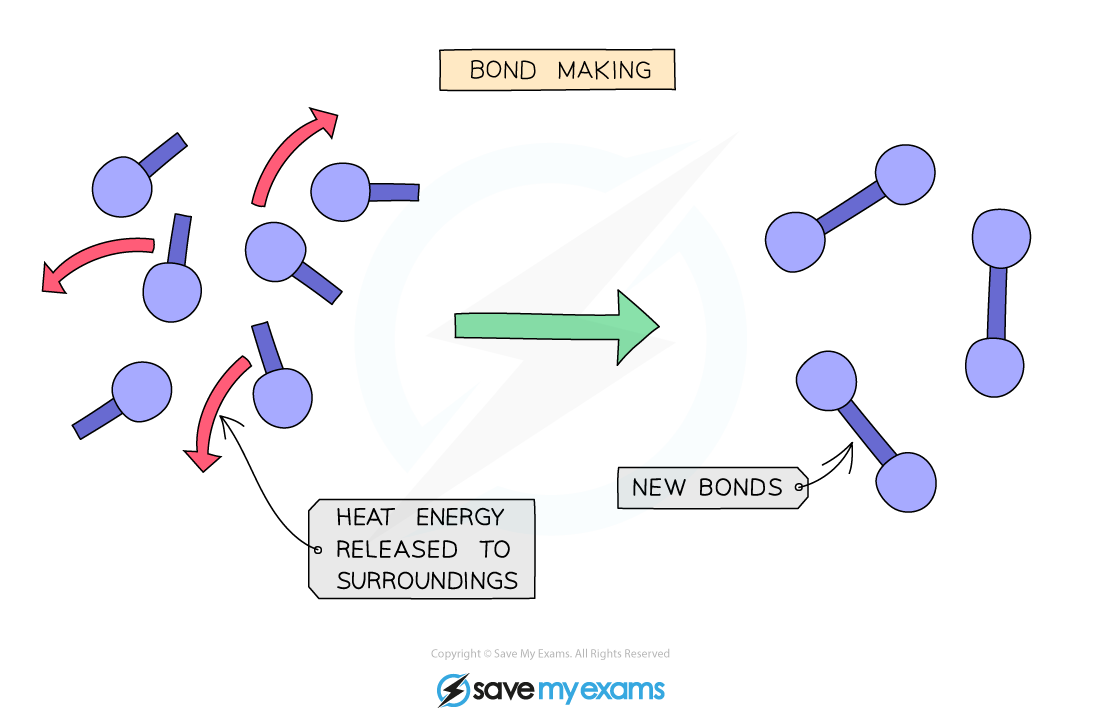
Making new chemical bonds releases energy which radiates outwards from the reaction to the surroundings in the form of heat
Endothermic reactions
If more energy is absorbed to break bonds than is released to form new bonds, this reaction is endothermic overall
The change in energy is positive since the products have more energy than the reactants
The symbol ΔH (delta H) is used to show the change in heat energy. H is the symbol for enthaply, which is a measure of the total heat of reaction of a chemical reaction
Therefore an endothermic reaction has a positive ΔH value, which is shown on the reaction pathway diagrams and in calculations
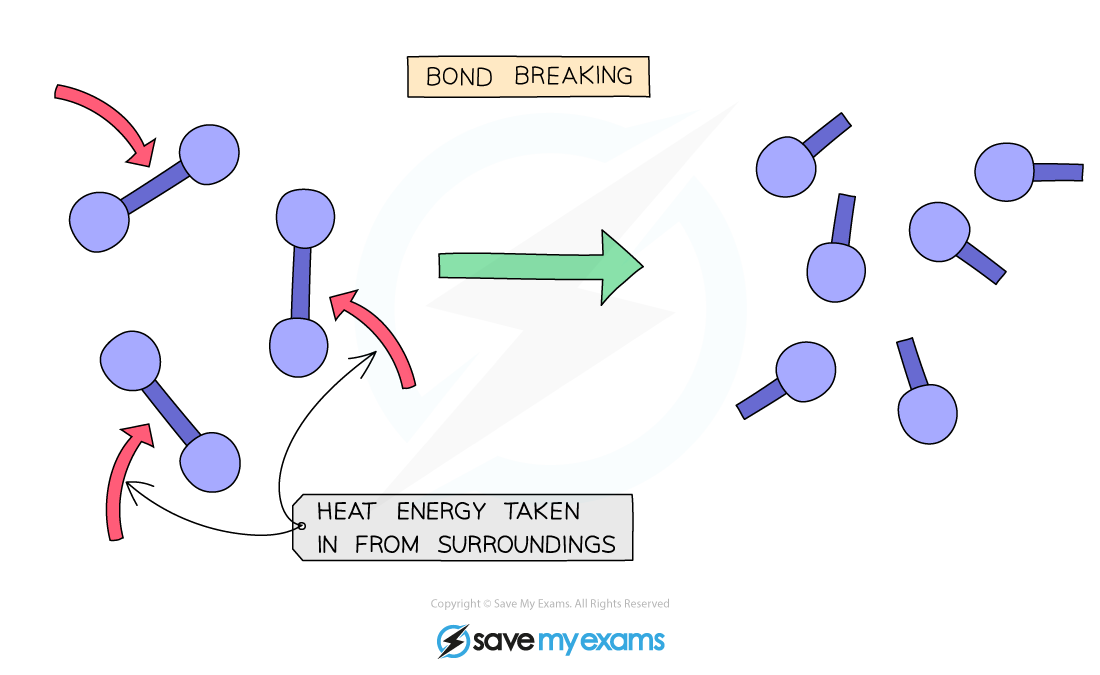
Breaking chemical bonds requires energy which is taken in from the surroundings in the form of heat
Bond Energy Calculations
Bond Energy Calculations
Energy of reaction calculations
Each chemical bond has specific bond energy associated with it
This is the amount of energy required to break the bond or the amount of energy given out when the bond is formed
This energy can be used to calculate how much heat would be released or absorbed in a reaction
To do this it is necessary to know the bonds present in both the reactants and products
Method
Write a balanced equation if none is present already
Optional - draw the displayed formula in order to identify the type and number of bonds more easily
Add together all the bond energies for all the bonds in the reactants – this is the ‘energy in’
Add together the bond energies for all the bonds in the products – this is the ‘energy out’
Calculate the enthalpy change:
Enthalpy change (ΔH) = Energy taken in - Energy given out