Proton Transfer, Strong & Weak Acids
Proton Transfer, Strong & Weak Acidsvideo
Proton Transfer, Strong & Weak Acids
Proton transfer
The earlier definition of an acid and a base can be extended
In terms of proton transfer, we can further define each substance in how they interact with protons
Acids
Acids are proton donors as they ionise in solution producing protons, which are H+ ions
These H+ ions make the aqueous solution acidic
Bases
Bases are proton acceptors as they accept the protons which are donated by the acid
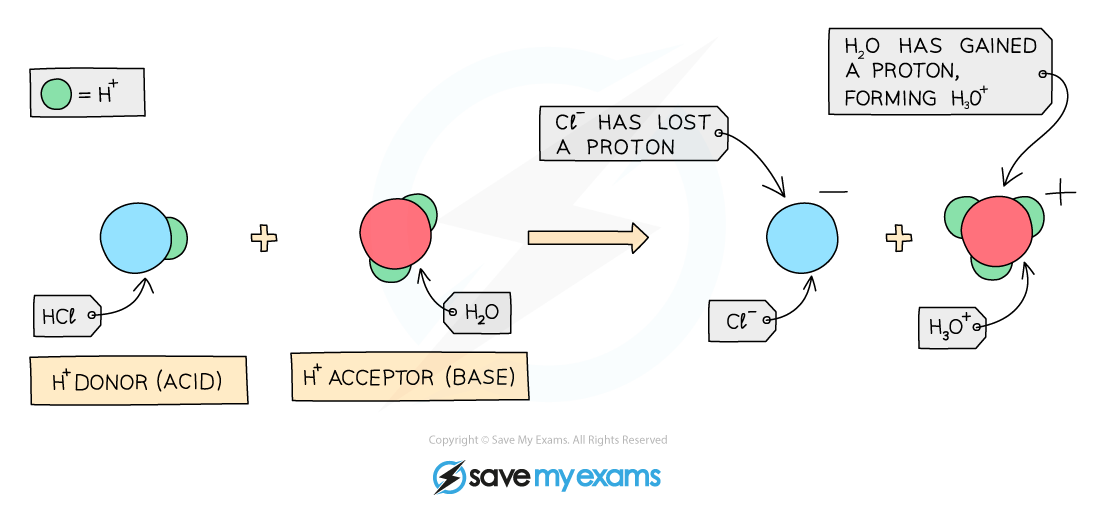
Diagram showing the role of acids and bases in the transfer of protons - here water acts as a base as it accepts a proton
Strong acids
Acids can be either strong or weak, depending on how many H+ ions they produce when dissolved in water
Strong acids completely dissociate (or ionise) in water, producing a high amount of H+ ions and producing solutions with a very low pH
Strong acids include HCl and H2SO4
Example of a strong acid: hydrochloric acid
HCl (aq) → H+ (aq) + Cl- (aq)
Weak acids
Weak acids partially dissociate (or ionise) in water, producing fewer H+ ions in solution than strong acids and producing solutions with pH values which are closer to the middle of the pH scale, whilst still being below 7
Weak acids include organic acids such as ethanoic acid, CH3COOH
For weak acids, there is usually an equilibrium set-up between the molecules and their ions once they have been added to water
Example of a weak acid: propanoic acid
CH3CH2COOH ⇌ H+ + CH3CH2COO-
The equilibrium lies to the left, indicating a high concentration of intact acid molecules, with a low concentration of H+ ions in the solution
Effect of concentration on strong and weak acids
A concentrated solution of an acid is one that contains a higher number of acid molecules per dm3 of solution
It does not necessarily mean that the acid is strong though, as it may be made from a weak acid which does not dissociate completely
For example a dilute solution of HCl will be more acidic than a concentrated solution of ethanoic acid, since most of the HCl molecules dissociate but very few of the CH3COOH do