Resource Allocation Decisions
Economic systems
Economic systems
An economic system is the way a country or society organises the production, distribution and consumption of goods and services to solve the problem of scarcity
In order to solve the basic economic problem of scarcity, economic systems emerge or are created by different economic agents within the economy
These agents include consumers, producers, the government and special interest groups (e.g. environmental pressure groups)
Any economic system aims to allocate the scarce factors of production
Three types of economic systems
1. Market economy (capitalist/free market system)
Decisions are made by individuals and private firms
It is based on supply and demand
There is little to no government intervention
2. Planned economy (command economy)
The government makes all key decisions about what, how and for whom to produce
Resources are owned and controlled by the state
3. Mixed economy
Combines features of both market and planned economies
The private sector and government share decision-making
Most modern economies are mixed economies
The three basic economic questions
The three basic economic questions
Each economic system has to ask and answer three basic questions
Each system answers them differently
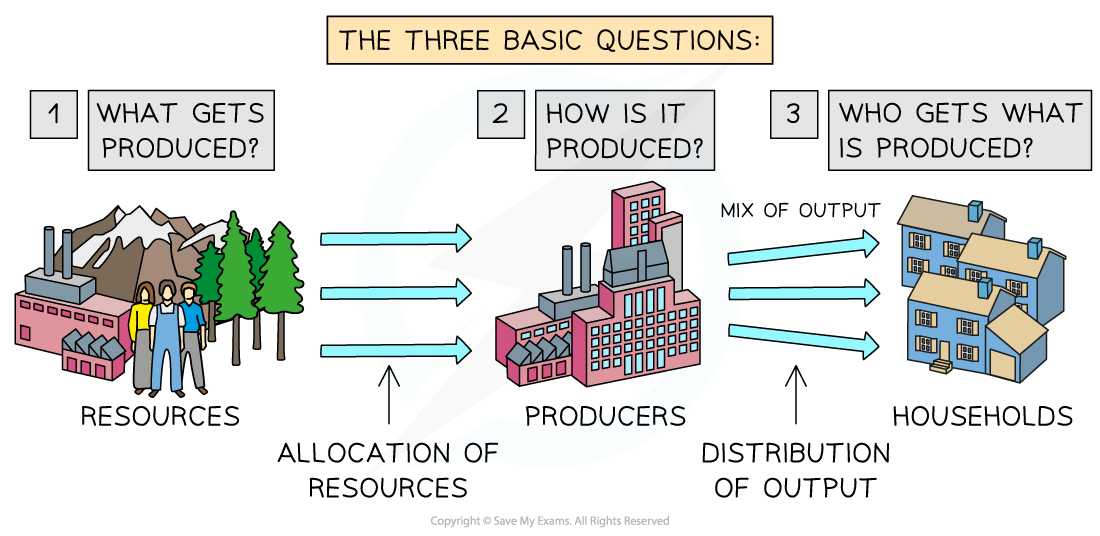
Economic decisions need to be made to answer three important questions
What to produce?
As resources are limited in supply, decisions carry an opportunity cost
For example, should a government invest limited public funds in better rail services or more public hospitals?
How to produce it?
Would it be better for the economy to have labour-intensive production so that more people are employed, or should goods and services be produced using machinery?
For whom are the goods and services to be produced?
Should goods and services only be made available to those who can afford them, or should they be freely available to all?
How does each system answer these questions?
Type of system | What to produce? | How to produce? | For whom? |
|---|---|---|---|
Market system |
|
|
|
Mixed system |
|
|
|
Planned system |
|
|
|