StudyDeck

Intersection of Two Circles

Exam code: 4037
Written by: Ashika|Reviewed by: Caroline Carroll|Updated 2 July 2026

Intersection of Two Circles

Intersection of two circles

What is meant by the intersection of two circles?

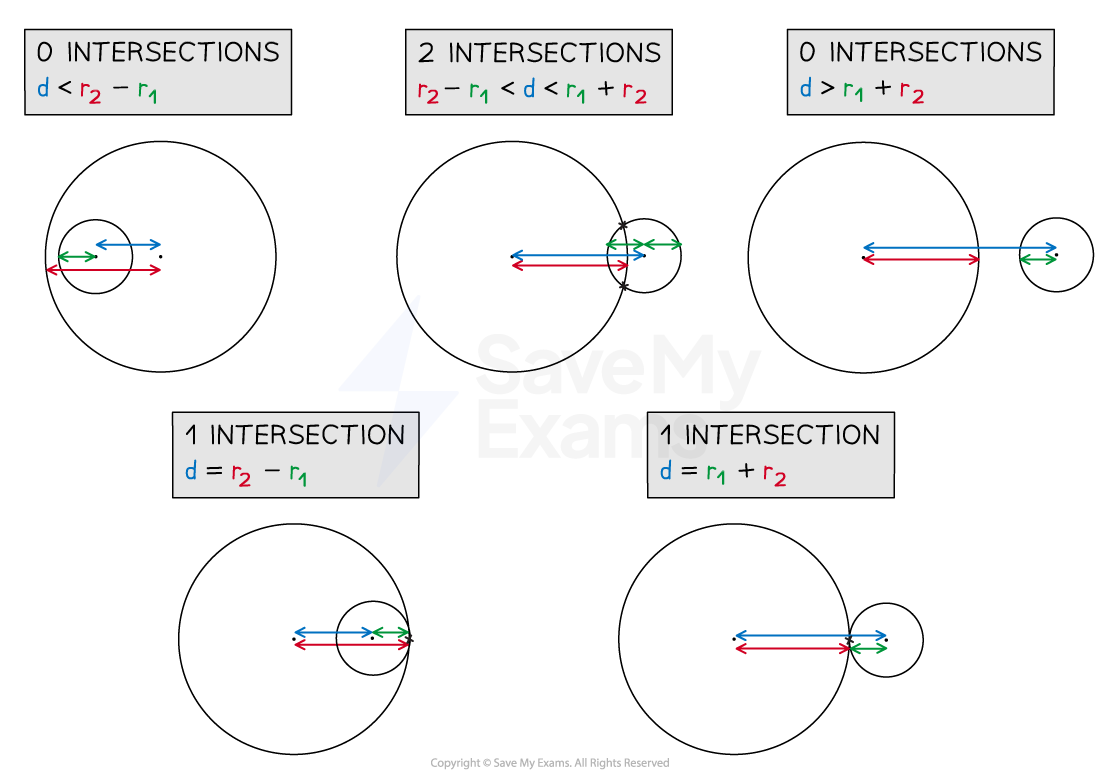
  • Two circles may intersect once (touch), twice (cross), or not at all

    • Touching circles may be referred to as tangent to each other

      • they would have a common tangent line

How do I determine if two circles intersect or not?

  • Find the distance, d{"language":"en","fontFamily":"Times New Roman","fontSize":"18","autoformat":true}, between the centres of the two circles

    • This can be found using Pythagoras' theorem

      • For centres x1, y1{"language":"en","fontFamily":"Times New Roman","fontSize":"18","autoformat":true} and x2, y2{"language":"en","fontFamily":"Times New Roman","fontSize":"18","autoformat":true}, d2=x2-x12+y2-y12{"language":"en","fontFamily":"Times New Roman","fontSize":"18","autoformat":true}

  • The radii of the two circles, r1{"language":"en","fontFamily":"Times New Roman","fontSize":"18","autoformat":true} and r2{"language":"en","fontFamily":"Times New Roman","fontSize":"18","autoformat":true}, where r2≥r1{"language":"en","fontFamily":"Times New Roman","fontSize":"18","autoformat":true} are also needed

  • If r2-r1<d<r1+r2{"language":"en","fontFamily":"Times New Roman","fontSize":"18","autoformat":true} then the circles intersect twice

  •  If d=r2-r1{"language":"en","fontFamily":"Times New Roman","fontSize":"18","autoformat":true} or d=r1+r2{"language":"en","fontFamily":"Times New Roman","fontSize":"18","autoformat":true} then the circles intersect once

  • If d>r1+r2{"language":"en","fontFamily":"Times New Roman","fontSize":"18","autoformat":true} or d<r2-r1{"language":"en","fontFamily":"Times New Roman","fontSize":"18","autoformat":true} then the circles do not intersect

The different cases for two circles intersecting
  • Rather than trying to remember those formulae, try to understand the logic behind each situation

How do I find the coordinates of the point(s) of intersection of two circles?

  • Once it has been determined that the circles do intersect at least once, the following process can be used to determine the coordinates of any intersections

  • STEP 1 Rearrange both circle equations so that one side is zero

  • STEP 2 Put the circle equations equal to each other (i.e. solve simultaneously!)

  • STEP 3 Expand/rearrange/simplify into a linear equation

    • The x2{"language":"en","fontFamily":"Times New Roman","fontSize":"18","autoformat":true} and y2{"language":"en","fontFamily":"Times New Roman","fontSize":"18","autoformat":true} terms will cancel, leaving an equation of the form y=mx+c, x=k{"language":"en","fontFamily":"Times New Roman","fontSize":"18","autoformat":true} or y=k{"language":"en","fontFamily":"Times New Roman","fontSize":"18","autoformat":true} (These are 'diagonal line', 'vertical line' and 'horizontal line') The intersection(s) will lie on this line

  • STEP 4 Substitute the linear equation into either of the circle equations Solving this equation will lead to either the x{"language":"en","fontFamily":"Times New Roman","fontSize":"18","autoformat":true}-coordinate(s) or y{"language":"en","fontFamily":"Times New Roman","fontSize":"18","autoformat":true}-coordinate(s) of the intersection(s)

  • STEP 5 Substitute the x{"language":"en","fontFamily":"Times New Roman","fontSize":"18","autoformat":true} (or y{"language":"en","fontFamily":"Times New Roman","fontSize":"18","autoformat":true}) coordinates into either circle equation to find the corresponding y{"language":"en","fontFamily":"Times New Roman","fontSize":"18","autoformat":true} (or x{"language":"en","fontFamily":"Times New Roman","fontSize":"18","autoformat":true}) coordinates This step will not be needed in the case of the linear equation being of the form x=k{"language":"en","fontFamily":"Times New Roman","fontSize":"18","autoformat":true} or y=k{"language":"en","fontFamily":"Times New Roman","fontSize":"18","autoformat":true}

Equation of Common Chord

Equation of common chord

What is a common chord?

  • For circles that intersect twice the common chord is the line that joins the points of intersection

  • This line is a chord in both circles

    • Circles that intersect once (touch) have a common tangent
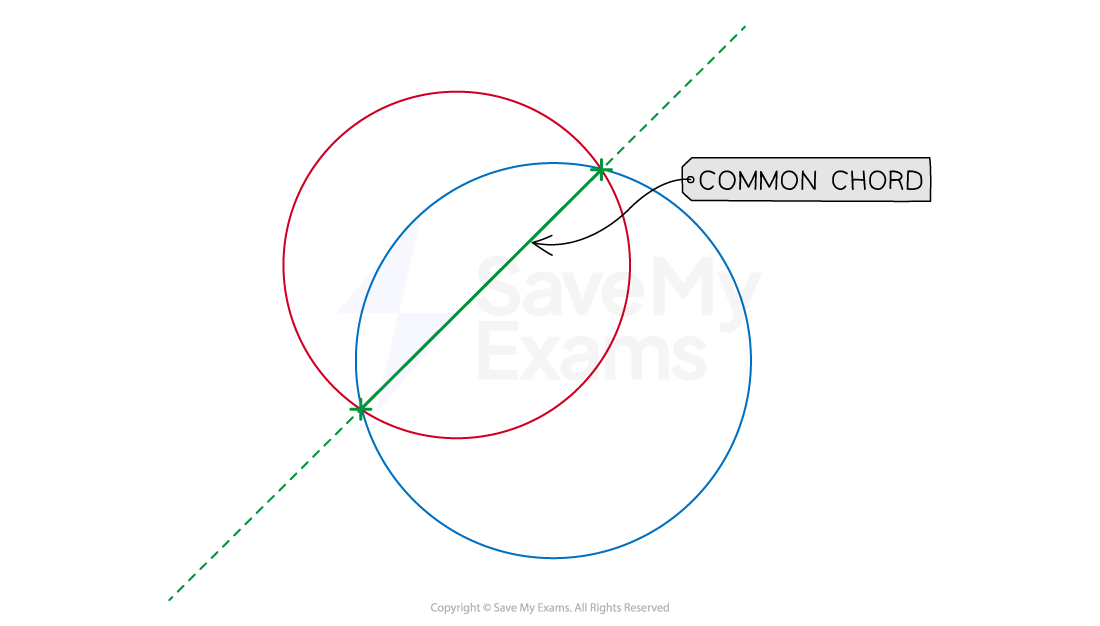
Common chord of two circles goes between the intersections

How do I find the equation of a common chord?

  • As a common chord is a straight line, its equation will be of the form y=mx+c{"language":"en","fontFamily":"Times New Roman","fontSize":"18","autoformat":true} unless

    • it is a horizontal line, in which case its equation will be of the form y=k{"language":"en","fontFamily":"Times New Roman","fontSize":"18","autoformat":true}

    • it is a vertical line, in which case its equation will be of the form x=k{"language":"en","fontFamily":"Times New Roman","fontSize":"18","autoformat":true}

  • Depending on the known information, there are two ways to find the equation of the common chord 

    • If the equations of the circles are known

      • Equate the equations and rearrange the equation into one of the three forms above

      • For example, x2+y2-4x+2y-8=x2+y2-8x-2y+16{"language":"en","fontFamily":"Times New Roman","fontSize":"18","autoformat":true} 4x+4y=24{"language":"en","fontFamily":"Times New Roman","fontSize":"18","autoformat":true} So the equation of the common chord is y=6-x{"language":"en","fontFamily":"Times New Roman","fontSize":"18","autoformat":true}

    • If the points of intersection are known

      • Use the method of finding the equation of a straight line from two known points

      • If the intersection points are x1, y1{"language":"en","fontFamily":"Times New Roman","fontSize":"18","autoformat":true} and x2, y2{"language":"en","fontFamily":"Times New Roman","fontSize":"18","autoformat":true} then the equation of the common chord would be

        • y-y1=y2-y1x2-x1x-x1{"language":"en","fontFamily":"Times New Roman","fontSize":"18","autoformat":true}

        • y2-y1x2-x1{"language":"en","fontFamily":"Times New Roman","fontSize":"18","autoformat":true} is the gradient and it can be easier to work this out first, separately