Levels of development
Specification link
This page covers section 8.2.1 of the CIE O Level specification.
8.2.1 - Reasons for differences in levels of development and the development gap, to include social, economic, and environmental factors.
What is the development gap?
What is the development gap?
The development gap is the difference in levels of development between the least developed and most developed countries in the world
The development gap shows how different these countries are in terms of their wealth, health, and general quality of life
The development gap affects how well millions of people live, with high-income countries usually having better living standards and more resources
The development gap can cause problems like
poverty
inequality
harm to the environment
social unrest
The development gap affects global stability and security because problems in poorer countries can impact the wider world
Reasons for the differences in development
Reasons for the differences in development
The development gap is a complex problem with many social, economic and environmental reasons
These reasons can become less or more important over time
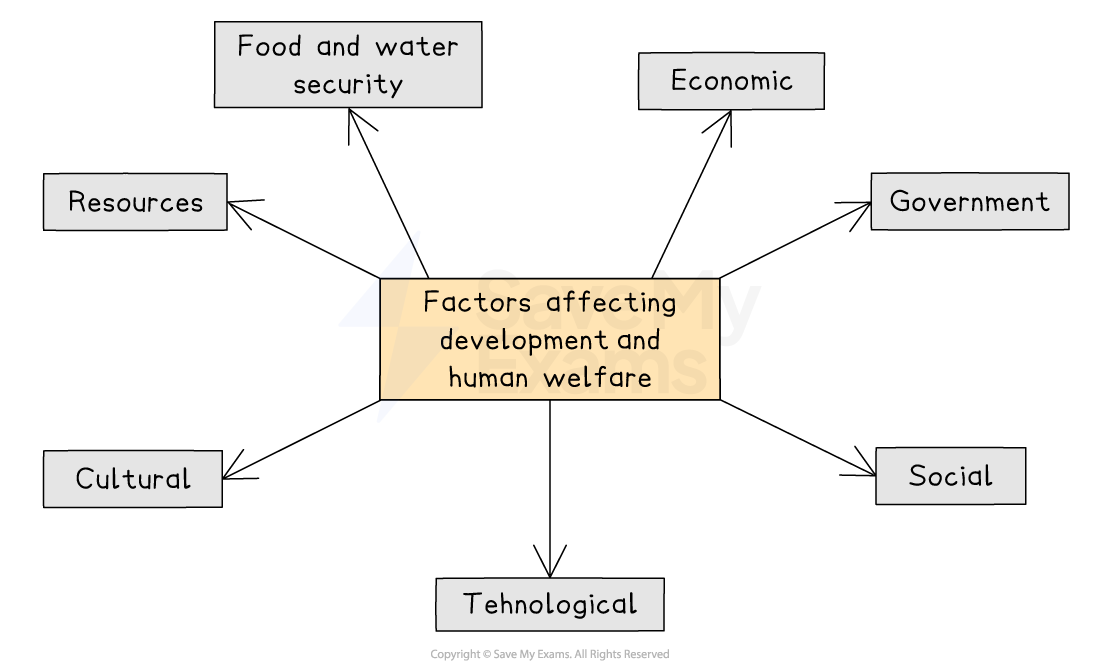
Environmental factors
Landlocked countries have no direct access to ports, making trade more difficult and they often develop more slowly as a result
Nine of the twelve most undeveloped countries in the world are landlocked and struggle to trade with other countries
Countries with extreme climates develop more slowly, as climate impacts agricultural productivity and infrastructure
Natural disasters such as earthquakes and floods occur more frequently in some countries, which diverts money from development to recovery
Climate-related diseases and pests, such as malaria, affect the ability of the population to stay healthy enough to work
Locust swarms can decimate crops
Some countries can meet all their needs from the natural resources they have
Many countries have to import some natural resources that are not available within their borders
Water, food and energy security are vital to support a country's development
Social factors
Demography
The birth and death rates, as well as immigration, affect the available workforce
Some countries have a large, youthful population but lack education and employment opportunities
Technology
Can help to increase water, food and energy security
Mechanisation of farming increases yields and improved land surveying may reveal more energy sources
Conflict and instability can disrupt economic development, hinder investment, and displace populations
Levels of education affect the skills people have. The more educated a population is, the more a country will develop
Healthcare affects how well people are, which affects their ability to work
Lack of equality can mean that the overall productivity of a country is affected
Colonialism – Some countries' colonial past has caused uneven growth, environmental degradation, loss of cultural systems and inequality
Colonial powers, such as the UK, France, and Spain, extracted resources from colonies, such as minerals and crops, leaving little wealth behind
They also set up systems that benefited themselves, not local people
This caused inequality and left many countries dependent on low-value exports after independence
Many African and American countries were impacted due to the transatlantic slave trade
Economic factors
Corruption can take money away from important projects and make it hard to put good policies into action
LICs usually trade primary products for less money to HICs
The HIC then produces a final, high-profit product
HICs have good road, railway, and electricity infrastructure
This helps attract foreign investment because companies can quickly produce and transport goods
This boosts a country's development by bringing in money