StudyDeck

Simplifying Surds

Exam code: 4024
Written by: Ashika|Reviewed by: Caroline Carroll|Updated 2 July 2026

Surds & Exact Valuesvideo

Surds & Exact Values

Surds & exact values

What is a surd?

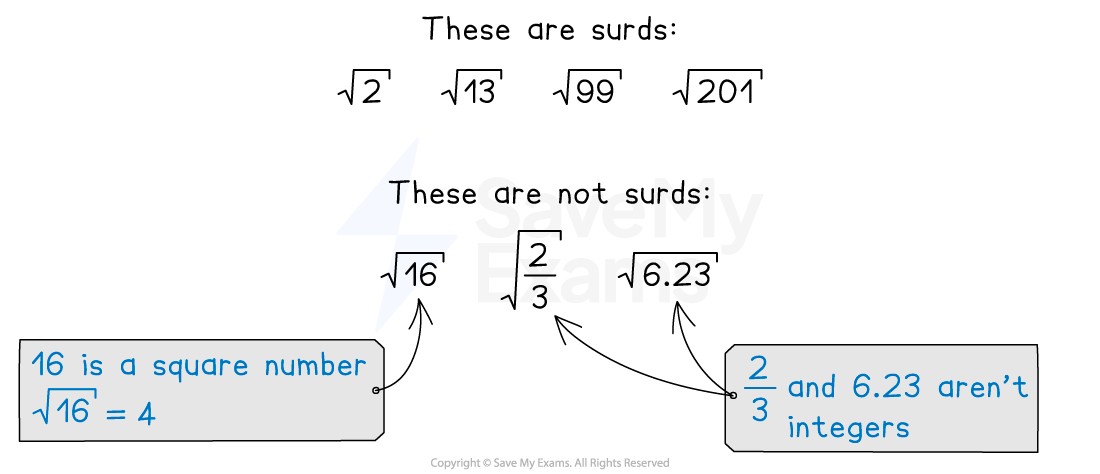
  • A surd is the square root of a non-square integer

  • Using surds lets you leave answers in exact form

    • e.g. 52{"language":"en","fontFamily":"Times New Roman","fontSize":"18","autoformat":true}  rather than 7.071067812...{"fontFamily":"Times New Roman","fontSize":"18","autoformat":true,"toolbar":""}

Examples of surds and not-surds

How do I do calculations with surds?

  •  Multiplying surds

    • You can multiply numbers under square roots together

    • 3 × 5 = 3×5 = 15{"language":"en","fontFamily":"Times New Roman","fontSize":"18","autoformat":true}

  • Dividing surds

    • You can divide numbers under square roots

    • 217=21 ÷ 7= 21 ÷ 7 = 3{"fontFamily":"Times New Roman","fontSize":"18","autoformat":true,"toolbar":""}

  • Factorising surds

    • You can factorise numbers under square roots

    • 35 =5 × 7 = 5 ×7{"language":"en","fontFamily":"Times New Roman","fontSize":"18","autoformat":true}

  • Adding or subtracting surds

    • You can only add or subtract multiples of “like” surds

      • This is similar to collecting like terms when simplifying algebra

    • 35+ 85 = 115 {"fontFamily":"Times New Roman","fontSize":"18","autoformat":true,"toolbar":""}

    • 73 – 43 = 33{"fontFamily":"Times New Roman","fontSize":"18","autoformat":true,"toolbar":""}

      • However 23+46{"fontFamily":"Times New Roman","fontSize":"18","autoformat":true,"toolbar":""} cannot be simplified

    • You cannot add or subtract numbers under square roots

    • Consider 9 + 4= 3 + 2 = 5{"language":"en","fontFamily":"Times New Roman","fontSize":"18","autoformat":true} 

      • This is not equal to 9+4 = 13 = 3.60555…{"language":"en","fontFamily":"Times New Roman","fontSize":"18","autoformat":true}

Simplifying Surds

Simplifying surds

How do I simplify surds?

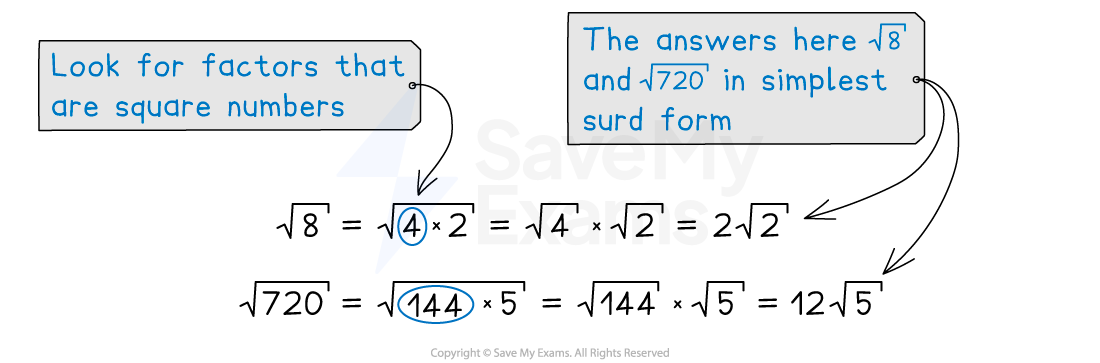
  • To simplify a surd, factorise the number using a square number, if possible

    • If multiple square numbers are a factor, use the largest

  • Use the fact that ab=a×b{"fontFamily":"Times New Roman","fontSize":"18","autoformat":true,"toolbar":""} and then work out any square roots of square numbers

    • E.g. 48 = 16 × 3 = 16 × 3= 4 × 3 = 43{"language":"en","fontFamily":"Times New Roman","fontSize":"18","autoformat":true}

Simplifying root 8 to 2 root 2 and root 720 to 12 root 5
  • When simplifying multiple surds, simplify each separately

    • This may produce surds which can then be collected together

      • E.g. 32 + 8{"language":"en","fontFamily":"Times New Roman","fontSize":"18","autoformat":true} can be rewritten as 162 + 42{"fontFamily":"Times New Roman","fontSize":"18","autoformat":true,"toolbar":""}

      • This simplifies to 42+22{"fontFamily":"Times New Roman","fontSize":"18","autoformat":true,"toolbar":""}

      • These surds can then be collected together

      • 62{"fontFamily":"Times New Roman","fontSize":"18","autoformat":true,"toolbar":""}

  • You may have to expand double brackets containing surds

    • This can be done in the same way as multiplying out double brackets algebraically, and then simplifying

    • The property a2 = a{"language":"en","fontFamily":"Times New Roman","fontSize":"18","autoformat":true} can be used to simplify the expression, once expanded

    • E.g. 6-26+4{"fontFamily":"Times New Roman","fontSize":"18","autoformat":true,"toolbar":""} expands to 62 +46-26-8{"fontFamily":"Times New Roman","fontSize":"18","autoformat":true,"toolbar":""}

      • This simplifies to 6+26-8{"fontFamily":"Times New Roman","fontSize":"18","autoformat":true,"toolbar":""} which gives -2+26{"fontFamily":"Times New Roman","fontSize":"18","autoformat":true,"toolbar":""}