Probability Tree Diagrams
Tree Diagramsvideo
Tree diagrams
How do I draw a tree diagram?
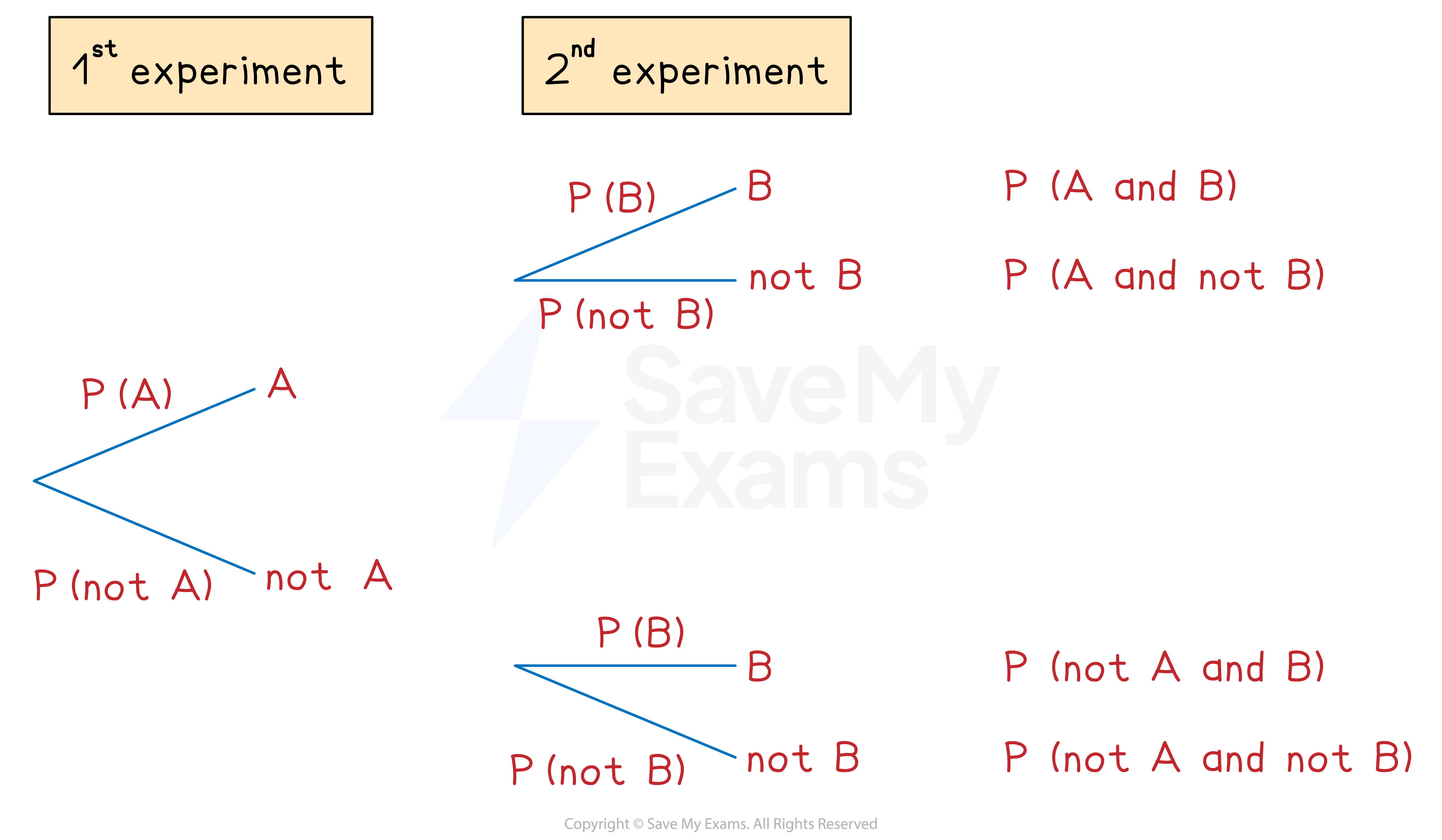
Tree diagrams can be used for repeated experiments with two outcomes
The 1st experiment has outcome A or not A
The 2nd experiment has outcome B or not B
Read the tree diagram from left to right along its branches
For example, the top branches give A followed by B
This is called A and B
How do I find probabilities from tree diagrams?
Write the probabilities on each branch
Remember that P(not A) = 1 - P(A)
Probabilities on each pair of branches add to 1
Multiply along the branches from left to right
This gives P(1st outcome and 2nd outcome)
Add between the separate cases
For example
P(AA or BB) = P(AA) + P(BB)
The probabilities of all possible cases add to 1
If asked to find the probability of at least one outcome, it is quicker to do 1 - P(none)
How do I use tree diagrams with conditional probability?
Probabilities that depend on a particular thing having happened first in a tree diagram are called conditional probabilities
For example, the probability that a team wins a game may depend on whether they won or lost the previous game
The probabilities for 'win' on the first set of branches may be different to those for 'win' on the second set of branches
Another example of conditional probabilities is "without replacement" scenarios
e.g. two items are drawn from a bag of different coloured items without the first item drawn being replaced
The probabilities on the second set of branches will change depending on which branch has been followed on the first set of branches
The denominators in the probabilities for the second set of branches will be one less than those on the first set of branches
The numerators on the second set of branches will also change
Conditional probability questions are sometimes introduced by the expression 'given that...'
e.g. 'Find the probability that the team win their next game given that they lost their previous game'
The notation is often used for conditional probabilities
That is read as 'the probability of A given B'
e.g. is the probability a team wins, given that they lost the previous game