Homeostasis
Homeostasis
Homeostasis
Homeostasis is defined as the maintenance of a constant internal environment
Homeostasis means that internal conditions within the body (such as temperature, blood pressure, water concentration, glucose concentration etc) need to be kept within set limits in order to ensure that reactions in body cells can function and therefore the organism as a whole can live
When one of these conditions deviates far away from the normal if not brought back within set limits the body will not function properly and the eventual consequence without medical intervention will be death
The Concept of Negative Feedback
The Concept of Negative Feedback
Negative feedback occurs when conditions change from the ideal or set point and returns conditions to this set point
It works in the following way:
if the level of something rises, control systems are switched on to reduce it again
if the level of something falls, control systems are switched on to raise it again
Negative feedback mechanisms are usually a continuous cycle of bringing levels down and then bringing them back up so that overall, they stay within a narrow range of what is considered ‘normal’
Negative Feedback Diagram
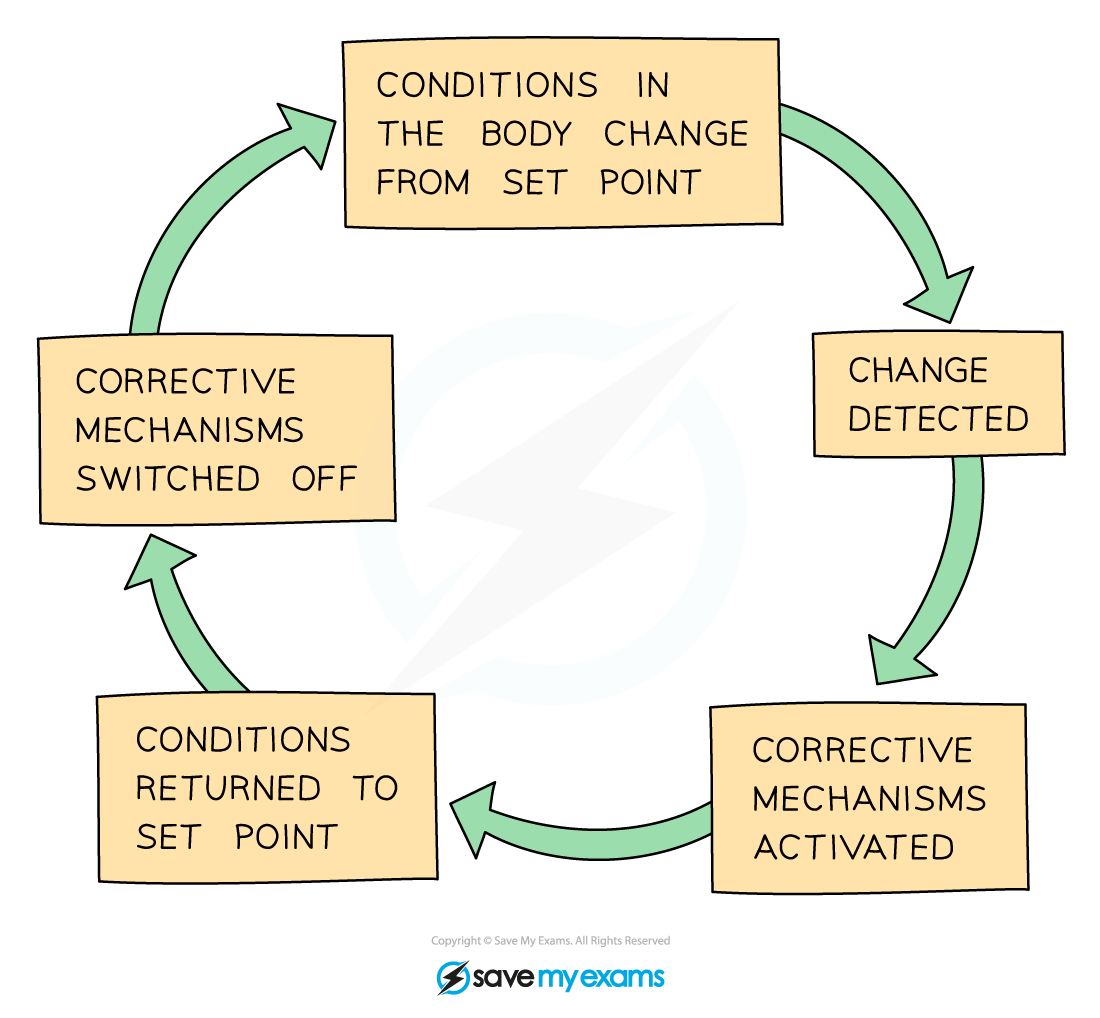
The negative feedback cycle