Classifying Organisms
How Organisms are Classifiedvideo
How Organisms are Classified
There are millions of species of organisms on Earth
A species is defined as
A group of organisms that can reproduce to produce fertile offspring
These species can be classified into groups by the features that they share e.g. all mammals have bodies covered in hair, feed young from mammary glands and have external ears
The Binomial System
The Binomial System
Organisms were first classified by a Swedish naturalist called Linnaeus in a way that allows the subdivision of living organisms into smaller and more specialised groups
The species in these groups have more and more features in common the more subdivided they get
He named organisms in Latin using the binomial system where the scientific name of an organism is made up of two parts starting with the genus (always given a capital letter) and followed by the species (starting with a lower case letter)
When typed binomial names are always in italics (which indicates they are Latin) e.g. Homo sapiens
The sequence of classification is: Kingdom, Phylum, Class, Order, Family, Genus, Species
Classification System Diagram
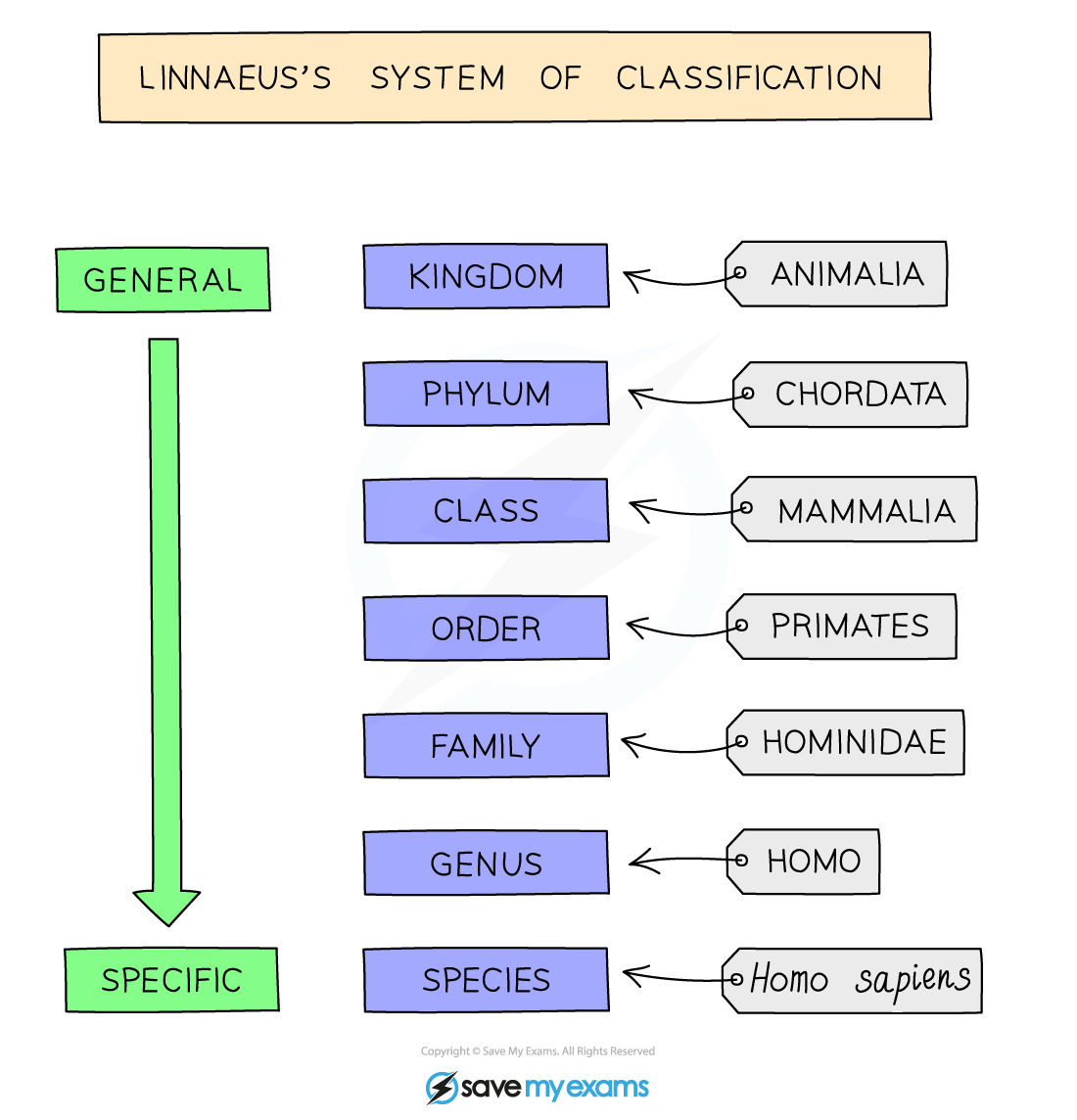
Linnaeus’s system of classification
Dichotomous Keys
Dichotomous Keys
Keys are used to identify organisms based on a series of questions about their features
Dichotomous means ‘branching into two’ and it leads the user through to the name of the organism by giving two descriptions at a time and asking them to choose
Each choice leads the user onto another two descriptions
In order to successfully navigate a key, you need to pick a single organism to start with and follow the statements from the beginning until you find the name
You then pick another organism and start at the beginning of the key again, repeating until all organisms are named
Dichotomous key Diagram
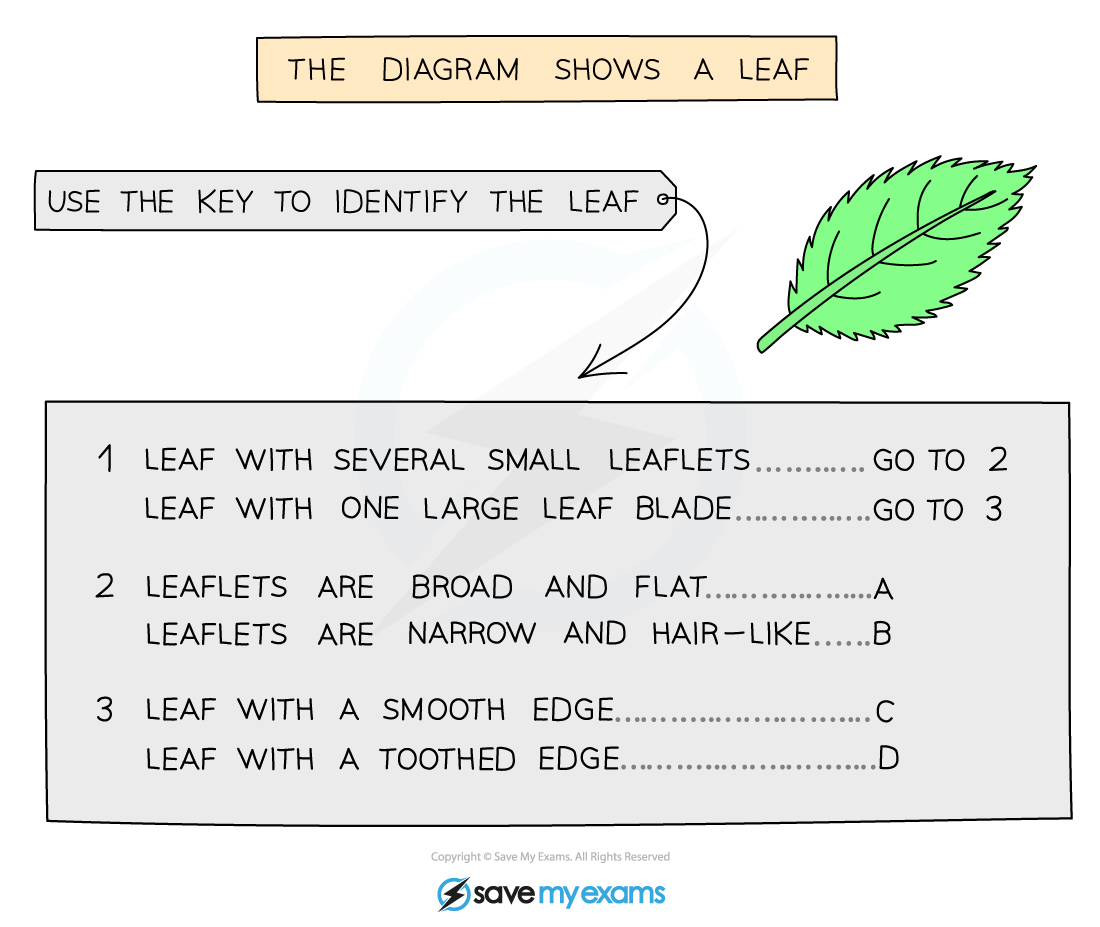
Example of a dichotomous key #1
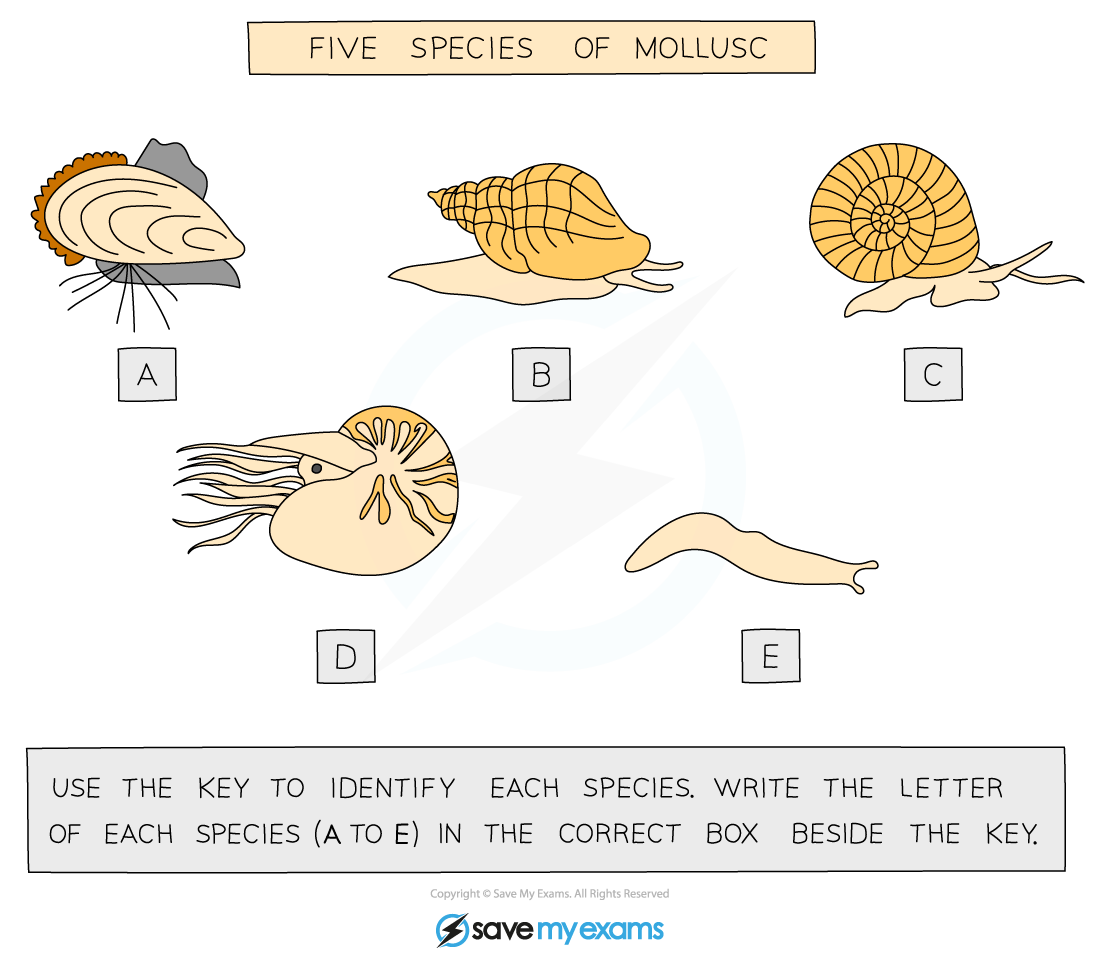
Key | ||
|---|---|---|
1a | Body is completely or partially covered in a shell | Go to 2 |
1b | Body is not completely or partially covered in a shell | Limax flavus |
2a | Shell is attached to rocks by thin threads | Mytilus edulis |
2b | Shell is not attached to rocks by thin threads | Go to 3 |
3a | Shell is a spire that comes to a point | Buccinum undatum |
3b | Shell is a spire that does not comes to a point | Go to 4 |
4a | Animal has tentacles | Nautilus pompilius |
4b | Animal has two tentacles | Planorbis planorbis |
Example of a dichotomous key #2