Kinetic Theory
Solids, Liquids & Gasesvideo
Solids, Liquids & Gases
Solids
Solids have a fixed volume and shape and they have a high density
The atoms vibrate in position but can’t change location
The particles are packed very closely together in a fixed and regular pattern
Liquids
Liquids also have a fixed volume but adopt the shape of the container
They are generally less dense than solids (an exception is water), but much denser than gases
The particles move and slide past each other which is why liquids adopt the shape of the container and also why they are able to flow freely
Gases
Gases do not have a fixed volume and fill their container
Gases have a very low density
Since there is a lot of space between the particles, gases can be compressed into a much smaller volume
The particles are far apart and move randomly and quickly (around 500 m/s) in all directions
They collide with each other and with the sides of the container (this is how pressure is created inside a can of gas)
Summary of the Properties of Solids, Liquids and Gases
State | Solid | Liquid | Gas |
|---|---|---|---|
Density | High | Medium | Low |
Arrangement of particles | Regular pattern | Randomly arranged | Randomly arranged |
Movement of particles | Vibrate around fixed positions | Move around each other | Move quickly in all directions |
Energy of particles | Low energy | Greater energy | Highest energy |
2D diagram | 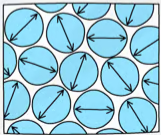 | 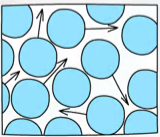 | 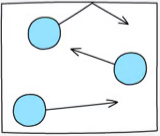 |