Diffusion
Diffusion
Diffusion
This is the process by which different gases or different liquids mix and is due to the random motion of their particles
Diffusing particles move from an area of high concentration to an area of low concentration
Eventually the concentration of particles is even as they spread out to occupy all of the available space
Diffusion happens on its own and no energy input is required although it occurs faster at higher temperatures
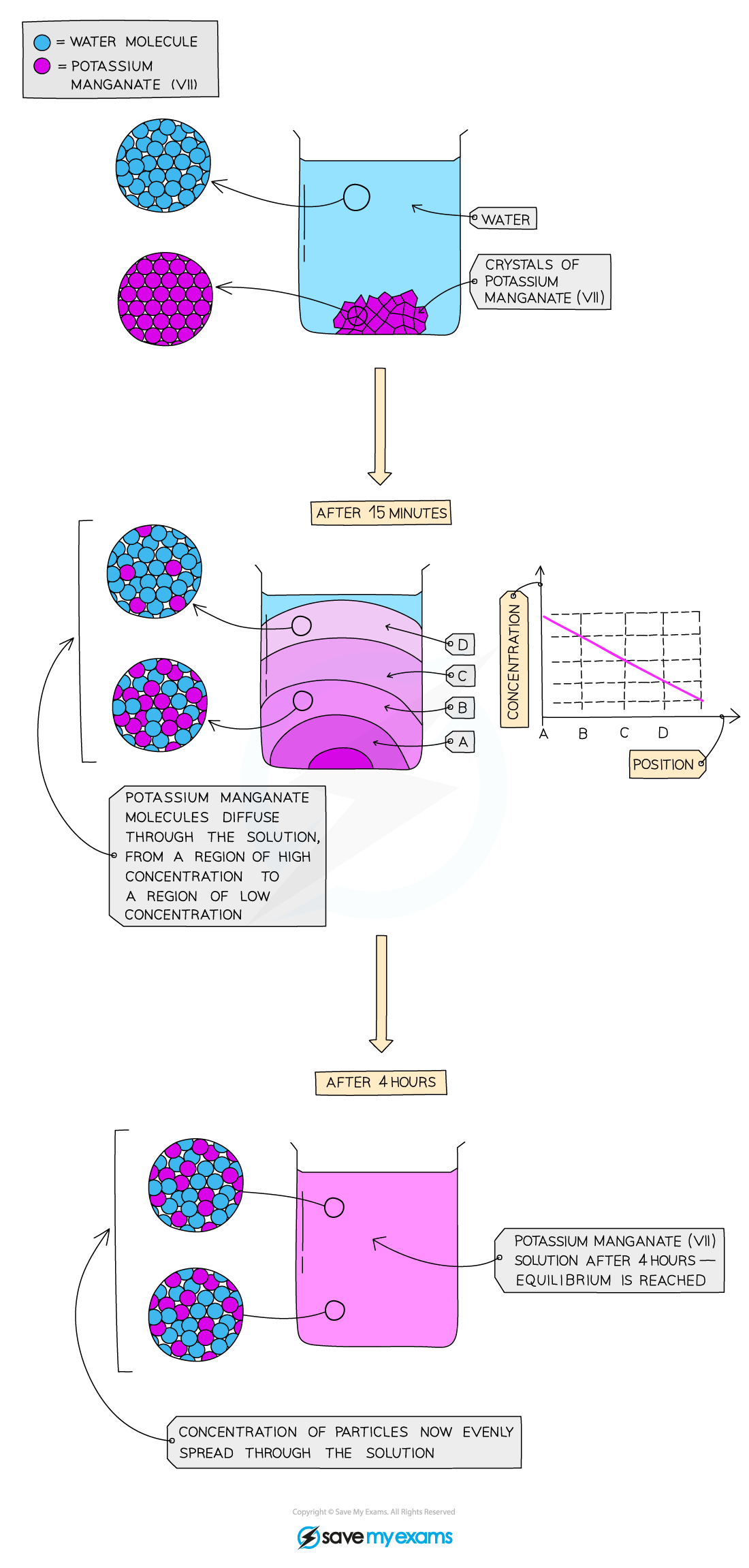
Diffusion of potassium manganate(VII), KMnO4 , in water. After a few hours the concentration of KMnO4 is the same throughout the solution
Diffusion & Molecular Mass
Diffusion & Molecular Mass
Diffusion occurs much faster in gases than in liquids as gaseous particles move much quicker than liquid particles
At the same temperature, different gases do not diffuse at the same rate.
This is due to the difference in their relative molecular masses
Lighter gas particles can travel faster and hence further, therefore the lower its relative mass the faster a gas will diffuse
This can be demonstrated in the reaction between ammonia, NH3, and hydrogen chloride gas, HCl, inside a long glass tube
Where the two gases meet a white smoke of ammonium chloride, NH4Cl, is formed
This does not occur in the middle of the tube as you might expect, but much closer to the end with the hydrogen chloride (Mr = 36.5) and the ammonia (Mr = 17) molecules are smaller and lighter
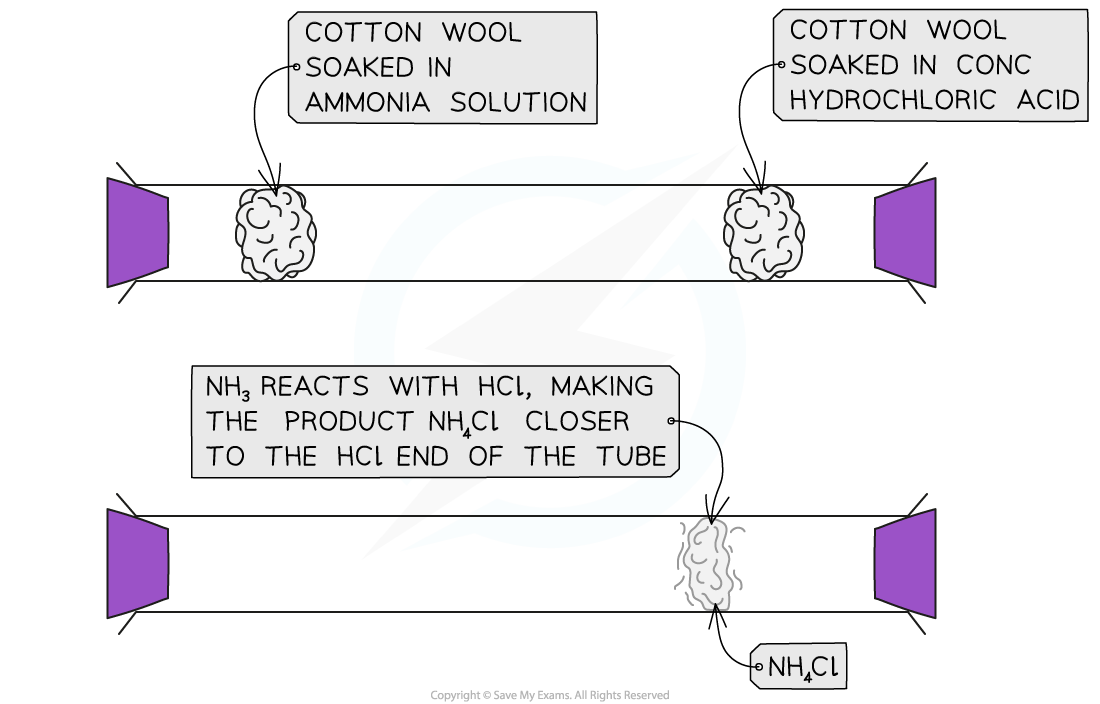
NH3 molecules have less mass than the HCl molecule, so diffuse faster, hence the product (a white smoke of NH4Cl) forms closer to the end where the HCl is