Water: Chemical Tests
Chemical Tests for Water
Chemical Tests for Water
Chemical tests for water
Using cobalt(II) chloride:
Cobalt(II) chloride turns blue to pink on the addition of water. This test is usually done using cobalt chloride paper
The equation is:
anhydrous cobalt(II) chloride + water hydrated cobalt(II) chloride
CoCl2 (s) + 6H2O (l) CoCl2.6H2O (s)
blue pink
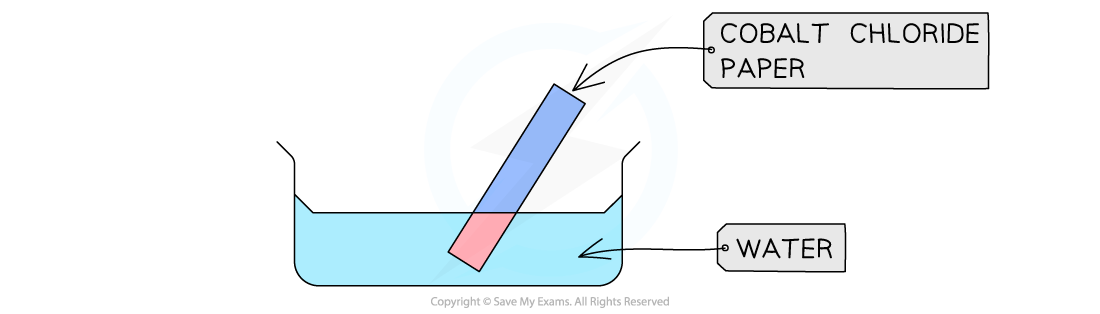
Test for water using cobalt chloride paper which turns pink in the presence of water
Using copper(II) sulfate:
Anhydrous copper(II) sulfate turns white to blue on the addition of water
The equation is:
anhydrous copper(II) sulfate + water hydrated copper(II) sulfate
CuSO4 (s) + 5H2O (l) CuSO4.5H2O (s)
white blue
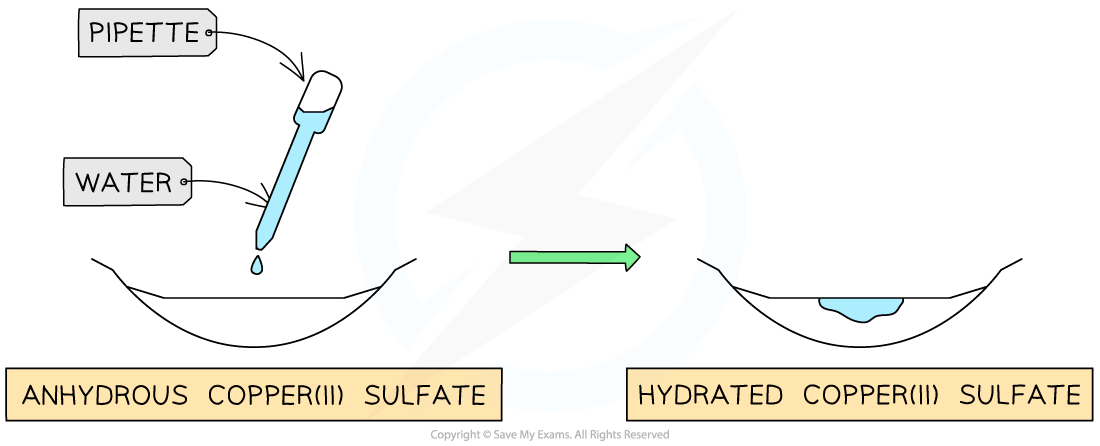
Test for water using anhydrous copper(II) sulfate which turns blue in the presence of water
Purity of Water
Purity of Water
Testing for purity
Pure substances melt and boil at specific and sharp temperatures
Water has a boiling point of 100 °C and a melting point of 0 °C
Mixtures have a range of melting and boiling points as they consist of different substances that melt or boil at different temperatures
Melting and boiling points data can therefore be used to determine the purity of water
Impurities tend to increase the boiling point of water, so impure water will boil at temperatures above 100 oC
Impurities tend to decrease the melting point of water, so impure water will melt at temperatures below 0 oC
Distilled water
Distilled water is water that has been heated to form a vapour, and then condensed back to a liquid
It contains very few impurities
Distilled water is used in practical chemistry because of its high purity
Tap water contains more impurities which could interfere with chemical reactions so is typically not used