Water Treatment
Water Treatmentvideo
Water Treatment
Water supply
Water is taken from rivers, reservoirs or underground water sources (groundwater)
A rock that stores water is known as an aquifer
Water treatment
Untreated water contains soluble and insoluble impurities
Insoluble impurities include soil, pieces of plants and other organic matter
Soluble impurities include dissolved calcium, metallic compounds and inorganic pollutants
Water is pumped into sedimentation tanks where the water is allowed to stand for a few hours
Mud, sand and other particles will fall to the bottom of the tank due to gravity and form a layer of sediment, in a process called sedimentation
Filtration is the process used to remove smaller particles by passing the water through layers of sand and gravel filters that trap solid particles
Water can also be passed through carbon (in the form of charcoal) to remove tastes and odours
Bacteria and other microorganisms are too small to be trapped by the filters so chlorination is used
This involves the careful addition of chlorine to the water supply which kills bacteria and other unwanted microorganisms
Cholera and typhoid are examples of bacterial diseases which can arise from the consumption of untreated water
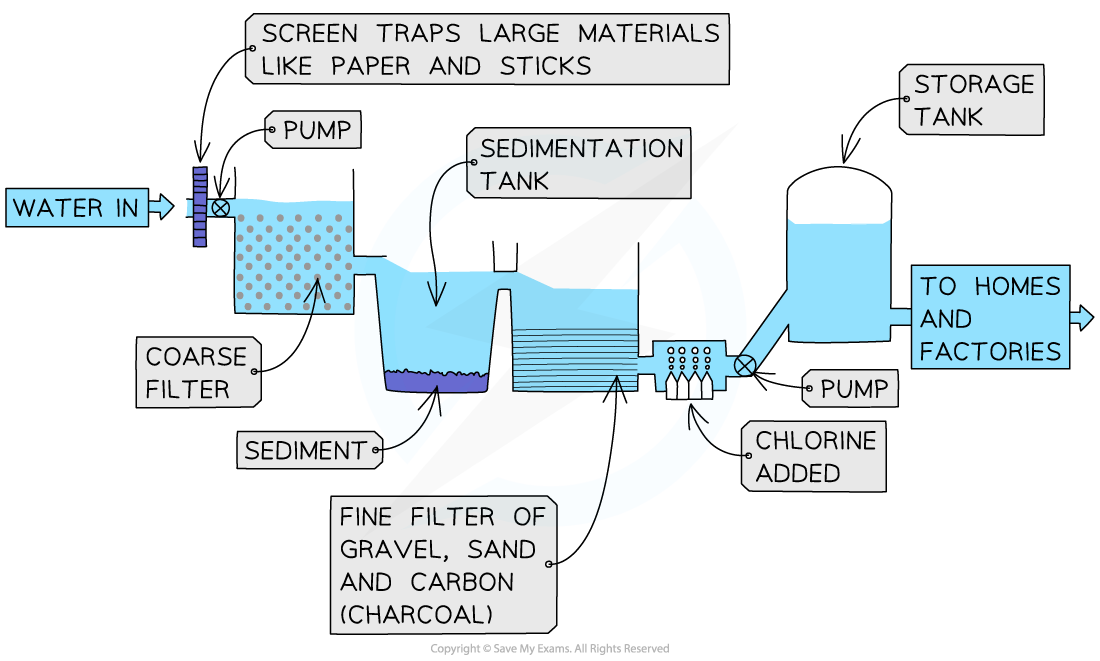
Diagram showing the stages in the treatment of water