Group VII Properties
Group VII Properties & Trendsvideo
Group VII Properties & Trends
The halogens
These are the Group VII non-metals that are poisonous and include fluorine, chlorine, bromine, iodine and astatine
Halogens are diatomic, meaning they form molecules of two atoms
The formulae of the halogens are F2, Cl2, Br2, I2 and At2
All halogens have seven electrons in their outer shell
They form halide ions by gaining one more electron to complete their outer shells
Fluorine is not allowed in schools so observations and experiments tend to only involve chlorine, bromine and iodine
Properties of the halogens
At room temperature (20 °C), the physical state of the halogens changes as you go down the group
Chlorine is a pale yellow-green gas, bromine is a red-brown liquid and iodine is a grey-black solid
This demonstrates that the density of the halogens increases as you go down the group:
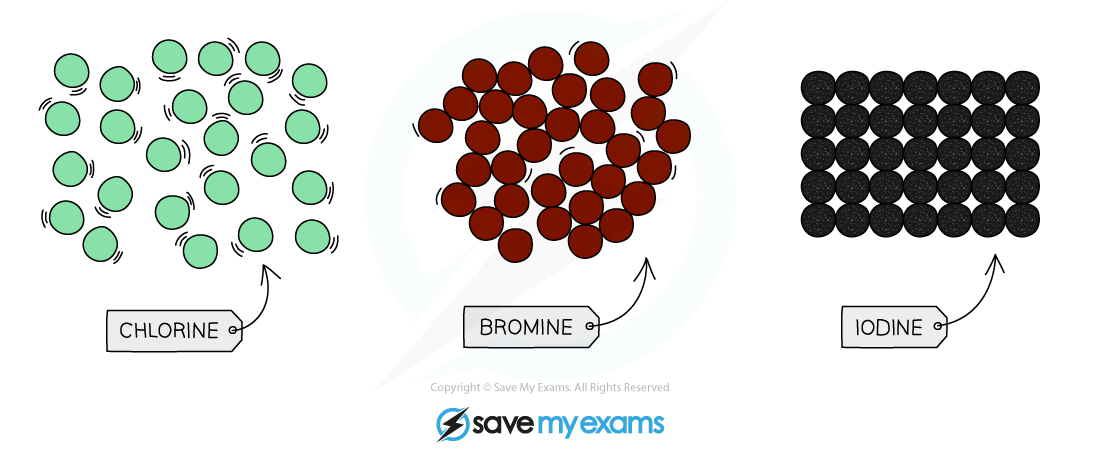
The physical state of the halogens at room temperature
Reactivity of Group VII non-metals increases as you go up the group (this is the opposite trend to that of Group I)
Each outer shell contains seven electrons and when the halogen reacts, it will need to gain one outer electron to get a full outer shell of electrons
As you go up Group VII, the number of shells of electrons decreases (period number decreases moving up the Periodic Table)
This means that the outer electrons are closer to the nucleus so there are stronger electrostatic forces of attraction, which help to attract the extra electron needed
This allows an electron to be attracted more readily, so the higher up the element is in Group VII then the more reactive it is
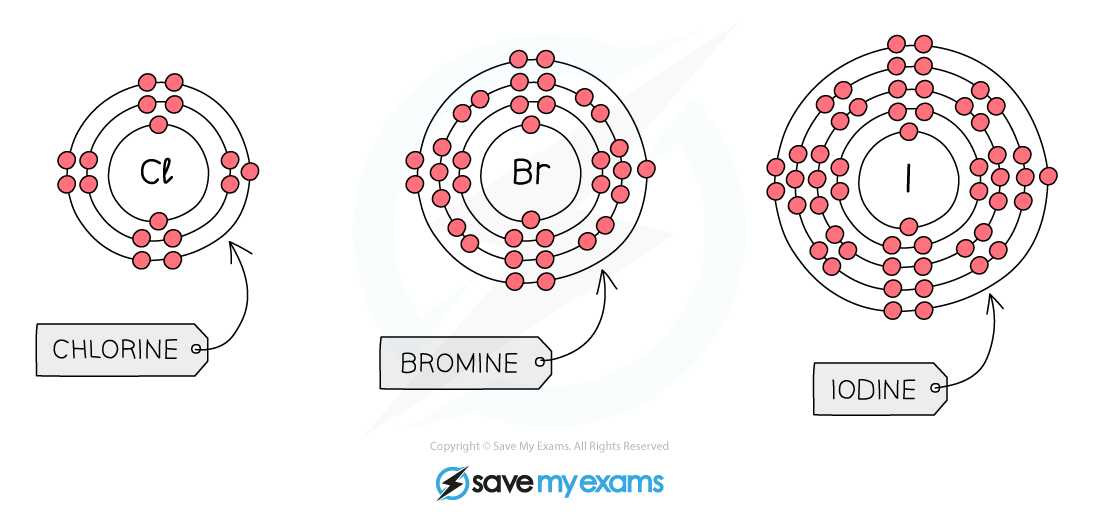
Diagram showing the electronic configuration of the first three elements in Group VII
Predicting Group VII Properties
Predicting Group VII Properties
You may be given information about some elements and asked to predict the properties of other elements in the group
The information you might be given could be in relation to melting/boiling point or physical state/density so it is useful to know the trends in properties going down the group
Melting and boiling point
The melting and boiling point of the halogens increases as you go down the group
Fluorine is at the top of Group VII so will have the lowest melting and boiling point
Astatine is at the bottom of Group VII so will have the highest melting and boiling point
Physical states
The halogens become denser as you go down the group
Fluorine is at the top of Group VII so will be a gas
Astatine is at the bottom of Group VII so will be a solid
Colour
The colour of the halogens becomes darker as you go down the group
Fluorine is at the top of Group VII so the colour will be lighter, so fluorine is yellow
Astatine is at the bottom of Group VII so the colour will be darker, so astatine is black