MAC Addresses & IP Addresses
Devices on a network send and receive data, a device needs an address to ensure it sends data to the correct place
There are two types of network address systems:
MAC Address
IP Address
MAC Addresses
MAC Addresses
What is a MAC address?
A MAC (Media Access Control) address is a unique identifier given to devices which communicate over a local area network (LAN)
A network interface card is given a MAC address at the point of manufacture
MAC addresses are static, meaning they can never change
MAC addresses make it possible for switches to efficiently forward data to the intended recipient
Any device that contains a Network Interface Card (NIC) has a MAC address assigned during manufacturing
A device connecting to a local network already has a MAC address, if it moves to a different network then the MAC address will stay the same
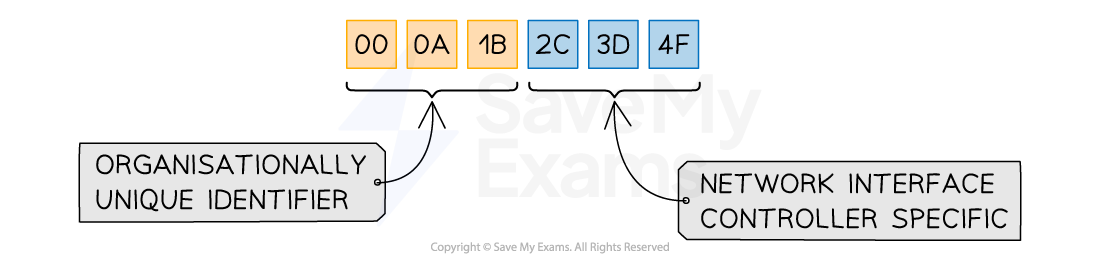
A MAC address is represented as 12 hexadecimal digits (48 bits), usually grouped in pairs
The first three pairs are the manufacturer ID number (OUI) and the last three pairs are the serial number of the network interface card (NIC)
There are enough unique MAC addresses for roughly 281 trillion devices
IP Addresses
IP Addresses
What is an IP address?
An IP (Internet Protocol) address is a unique identifier given to devices which communicate over the Internet (WAN)
IP addresses can be static, meaning they stay the same or dynamic, meaning they can change
Static IP addresses are commonly used for servers and websites so they can always be found at the same address
Dynamic IP addresses are assigned automatically by a DHCP server (Dynamic Host Configuration Protocol)
IP addresses make it possible to deliver data to the right device
A device connecting to a network will be given an IP address, if it moves to a different network then the IP address will change
IPv4
Internet Protocol version 4 is represented as 4 blocks of denary numbers between 0 and 255, separated by full stops
Each block is one byte (8 bits), each address is 4 bytes (32 bits)

IPv4 provides over 4 billion unique addresses (232), however, with over 7 billion people and countless devices per person, a solution was needed
IPv6
Internet Protocol version 6 is represented as 8 blocks of 4 hexadecimal digits, separated by colons
Each block is 2 bytes (16 bits), each address is 16 bytes (128 bits)

IPv6 could provide over one billion unique addresses for every person on the planet (2128)