A Taste of Honey: Writer's Methods and Techniques
A Taste of Honey: Writer's methods and techniques
Writer’s Methods and Techniques
‘Methods’ is an umbrella term for anything the writer does on purpose to create meaning. Using the writer’s name in your response will help you to think about the text as a conscious construct and will keep reminding you that Delaney purposely put the play together. Below you will find sections on:
Form and structure
Stagecraft
Language
Imagery and symbolism
Shelagh Delaney employs various dramatic devices and literary techniques to convey meaning and deliver messages. The exam question on A Taste of Honey requires you to analyse methods, which means you should consider how Delaney’s choices affect how an audience reacts. Here we will explore the way Delaney uses:
A Taste of Honey: Writer's methods and techniques: Form and structure
Form and structure

Shelagh Delaney’s play is a kitchen sink drama, which means the play is a realistic depiction of ordinary individuals’ lives, and that it portrays the struggles of working-class life.
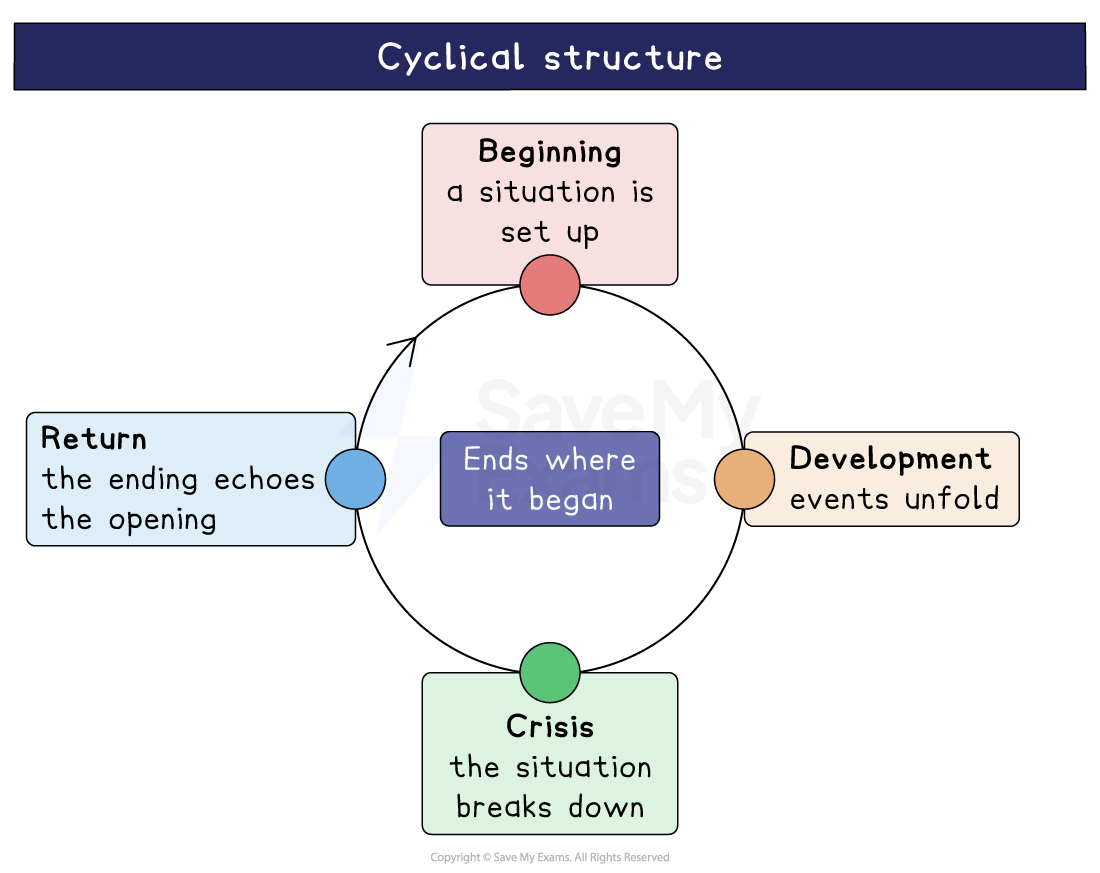
It is useful to consider the genre of the play in your analysis as this is a key writer’s method. With this in mind, it is worth analysing the way the play uses dramatic conventions.
The play is divided into two acts that consist of two scenes:
Act 1 introduces single mother Helen and her teen daughter Jo moving into a rundown flat
Act 2 jumps to several months later when Jo is pregnant: the setting is now Jo’s flat (small, sparsely furnished)
Delaney uses a cyclical structure to reflect a cycle of poverty for the working class:
In Act 1, Helen says to Jo: “That’s where we all end up sooner or later”
By Act 2, Jo says: “So we’re back where we started”
When Jo leaves home, she finds herself in a similar situation to her mother, which presents ideas about generational cycles:
In the exposition, Helen says that Jo, like her, is “not very fond of work”
In Act 2, Jo’s flat is messy: Geof comments, “I can tell it's yours from the state it’s in”
Helen tells Jo that she has to consider cost when she finds a new home
Jo, when she moves into her own flat, tells Geof: “I've got to work all day in a shoe shop and all night in a bar to pay for it”
A Taste of Honey: Writer's methods and techniques: Stagecraft
Stagecraft

Delaney’s naturalistic style presents a brutally honest depiction of social issues in 1950s England
The play is an example of social realism:
It portrays working-class characters disillusioned with modern society
Helen and Jo’s rundown flat is in an industrial area in the North of England
Jo is underfed, and Helen resorts to drinking and promiscuity
Delaney breaks the fourth wall to create audience engagement:
When Helen and Jo argue, they often comment to the audience, referring to each other in the third person
Helen asks for support from the audience: “Wouldn't she get on your nerves?”
Jo’s comments raise key ideas: “So that's what she was running away from”
Delaney uses music to signal key events:
There is jazz music playing when Jo and Helen move into their flat
Helen sings when she has fond memories of a freer life: “I thought it was wonderful[…] You know, playing the piano and all that”
Music accompanies Peter’s fateful arrival
Nursery rhymes represent the idea of motherhood and a happy childhood:
Children sing nursery rhymes outside Jo and Helen’s flat, which serves to emphasise Jo’s lack of a real childhood
Often, music accompanies moments when Jo and Helen feel hopeful:
A traditional wedding song “Here Comes the Bride” plays when Helen and Peter plan to marry
Jo’s hope for a different future to her mother is implied when Jimmie (the Boy) sings to the audience and Jo dances
Jo sings a song to end the play as she thinks about Geof
A Taste of Honey: Writer's methods and techniques: Language
Language

Delaney’s script is made up of colloquialisms and regional dialect:
Helen tells Jo: “You're asking for a bloody good hiding, lady”
She says of Peter’s arrival, “Look what the wind's blown in”
Jo remarks about being in films: “I'd sooner be put on't streets. It's more honest”
Characters insult each other regularly when they feel unsupported or disrespected:
This creates a dark humour which shows how troubled individuals mask painful feelings or take their disappointments out on each other
For example, when Helen tells Jo she is always “bathing”, Jo replies, “I'm not like you. I don't wait until it becomes necessary before I have a good wash”
Sarcasm portrays characters attempting to be resilient while feeling powerless:
Helen’s self-deprecating comments conveys a lack of self-esteem, while also creating humour:
She tells Jo, “I know, I'm a cruel, wicked woman”
Helen jokes about her terrible living conditions, saying her bed is “Like a coffin only not half as comfortable”
A Taste of Honey: Writer's methods and techniques: Imagery and symbolism
Imagery and symbolism

Delaney uses symbolism to highlight key themes
Engagement rings symbolise fragile or uncertain relationships
Helen values rings as tokens of financial security, while Jo wears hers around her neck to show her hesitation about marriage:
When Peter asks Helen if the “little lady” wants an engagement ring, Jo says their “courtship had passed the stage of symbolism”
Delaney shows Helen willing to give up her dignity for the “odd diamond ring”
Jo wears her engagement ring around her neck, perhaps because of her uncertain feelings about marriage
Personal belongings contribute to Delaney’s characterisations:
Peter’s wallet full of pictures of other women represents his deceit
Jimmie (the Boy) has a “toy car” in his pocket, implying innocence
Jo’s drawings represent her lost potential
Flowers represent the cycle of hope and hopelessness:
Peter’s proposal is accompanied by a bouquet of flowers
When Jo plants flower bulbs, she says “I hope they bloom. Always before when I've tried to fix up a window box nothin's ever grown in it”
Sources
Delaney, Shelagh (2008), A Taste Of Honey (Edited by Glenda Leeming and Elaine Aston), Bloomsbury Academic.
Capitani, Maria Elena, 'A New Reality: Shelagh Delaney’s A Taste of Honey (1958)', in Sue Kennedy, and Jane Thomas (eds), British Women's Writing, 1930 to 1960: Between the Waves (Liverpool, 2020; online edn, Liverpool Scholarship Online, 20 May 2021), https://doi.org/10.3828/liverpool/9781789621822.003.0013, accessed 22 Sept. 2025.