Arithmetic Progressions
Arithmetic Sequences
Arithmetic sequences
What is an arithmetic progression?
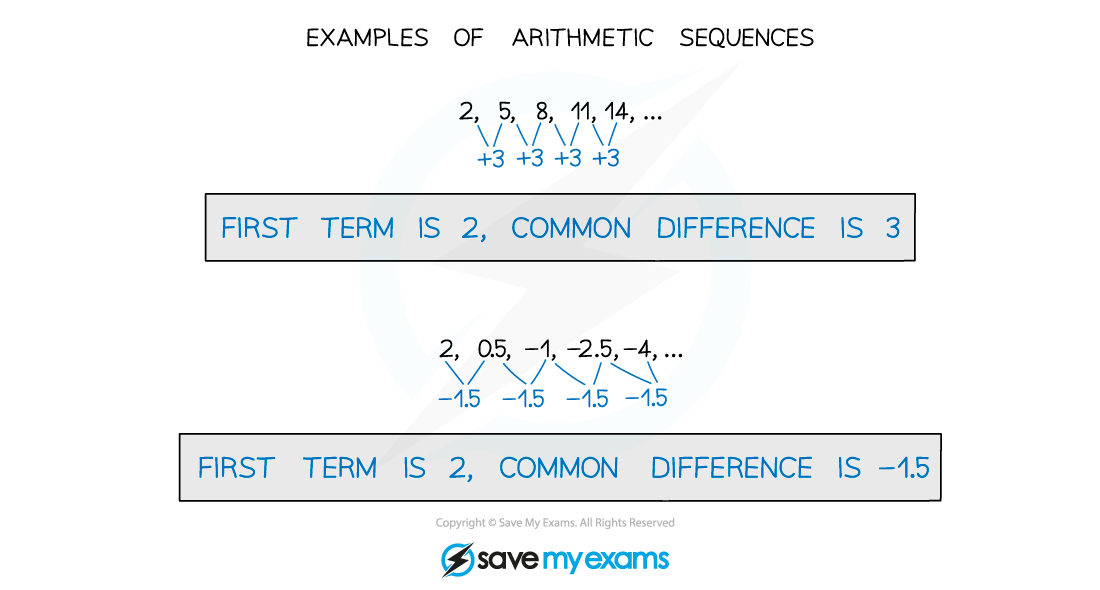
In an arithmetic progression (also called arithmetic sequence), the difference between consecutive terms in the sequence is constant
This constant difference is known as the common difference, d, of the sequence
For example, 1, 4, 7, 10, … is an arithmetic sequence with the rule ‘start at one and add three to each number’
The first term, a, is 1
The common difference, d, is 3
An arithmetic progression can be increasing (positive common difference) or decreasing (negative common difference)
Each term of an arithmetic progression is referred to by the letter u with a subscript determining its place in the sequence
How do I find a term in an arithmetic progression?
The nth term formula for an arithmetic progression is given as
Where is the first term, and is the common difference
This is given on the list of formulas page of the exam, you do not need to know how to derive it
Sometimes you will be given a term and asked to find the first term or the common difference
Substitute the information into the formula and solve the equation
Sometimes you will be given two terms and asked to find both the first term and the common difference
Substitute the information into the formula and set up two simultaneous equations
Solve the simultaneous equations
Arithmetic Series
Arithmetic series
What is an arithmetic series?
An arithmetic series is the sum of the terms in an arithmetic progression
It is often referred to as the sum of an arithmetic progression
For the arithmetic sequence 1, 4, 7, 10, … the arithmetic series is 1 + 4 + 7 + 10 + …
How do I find the sum of an arithmetic progression?
Use the following formulae to find the sum of the first n terms of the arithmetic series:
is the first term
is the last term
is the common difference
is the number of terms in the series
Both formulae are given on the formula page, you do not need to know how to derive them
You can use whichever formula is more convenient for a given question
If you know the first term and common difference use the second version
If you know the first and last term then the first version is easier to use
A question will often give you the sum of a certain number of terms and ask you to find the value of the first term or the common difference
Substitute the information into the formula and solve the equation