Language of Sequences & Series
Language of Sequences & Series
Language of sequences & series
What is a progression?
A progression (also called a sequence) is an ordered set of numbers with a rule for finding all of the numbers in the sequence
For example 1, 3, 5, 7, 9, … is a sequence with the rule ‘start at one and add two to each number’
The numbers in a progression are often called terms
The terms of a progression are often referred to by letters with a subscript
This will often be the letter u
So in the progression above, u1 = 1, u2 = 3, u3 = 5 and so on
Each term in a progression can be found by substituting the term number into formula for the nth term
What is a series?
You get a series by summing up the terms in a progression
E.g. For the sequence 1, 3, 5, 7, … the associated series is 1 + 3 + 5 + 7 + …
We use the notation Sn to refer to the sum of the first n terms in the series
Sn = u1 + u2 + u3 + … + un
So for the series above S5 = 1 + 3 + 5 + 7 + 9 = 25
Sigma Notation
Sigma notation
What is sigma notation?
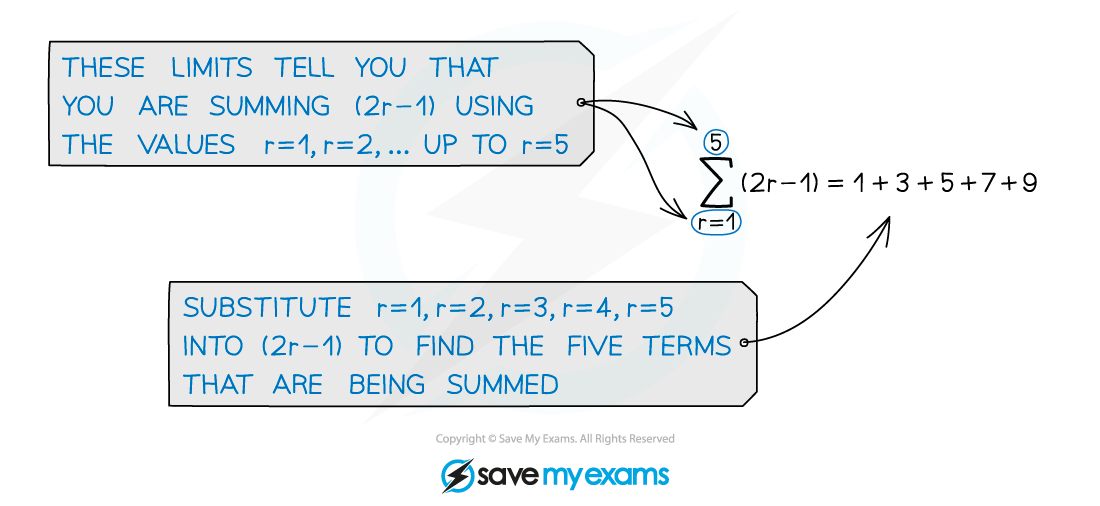
Sigma notation is used to show the sum of a certain number of terms in a sequence
The symbol Σ is the capital Greek letter sigma
Σ stands for ‘sum’
The expression to the right of the Σ tells you what is being summed, and the limits above and below tell you which terms you are summing
Be careful, the limits don’t have to start with 1
For example or
r and k are commonly used variables within sigma notation