Coastal Processes
Specification link
This page covers sections 2.1.1 and 2.1.2 of the CIE O Level Geography specification.
2.1.1 - Coastal erosion: hydraulic action, corrosion, corrasion, attrition, transportation, deposition, and longshore drift.
2.1.2 - Types of waves: constructive and destructive and wave refraction.
Coastal processes
Coastal processes
The coast is the area where land and sea meet
Coastal processes are divided into two parts:
Marine processes: offshore (water-based)
Terrestrial processes: onshore (land-based)
These processes are further divided into:
Erosion
Transportation
Deposition by wave action
Together with the local geology, these processes produce distinctive landforms around the coastline
A coastline made up of softer rocks such as sands and clays will be easily eroded by destructive waves to form low, flat landscapes such as bays and beaches
Coastlines of more resistant, harder rock will take longer to erode and produce rugged landscapes such as headlands
Marine erosion
Destructive waves are responsible for the majority of erosion that happens along a coast
They cut into the coastline in four ways:
Hydraulic action is the sheer force of the waves hitting the coast
Attrition occurs when material carried in the waves bumps against each other and becomes smaller and smoother
This does not erode the coast but forms the sand and shingle
Corrosion, also known as solution, occurs because seawater is slightly acidic and gradually dissolves material. Some types of coastal rock such as limestone and chalk, are particularly prone to corrosion
Abrasion, also known as corrasion, occurs when waves pick up material and hurl it at the cliffs
Marine transportation
The sea transports sediment that it gets from erosion in the same way rivers do
Material in the sea arrives from many sources:
eroded from cliffs
transported by longshore drift along the coastline
brought inland from offshore by constructive waves
carried to the coastline by a river
In the water, material is moved through:
Traction when large, heavy material is dragged along the sea floor
Saltation occurs when smaller material bounces along the sea floor
Suspension is the fine material held in the seawater
Solution is dissolved material carried in the seawater
Longshore drift (LSD)
Longshore drift (LSD) is the main process of transportation along the coast
Waves approach the beach at an angle due to the prevailing wind
As the waves break, the swash carries material up the beach at the same angle
As the swash dies away, the backwash carries the material down the beach at right angles (90°)
The process repeats, transporting material along the beach in a zig-zag movement
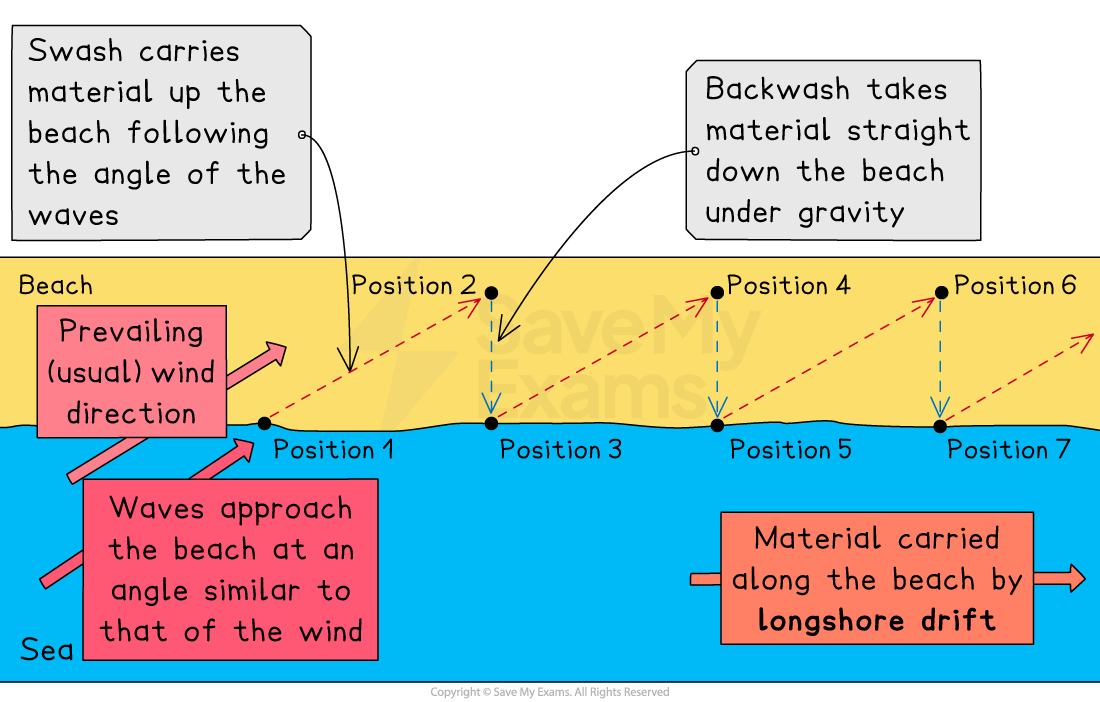
Beach sediment is carried farther down the coast on coasts where longshore drift is one way; if it is blocked, sediment cannot move, and the area farther down the coast is deprived of sediment. This results in two problems:
Smaller beaches are less attractive to tourists, causing a loss of income
Removes natural coastal protection
Marine Deposition
The waves carry sand or shingle as they travel
Swash carries sediment onto the shore
Backwash carries sediment away
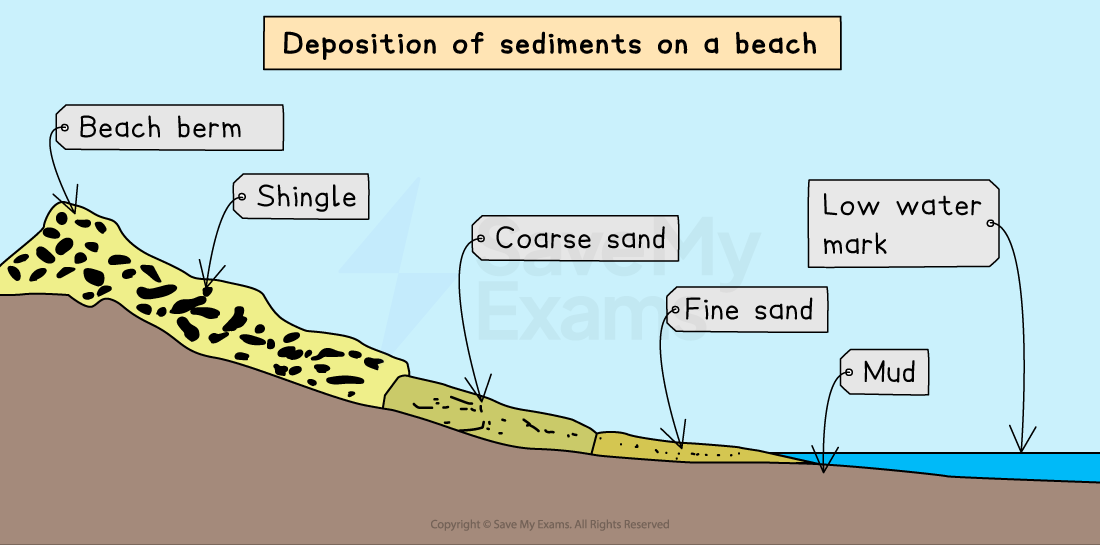
The largest material is deposited along the upper reach of the swash when a constructive wave carries sediment up the beach
The backwash loses water and energy as it travels because of the sand's porosity, resulting in smaller and smaller deposits.
When a constructive wave carries sediment up the beach, the largest material is deposited along the upper reach of the swash
During a storm, large shingle is thrown above the usual high tide level to form a ridge at the top of the beach called a berm
Wave types
Wave types
Waves are marine processes
They erode, transport and deposit material
Waves are formed by winds blowing over the surface of the sea
The height and strength of a wave are dependent on three factors:
the fetch
the amount of time the wind blows
the strength of the wind
The greater the strength, time and fetch of the wind, the larger the wave
As a wave approaches the coast, it enters shallower water; friction from the seabed causes the wave to lean forward and eventually crest and break onto the beach
The movement of water up the beach is called the swash, and the return movement is the backwash
Types of waves
There are two types of waves:
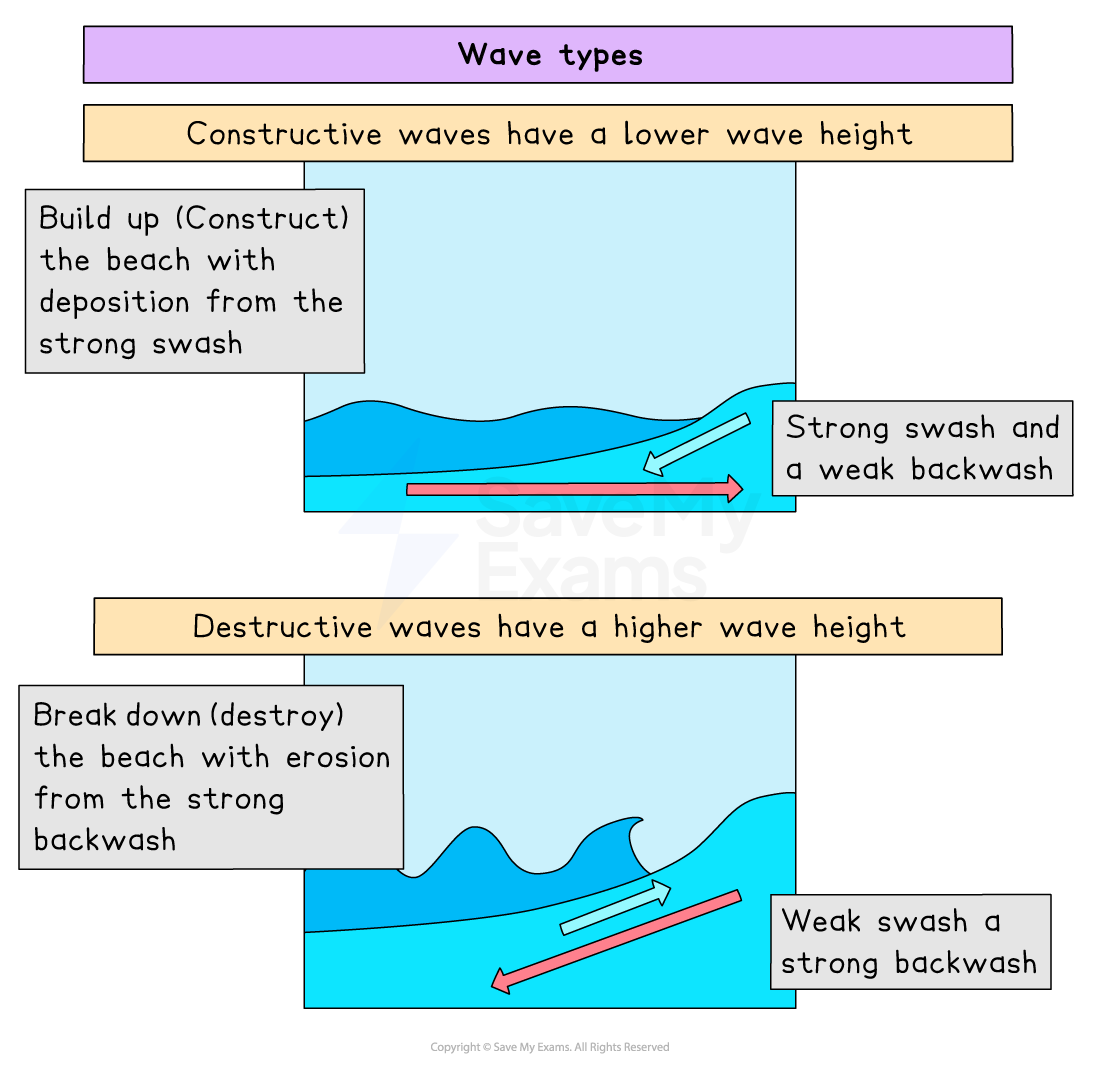
Destructive waves erode the beach
Constructive waves are beach builders
Constructive waves
Constructive waves, also known as beach builders, have the following characteristics:
a long wavelength with low height
a low-frequency wave rate of 6-8 per minute
a shallow wave gradient
low energy
a stronger swash that carries material up onto the beach and deposits a gently sloping, sandy beach
Destructive waves
Destructive waves erode the beach and have:
a steep wave gradient
a short wavelength with high height
a high-frequency wave rate of 10-12 per minute
high energy
a strong, abrasive backwash that drags material out to sea and forms steep, shingle beaches
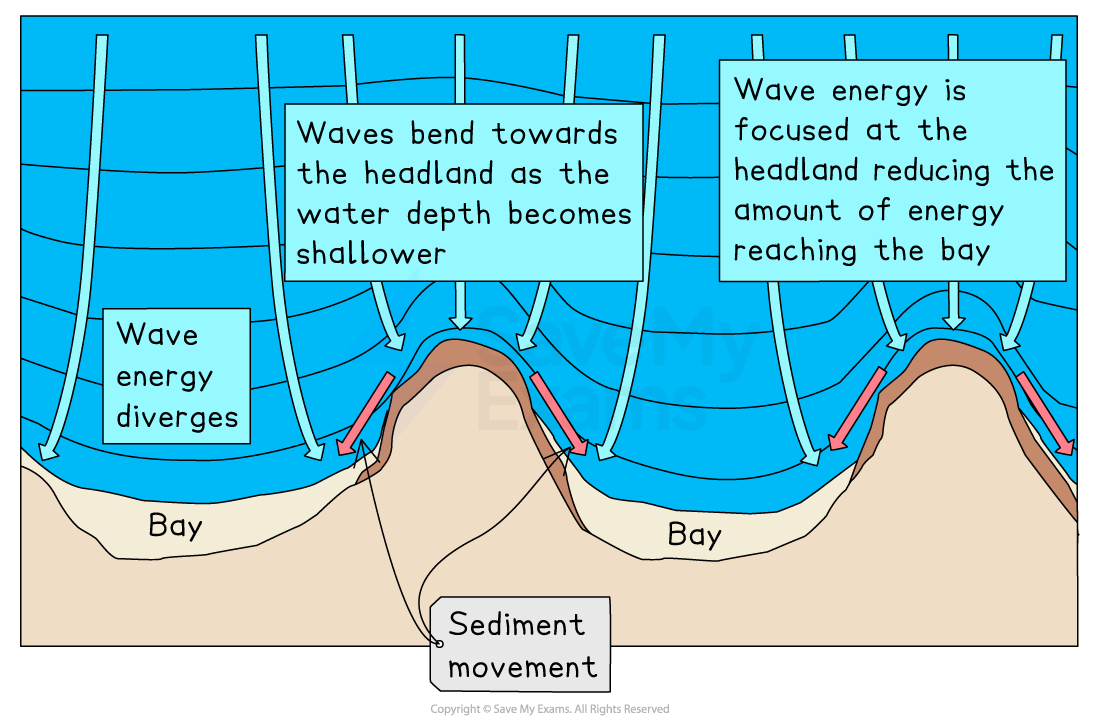
Wave refraction
Coastlines have different-depths of water and reflect waves
The depths vary because headlands and bays have formed over time
As waves travel into shallower water near the beach, they slow down
This makes the wave bend or refract to fit the shape of the shoreline
When waves are refracted, the energy is focused on the headland
This cause more erosion to the headland than bays, where sediment is deposited