Rapid urban growth rates in LICs
Specification link
This page covers section 7.1.2 of the CIE O Level specification.
7.1.2 - Causes of rapid urban growth in LICs: rural to urban migration, social, economic, environmental, and political factors, natural increase.
Causes of rapid urban growth rates in LICs
Causes of rapid urban growth rates in LICs
The UN predicts that by 2030 over 60% of the world's population will live in an urban environment
Urbanisation usually occurs because people move from rural to urban areas as a country develops
HICs saw the majority of their urbanisation before 1950 due to industrialisation in many urban areas
From the 1950s, LICs have seen rapid growth in urbanisation, particularly in South America, Asia and Africa
By 2021, the urban population in LICs had doubled
There are three main reasons for rapid urbanisation in LICs
Rural-urban migration due to push-pull factors
Speed of industrial and economic development in major towns and cities
Rate of population growth as development occurs
1. Rural-urban migration
Rural-urban migration is a major factor that drives urbanisation
It is the movement of people from the countryside to cities
This migration causes the urban population to grow, often at the expense of the rural population
For example, in China, rural-urban migration has led to massive city growth, with people moving from farming regions to cities like Shenzhen and Beijing in search of jobs in factories or offices
This has left many rural areas without people to work the land for food
Factors that cause this migration are known as push and pull
Push factors are the reasons people leave rural areas
Pull factors are the attractions of urban areas that draw people to move there
Push-pull factors are unique to each person depending on their end goal
What is a pull factor for one person may not be for another
These factors can be further classified as:
Social such as population growth
Economic – higher wages in cities
Environmental – a lack of resources in rural areas
Political, such as government policies that promote urban development
Rural-urban migration is usually a combination of factors that cause people to migrate
For example: High levels of unemployment are a push factor, whereas higher wages and a better lifestyle are a pull factor
Social
Push
Population growth leading to poverty
Poor housing and health care
Fewer and lower-quality schools and educational resources
Lack of social networks and family support
Lack of facilities such as shops, can 'push' young people from rural areas
Pull
Cities typically have better schools, universities, and medical facilities
More opportunities for cultural and personal development
Sense of community and belonging
Higher levels of retail and leisure facilities, such as restaurants, theatres and gyms
Economic
Push
A lack of industrial, service, and technology sectors
Skilled workers leaving rural areas
High levels of unemployment
Lower wage rates
Pull
Better job options to earn more money
Brain gain in areas of economic development
Access to public transport and wider range of goods and services
Environmental
Push
Disasters like earthquakes, floods, or droughts
Soil erosion causing a loss of productive land and crop failure
Pull
Improved living conditions
Greater food security
Cleaner water
Better waste management
Political
Push
Civil war
Lack of government support
Religious or cultural discrimination
Pull
Higher personal safety with better infrastructure
Higher political freedom, democracy or human rights
Government policies on development
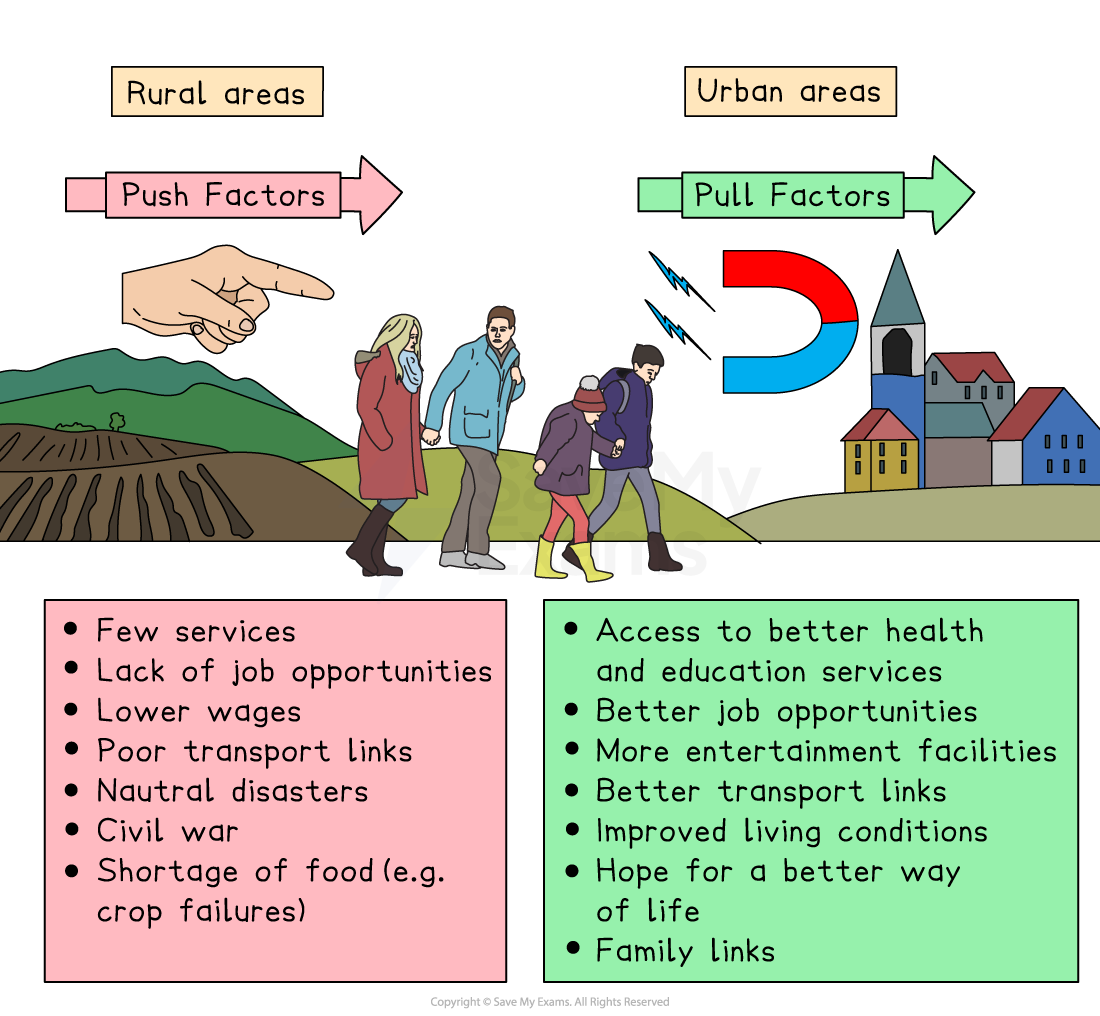
2. Speed of economic and industrial development
Economic growth drives urbanisation
As a city prospers, it attracts people and businesses
This encourages inward investment
This leads to yet more development and growth
Generating further need for skills and labour and job growth
This cycle multiplies the positive effects and growth continues
The faster the growth of secondary and tertiary employment sectors, the faster the growth of urbanisation
Most new economic development is concentrated in the big cities in LICs through investment in low-cost manufacturing of textiles, garments and shoes
Leading to high rates of rural-to-urban migration
3. Rate of population growth
Economic growth needs a supply of labour
There are two ways to meet this demand:
Rural-urban migration is an important source of labour, as it attracts a wider pool of people into the urban region
Natural increase in an urban population but this is a slow way of meeting demand
Natural increase
High levels of natural increase in population accounts for roughly 60% of urban population growth
It indicates how a population changes due to natural processes (births and deaths) without including migration
If birth rates are higher than death rates, then there will be a natural increase
If death rates are higher than birth rates, there will be a natural decrease
Factors like birth rates, death rates, and life expectancy significantly impact natural increase