Urban growth rates
Specification link
This page covers section 7.1.1 of the CIE O Level specification.
7.1.1 - Reasons for variations in global urban growth rates.
Reasons for variations in global urban growth rates
Reasons for variations in global urban growth rates
The term 'urban area' refers to any highly developed built-up area, such as towns, cities, and suburbs
An urban area is characterised by a high density of man-made structures, including homes, businesses, schools, hospitals, bridges, roads, and other infrastructure
Urban growth is the increase in the population size and/or physical area of a town or city
Urban growth occurs because of:
Natural population increase
More people are born than die
Accounts for roughly 60% of urban population growth
Rural-urban migration
Accounts for 40% of urban growth
Due to rural push factors along with urban pull factors
Economic development
Countries become more urban as they develop economically
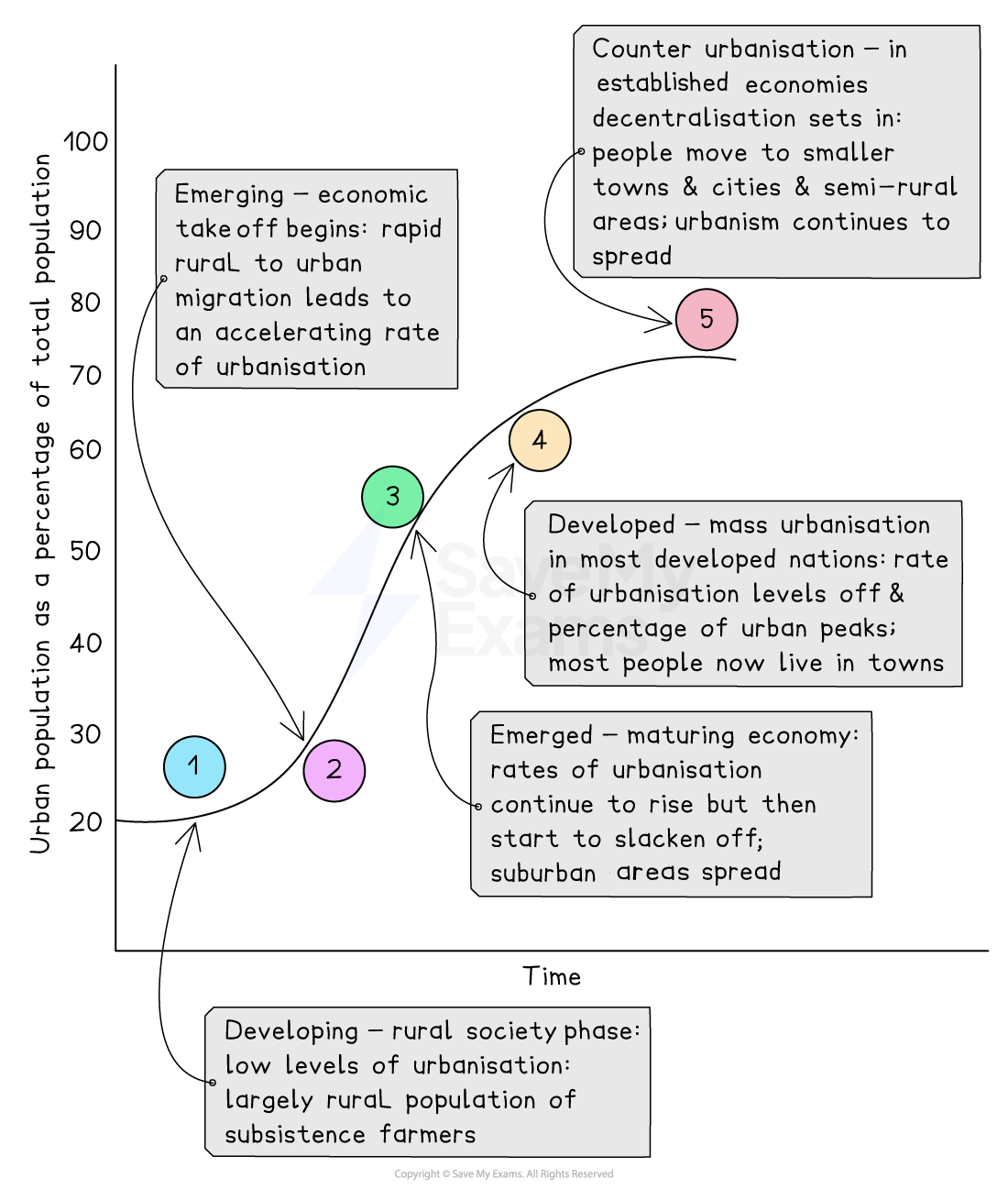
Urbanisation is the process by which an increasing percentage of a country's population comes to live in towns and cities
More people now live in towns and cities than in rural areas in search of a better quality of life
Urbanisation growth rate varies between and within countries globally
The world population doubled between 1950 and 2015, but the urban population more than trebled
Modern transport and communication has created conurbations, further adding to the growth of urban areas
High-income countries (HICs) show the highest levels of urbanisation, with the lowest levels being in Africa and SE Asia
Government policies – Some governments actively encourage urban growth by investing in cities and infrastructure
China, for example, has rapidly urbanised through deliberate government planning
Other countries might focus more on rural development
HICs
Rate of urban growth: Slow or declining
HICs have lower rates of urbanisation, as towns and cities already exist
Example: UK, Germany, Japan, and America
Cause: The industrial revolution 'pulled' the population into developing urban areas at that time
Nowadays, many people in HICs are being 'pushed' (counter-urbanisation) away from overcrowded cities to rural settlements
HICs tend to have good transport and communication networks; therefore, people can live in rural areas while commuting to cities or work from home
MICs
Rate of urban growth: Rapid
Example: India, Russia, Brazil and China
Cause: These areas are becoming key trade hub cities and are seeing greater growth than others due to investment from the government and TNCs
Cities such as Lagos in Nigeria, Shanghai in China, Mumbai in India, Sao Paulo in Brazil and St Petersburg in Russia – none of these are the country's capital
Trade such as finance, electronics and manufactured goods
LICs
Rate of urban growth: Fastest rates of urbanisation
Example: Sub-Saharan countries, including Rwanda and Ethiopia. Asian countries like Vietnam, Bangladesh, and the Philippines are expected to contribute 60% to global growth by 2030
Cause:
Economic development is concentrated in the big cities
Investment in low-cost manufacturing of textiles, garments and shoes
High rates of rural-to-urban migration
High levels of natural increase in population
Megacities
In 1900 there were just 2 'millionaire' cities (London and Paris); by 2018 this had grown to 512
As the growth of cities continues, the term 'megacity' is used to describe cities with more than 10 million people
In 1970 there were only 4
By 2000 there were 15
2007 saw more people living in an urban environment than a rural one
In 2018 that rose to 33
Largest growth of megacities is seen in Asia – Tokyo has close to 37.3 million people
By 2050 it is thought that more than two-thirds (7 billion) of the world population will live in urban areas
This scaling up of the urban environment is the fastest in human history