Impacts of climate change
Specification link
This page covers section 5.2.1, 5.3.1 and 5.3.2 of the CIE O Level specification.
5.2.1 - The present day and predicted future impacts of climate change. For example, rising sea levels, and changes to global temperature, weather patterns, and food production.
5.3.1 - The strategies (including national and international agreements) and techniques used to manage the impacts of climate change.
5.3.2 - An evaluation of mitigation (including international agreements) and adaptation strategies and techniques used to manage the impacts of climate change.
Impacts of climate change
Impacts of climate change
Health
Increased temperatures and lack of precipitation may lead to the spread of diseases:
Italy has experienced cases of malaria since 2017, when it was previously a malaria-free area
An additional 280 million people may be affected by malaria
Waterborne diseases are more likely to spread
Heat waves may become more frequent
Heat stroke, dehydration and sunburn increase during heat waves
Stagnant air during heat waves increases air pollution levels:
Respiratory diseases increase and those suffering from respiratory illnesses such as asthma may be more affected
Increased temperatures negatively affect people with cardiopulmonary diseases
Diets may be restricted by food shortages leading to malnutrition and famine
Homes and settlements
Increased flooding due to sea level rise and increased frequency and severity of storms will lead to the displacement of large numbers of people
Settlements in low-lying areas may have to be abandoned or need additional defences against sea level rise
Moving settlements or improving flood defences will be costly
Agriculture
Farmers may need to change the crop they grow if climate conditions become unsuitable
Coastal flooding may lead to salt intrusion
Reduced availability of water will mean that irrigation is limited or impossible
Food shortages will lead to malnutrition and famine
Food prices may rise
Employment
Job opportunities may change or decrease for the following reasons:
Tourism may decline in some areas; for example, ski resorts may close due to the lack of reliable snow
Coastal resorts may be at risk of flooding leading to the closure
Farmers may have to change the crop they grow or livestock they raise or leave farming
In some areas, agriculture may decline due to rising temperatures or changing rainfall patterns
Sea level rise
Warmer temperatures cause the water in seas and oceans to expand, increasing the sea level
Melting ice is adding to the increasing volume of water:
Average sea levels have risen 23 cm since 1880
Sea levels are forecast to increase a further 30 cm by 2050
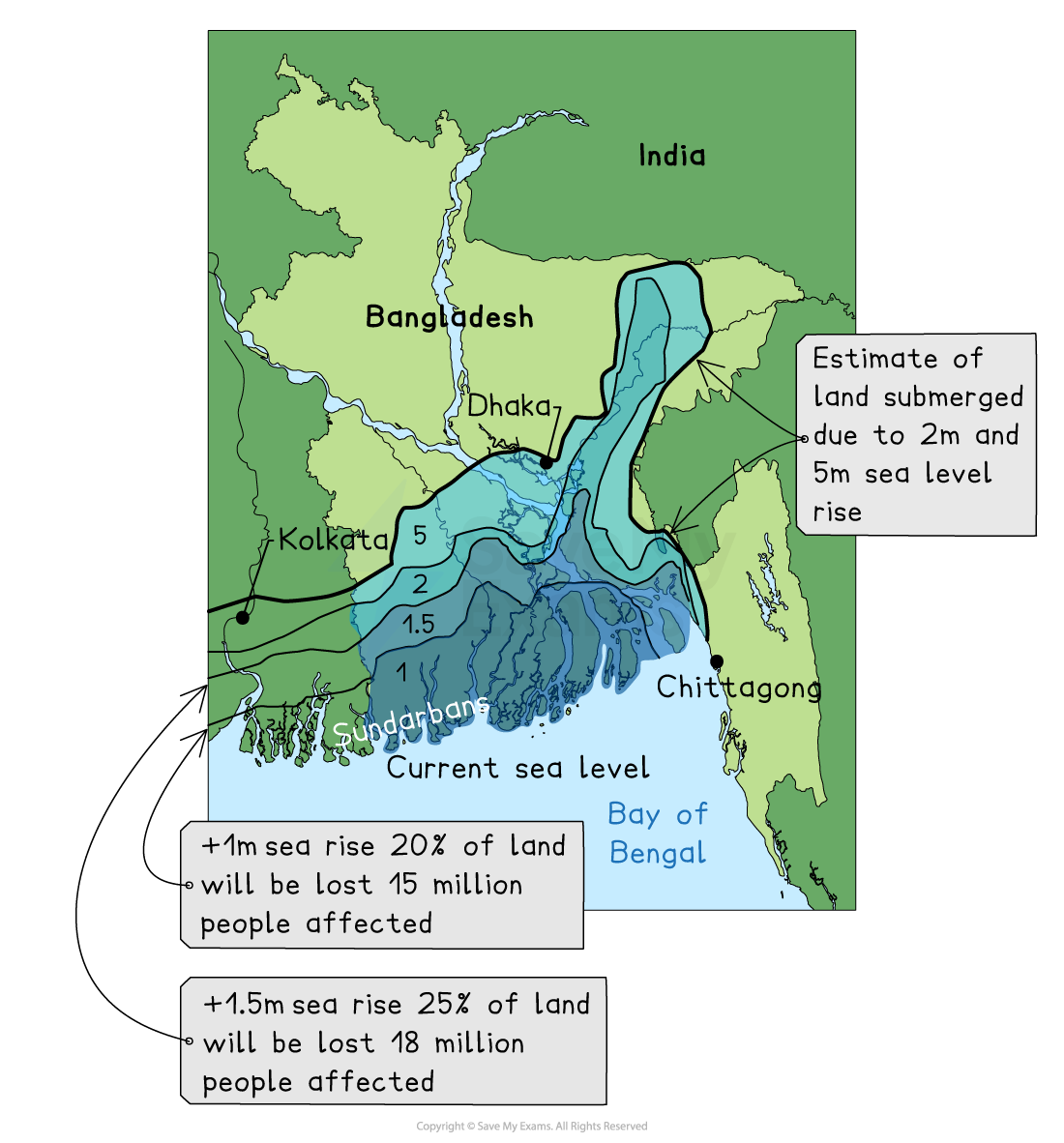
Low-lying coastal areas such as southern Bangladesh and islands are at higher risk of flooding:
The Maldives may be uninhabitable by 2050
Beach erosion will increase, leading to greater coastal erosion
Coastal ecosystems, including coral reefs and mangrove swamps, will be affected
Saltwater is contaminating freshwater supplies and affecting coastal agriculture
Ecosystem change
The location of biomes may shift to the north (Northern Hemisphere) and south (Southern Hemisphere) as they rely on specific climate conditions:
Polar and tundra biomes are at risk of becoming extinct as they cannot shift any further north/south
Increasing sea temperatures and ocean acidification have resulted in coral bleaching
Migration and behavioural patterns of animals affected by changing temperatures:
Fish species are moving north and south of their usual habitats to seek cooler water
Reduced hibernation due to warmer winters
Melting of ice caps/glaciers leading to changing ocean currents
Mangrove swamps and coral reefs are threatened by rising sea levels
Loss of habitats through flooding, drought and wildfires
Food webs breaking as species numbers are reduced and food sources are decreased
Loss of plants and vegetation
Natural hazards
Changes in climate patterns are likely to increase the frequency and severity of storms:
The 2020 Atlantic hurricane season was the first most active on record and 2021 was the third most active
The frequency and length of droughts are increasing
Dry conditions lead to the increased risk of wildfires:
In 2021, Australia, Greece, South Africa, Brazil and the USA were just some of the places to experience severe wildfires
In September 2021, the USA National Fire Centre reported 44,647 wildfires that had burnt 5.6 million acres
Rising sea levels together with increased storms lead to increased flooding risk
Responses to climate change
Responses to climate change
Global warming and climate change require an international response because they affect the entire globe
Responses can involve either adaptation or mitigation
Mitigation includes ways that people try to reduce or eliminate greenhouse emissions
The aim is to halt global warming and therefore climate change
Mitigations can include international agreements as well as national and individual actions
International agreements
In 1988 the Intergovernmental Panel on Climate Change (IPCC) was set up to assess the 'risks of human-induced climate change'
This was followed by several international agreements
Earth Summit, Rio 1992
In May 1992 the United Nations Framework Convention on Climate Change (UNFCCC) was established
It was then signed by 166 countries at the Earth Summit in Rio or at the UN headquarters
The Earth Summit also set out:
Twenty seven principles aimed at guiding countries towards more environmentally sustainable development
Aims to stabilise greenhouse gas levels
Principles for the management, conservation and sustainable development of all forests
Kyoto Protocol 1997
Delegates from 150 countries agreed to reduce greenhouse gas emissions
It stated that industrialised countries would reduce emissions to below the levels in 1990
Developing countries, including China and India, were exempt from the agreement
The USA did not sign up for the treaty
Canada withdrew in 2011, stating that without China and the USA, the treaty would not work
The Kyoto Protocol was the first legally binding international treaty to set emissions targets
Marrakech Agreement, 2007
It was agreed that funding would be provided to less developed countries to support them in adapting to the effects of climate change
Paris Agreement 2015
Global agreement to limit global warming to 2°C (preferably 1.5°C) above pre-industrial levels
The agreement also includes reducing CO₂ emissions by at least 60% by 2050
Signed by 196 countries, including the USA and China (the USA withdrew in 2020 and rejoined in 2021)
Introduced Nationally Determined Contributions (NDCs)
These are climate action plans submitted by each country outlining their commitments
Currently these are not sufficient to meet the 2oC target (projections show 2.6-2.7oC warming by 2100)
Conference of the Parties (COP)
The United Nations (UN) holds an annual (every year) meeting to discuss climate change.
COP29 was held in Baku, Azerbaijan
All nations agreed to:
Continue to take action to further reduce greenhouse gas emissions
Triple financial aid to developing countries
Reducing emissions
Emissions can be reduced in several ways, including:
Reducing deforestation
Increasing afforestation
Improving energy efficiency in industry and domestic appliances
Reducing emissions from industry
Improving public transport
Electric vehicles
Use of renewable energy and nuclear power
Carbon capture and storage
Reducing meat consumption
Alternative feed for cattle to reduce methane emissions
Adaptations
Climate change is already impacting many countries
Mitigation strategies will take time to have an impact
Adaptations are needed to help populations cope with the impacts which are already being felt
Examples of adaptations include:
Improved building design to withstand flooding and increased storm intensity
More efficient use of freshwater resources and desalination
Coastal and river defences to reduce the impact of flooding
Changing the types of crop grown
Relocation of vulnerable communities
Extreme weather plans
Effectiveness of mitigation and adaption strategies
Effectiveness of mitigation and adaptation strategies
Climate change is a global issue
It requires international cooperation and collaboration
The effectiveness of both strategies depends on various factors, including:
Political willingness to implement the strategies
Availability of finance and economic resources
Technological advancements
Mitigation strategies
Mitigation strategies are important in the long term to reduce the rate or even halt global warming
Their effects can be gradual and may take time to have an impact
Challenges of mitigation strategies
Implementing mitigation strategies changes can be expensive
They rely on international cooperation and may be politically challenging to implement
Even if countries sign up to agreements, they may not be able to achieve the changes outlined
There may be resistance from industries reliant on fossil fuels
Not all mitigation strategies are equally effective
Adaptation strategies
Adaptation strategies can help reduce the short-term negative impacts of climate change
Challenges of adaptation strategies
Adaptation measures can be expensive and require significant infrastructure changes
Some adaptation strategies may not be effective when there are extreme climate events
Adaptation efforts may be more effective if combined with mitigation efforts