StudyDeck

Similar Areas & Volumes

Exam code: 4024
Written by: Ashika|Reviewed by: Caroline Carroll|Updated 2 July 2026

Similar Areas & Volumesvideo

Similar Areas & Volumes

Similar areas & volumes

How do I find the length, area or volume scale factors of similar shapes?

  • The scale factor (SF) for a given quantity (length, area or volume) between two similar shapes can be found by dividing the quantity on one shape by the quantity on the other shape
    • scale factor=quantity on one shapecorresponding quantity on the other shape{"fontFamily":"Times New Roman","fontSize":"18","autoformat":true,"toolbar":""}

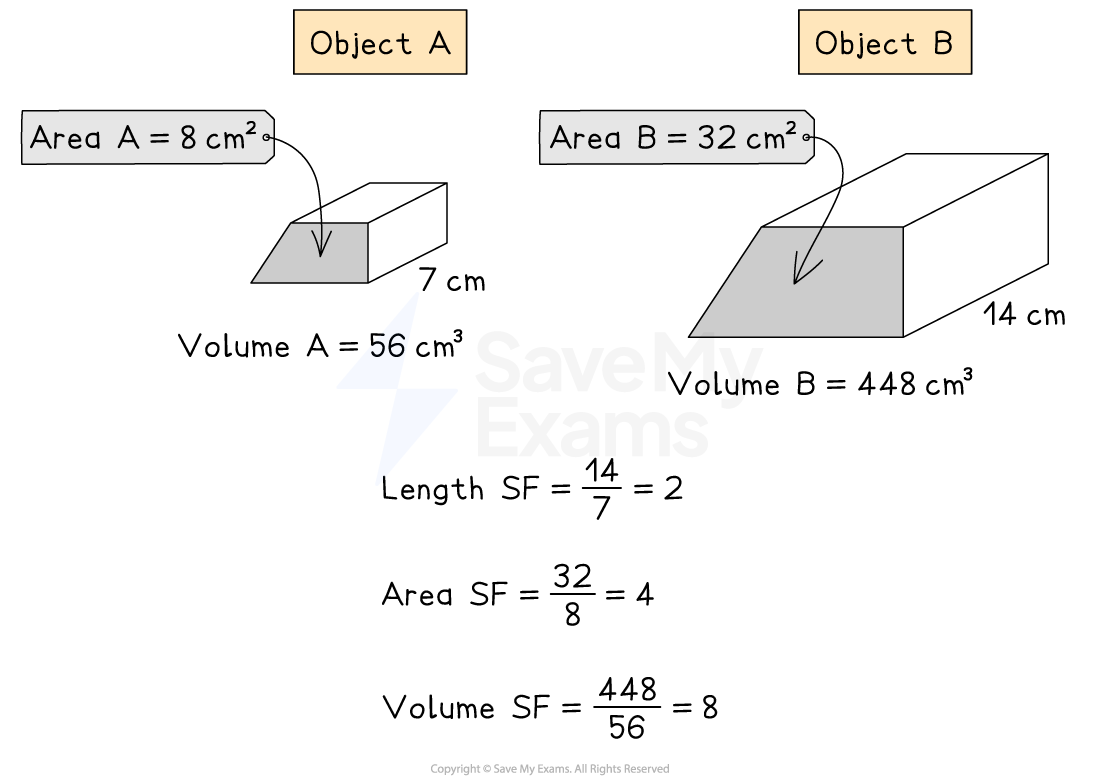
Two objects, A and B. Object A has a depth of 7 cm, a front surface area of 8 cm² and a volume of 56 cm³. Object B has a depth of 14 cm, a front surface area of 32 cm² and a volume of 448 cm³. Length SF = 2, area SF = 4, volume SF = 8.
Example of scale factor of similar shapes
  • An object could be made either bigger or smaller by a scale factor

    • The object gets bigger if the scale factor is bigger than 1

    • The object gets smaller if the scale factor is bigger than 0 and less than 1

What is the connection between the scale factors for lengths, areas and volumes of similar shapes?

  • The length, area and volume scale factors are powers with the same base number

  • If the length scale factor is k then

    • The area scale factor is k2

    • The volume scale factor is k3

  • If you know one scale factor, you can find the scale factors

    • If you have the length scale factor

      • Area scale factor=Length scale factor2{"fontFamily":"Times New Roman","fontSize":"18","autoformat":true,"toolbar":""}

      • Volume scale factor=Length scale factor3{"fontFamily":"Times New Roman","fontSize":"18","autoformat":true,"toolbar":""}

    • If you have the area scale factor

      • Length scale factor=Area scale factor{"fontFamily":"Times New Roman","fontSize":"18","autoformat":true,"toolbar":""}

      • Volume scale factor=Area scale factor3{"fontFamily":"Times New Roman","fontSize":"18","autoformat":true,"toolbar":""}

    • If you have the volume scale factor

      • Length scale factor=Volume scale factor3{"fontFamily":"Times New Roman","fontSize":"18","autoformat":true,"toolbar":""}

      • Area scale factor=Volume scale factor32{"fontFamily":"Times New Roman","fontSize":"18","autoformat":true,"toolbar":""}

How do I find missing lengths, areas and volumes for similar shapes?

  • STEP 1
    Identify the equivalent known quantities

    • Recognise if the quantities are lengths, areas or volumes

  • STEP 2
    Find the scale factor from two known lengths, areas or volumes

    • scale factor=second quantityfirst quantity{"fontFamily":"Times New Roman","fontSize":"18","autoformat":true,"toolbar":""}

  • STEP 3
    Use the scale factor you have found to find other required scale factor(s)

    • Length scale factor=k{"fontFamily":"Times New Roman","fontSize":"18","autoformat":true,"toolbar":""}

    • Area scale factor=k2{"fontFamily":"Times New Roman","fontSize":"18","autoformat":true,"toolbar":""}

    • Volume scale factor=k3{"fontFamily":"Times New Roman","fontSize":"18","autoformat":true,"toolbar":""}

  • STEP 4
    Multiply or divide by relevant scale factor to find the missing quantity

    • Think about whether the quantity should be bigger or smaller than the given quantity