Limiting Factors
Limiting Factorsvideo
Limiting Factors
A plant that is given unlimited sunlight, carbon dioxide and water, and that is in a warm environment, will be able to photosynthesise at its maximum rate
However, most plants do not have unlimited supplies of their raw materials, so their rate of photosynthesis is limited by whichever factor is in shortest supply at any given time
So, a limiting factor can be defined as:
An environmental factor that limits the rate of a reaction
There are three main factors which limit the rate of photosynthesis:
Temperature
Light intensity
Carbon dioxide concentration
Note that although water is necessary for photosynthesis, it is not considered a limiting factor
Water is involved in multiple plant processes, such as transport and cell turgidity, so it is likely to affect other plant processes before it directly affects the rate of photosynthesis, e.g. limited water availability will cause stomata to close, limiting carbon dioxide availability
Temperature
As temperature increases, the rate of photosynthesis increases
On a graph of temperature against rate of photosynthesis, this can be seen as an upward curve
This trend continues up to a temperature at which the enzymes begin to denature and the rate of reaction then decreases
Temperature and photosynthesis graph
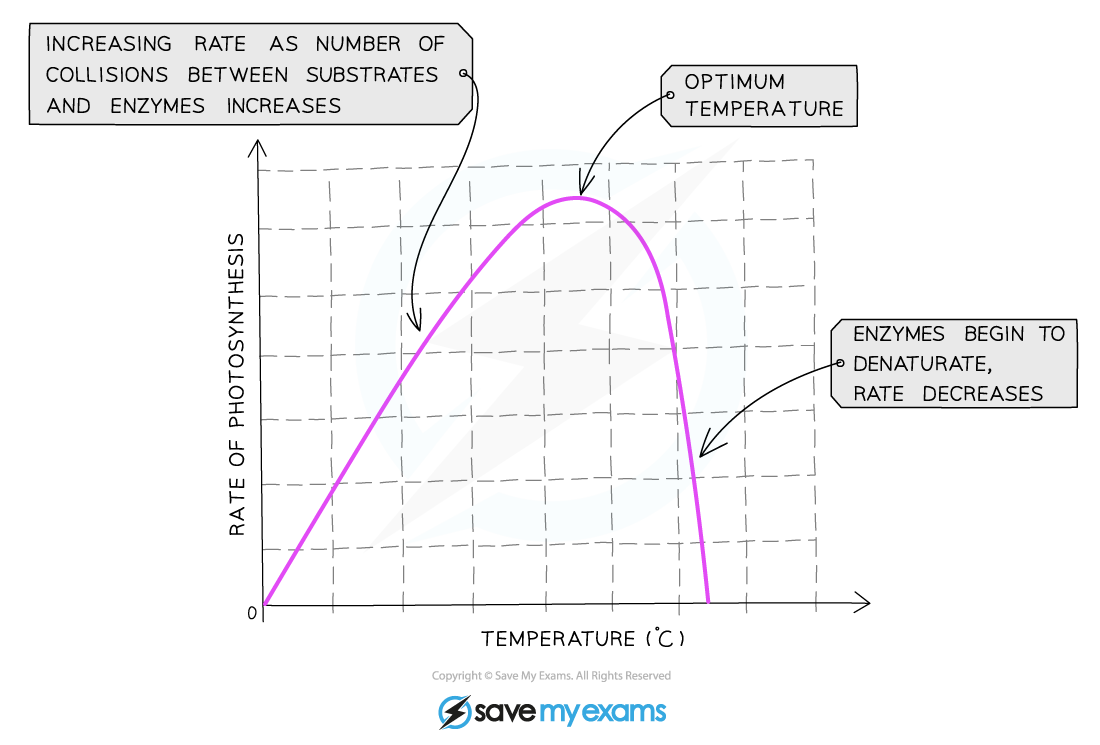
As temperature increases, the rate of photosynthesis increases. The continues up to a temperature at which enzyme denaturation occurs, after which the rate of photosynthesis decreases
Light intensity
The higher the light intensity, the faster the rate of photosynthesis
On a graph of light intensity and rate of photosynthesis, this can be seen as a linear relationship
While the graph shows this linear relationship, light intensity is the limiting factor
This trend will continue until some other factor required for photosynthesis prevents the rate from increasing further
At this point, the factor that prevents the rate from increasing further becomes the limiting factor; the new limiting factor could be:
Temperature
Carbon dioxide concentration
Light intensity and photosynthesis graph
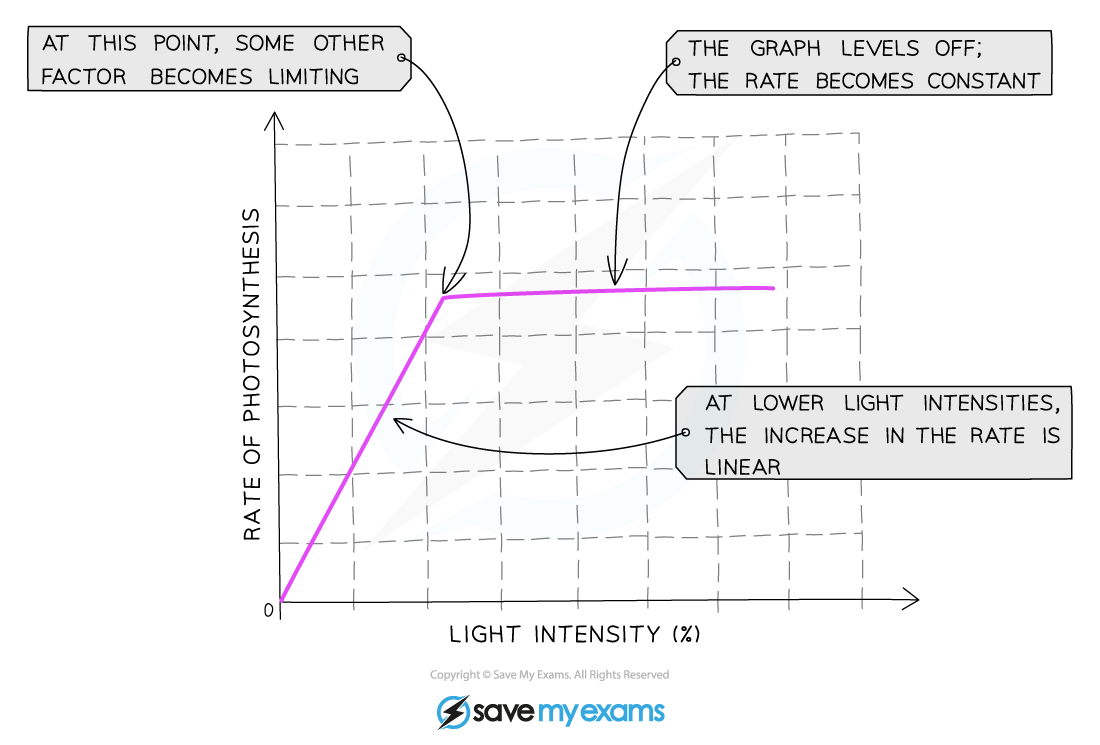
As light intensity increases, so does the rate of photosynthesis; this can be seen as a linear relationship on a graph. Once the graph levels off, another factor, e.g. temperature, has become the limiting factor
Carbon dioxide concentration
As carbon dioxide concentration increases, the rate of photosynthesis increases
On a graph of carbon dioxide concentration and rate of photosynthesis, this can be seen as a linear relationship
While the graph shows this linear relationship, carbon dioxide concentration is the limiting factor
This trend will continue until some other factor required for photosynthesis prevents the rate from increasing further; the new limiting factor could be:
Temperature
Light intensity
Carbon dioxide concentration and photosynthesis graph
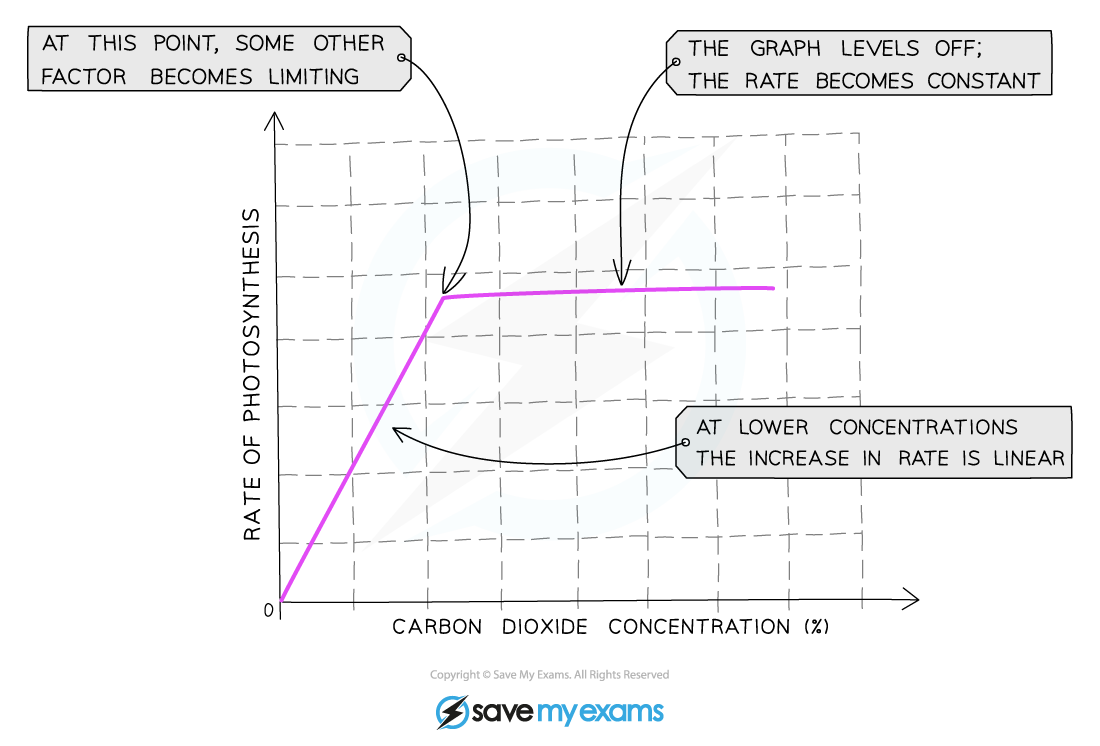
As carbon dioxide concentration increases, so does the rate of photosynthesis. This continues until another factors becomes limiting