Identifying Leaf Structures in a Dicotyledonous Plant
Identifying Leaf Structures in a Dicotyledonous Plantvideo
Identifying Leaf Structures in a Dicotyledonous Plant
Dicotyledonous plants are a group of flowering plants
The following structures are present in the leaves of dicotyledonous plants:
Cuticle
Stomata
Guard cells
Spongy mesophyll
Palisade mesophyll
Air spaces
Vascular bundles
Xylem
Phloem
Chloroplasts
Upper and lower epidermis
These structures are all adaptive features that allow leaves to photosynthesise efficiently
Dicotyledonous leaf structure diagram
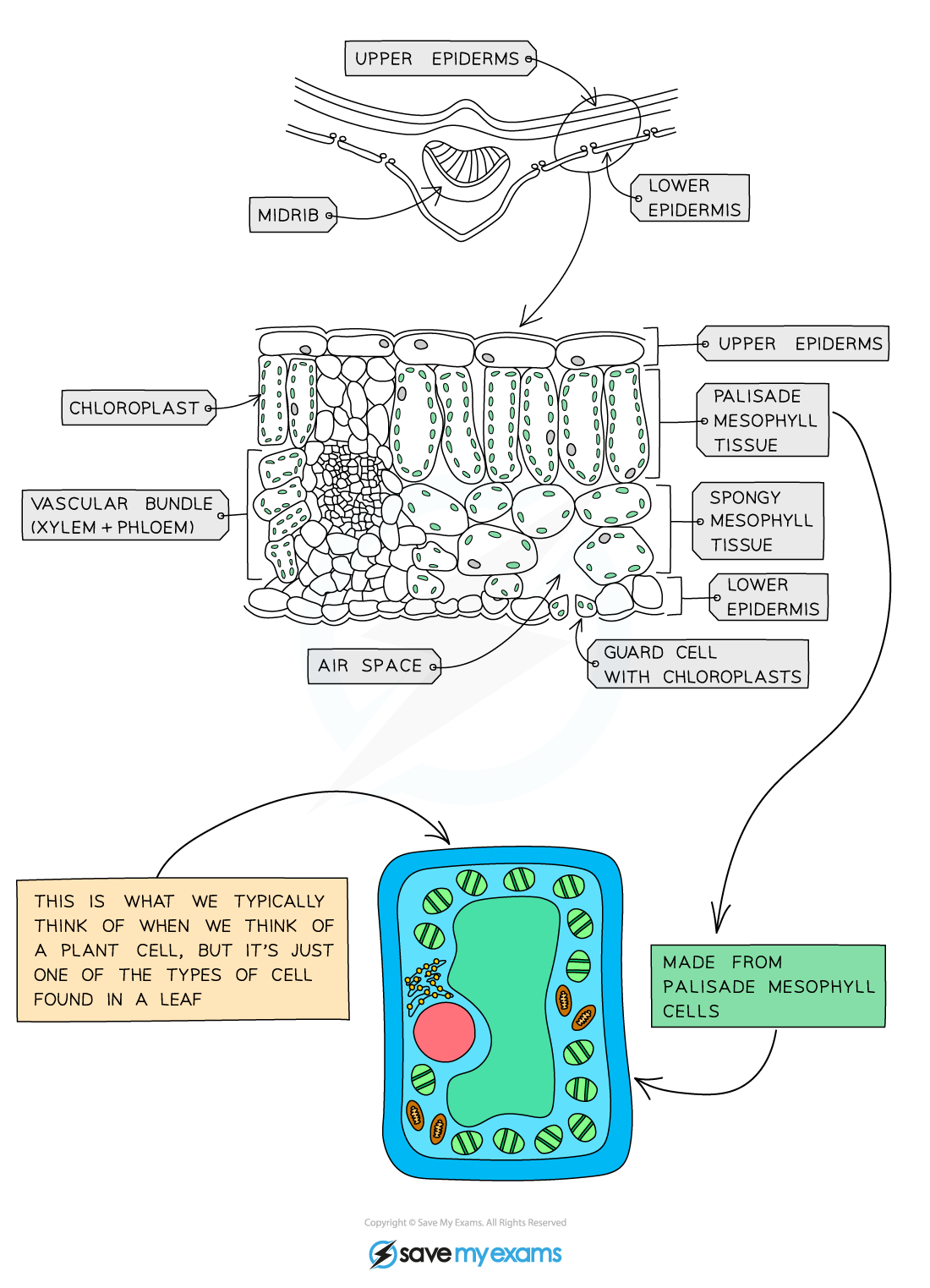
The structures that make up the leaves of dicotyledonous plants allow them to carry out photosynthesis efficiently
Leaf structure under a microscope diagram
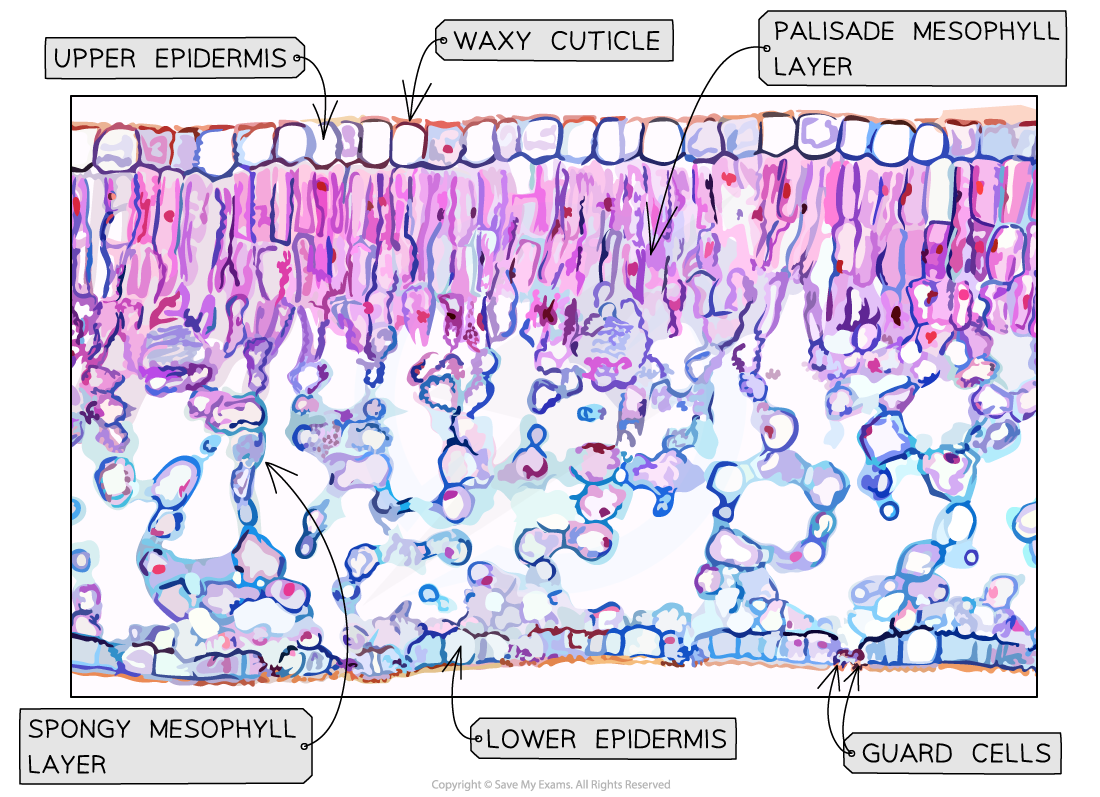
Leaf structures can be seen clearly under a microscope
Leaf structure adaptations table
Structure | Description | Adaptation |
|---|---|---|
Waxy Cuticle | A transparent, fatty layer that covers the upper surface of the leaf | Protects the leaf and reduces water loss by evaporation while allowing light through |
Stomata (singular stoma) | Pores through which gases and water vapour can diffuse; most plants have more stomata on their lower leaf surface | Allow carbon dioxide to diffuse into the leaf, and oxygen and water vapour to diffuse out |
Guard Cells | Cells that surround the stomata; guard cells can change shape to open or close the stomata | Plants can close the stomata to reduce water loss |
Spongy Mesophyll | A layer of photosynthesising cells with air spaces between them | Carry out photosynthesis, and allow the easy movement of gases |
Palisade Mesophyll | A layer of column-shaped cells that are tightly packed together; they contain many chloroplasts | Many cells can fit in a single layer beneath the upper surface of leaves, maximising photosynthesis |
Vascular Bundle | Contains xylem and phloem | Allows the raw materials of photosynthesis to reach the leaf |
Xylem | Transports water around the plant | Provides water for photosynthesis, and maintains the transpiration stream |
Phloem | Transports sucrose and amino acids around the plant | Allows the products of photosynthesis to travel away from the leaves to other parts of the plant |
Upper Epidermis | A layer of thin cells on the top surface of leaves | Allows light to pass through to the palisade and spongy mesophyll cells |
Lower Epidermis | A layer of cells, guard cells and stomata on the underside of leaves | Allows gas exchange to take place |