Using Cash-flow Forecasts
The importance of cash to a business
The importance of cash to a business
Cash is the 'blood' of a business, as without it, a business will die
It is a liquid asset in the form of notes, coins and money in the bank
A profitable business is likely to fail if it does not have sufficient cash
Cash-poor businesses will struggle to pay suppliers, employees and operating expenses
This is called insolvency
E.g. Lifestyle retailer Joules announced plans to liquidate in December 2022 as a result of cash-flow difficulties despite making a profit of £2.6 million during the previous year
A new business may have to pay cash on purchase for all of its supplies until its suppliers trust them enough to provide credit terms (buy now, pay later)
A supplier may then give the business trade credit of 30 or 60 days
This means that the business can receive their stock now and only pay for it in 30 or 60 days; the cash outflow is delayed
As the business sells its products, they receive money generated from the business revenue and this represents a cash inflow
At the end of 60 days they will pay their supplier (cash outflow), but the firm may still have half of its stock available for sale
A cash-flow cycle shows the stages between paying out cash for labour, materials, and so on, and receiving cash from the sale of goods
Cash-flow cycle
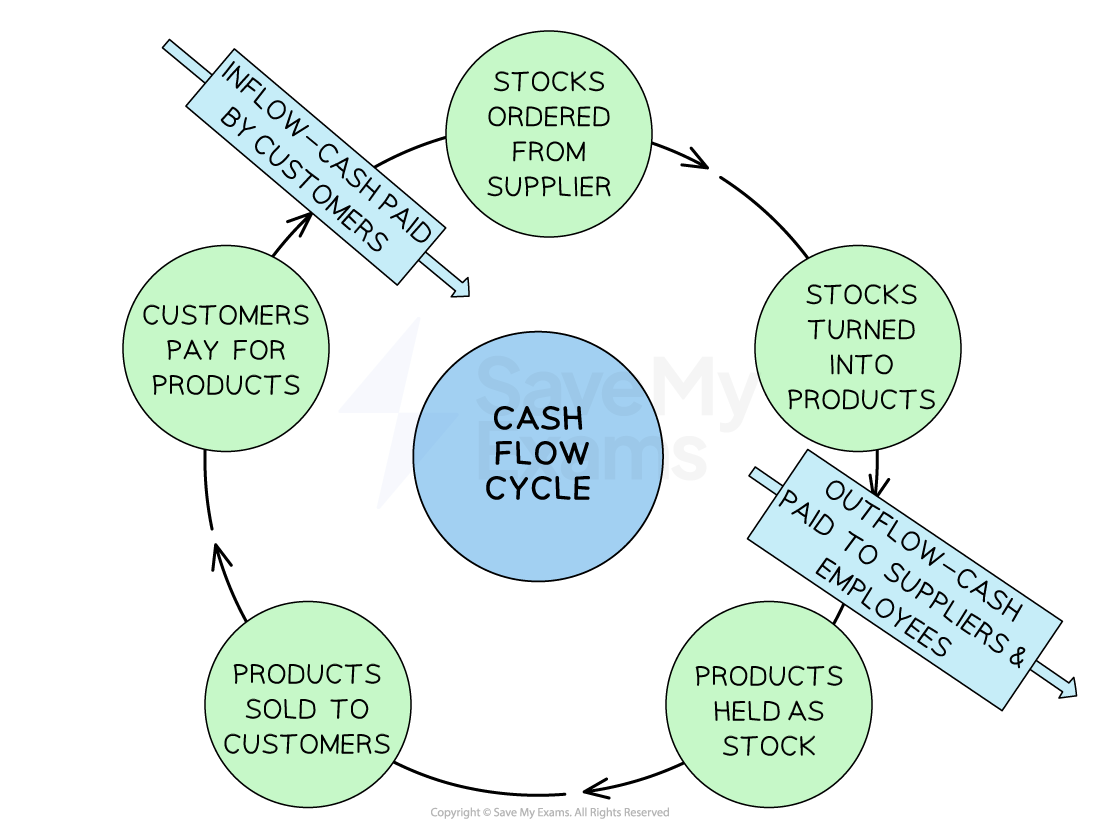
Explanation of the cash-flow cycle
The diagram shows that cash is needed to pay for materials used to produce the product
Time is needed to produce the products before they can be sold to customers
If customers purchase the goods using a credit facility provided by the business, then they will not have to pay immediately, which will delay cash inflows
When they do pay for the goods immediately, this money will be used to pay business expenses
Due to the time between each stage, the business needs to make sure it has enough working capital to keep running and pay bills
Businesses, particularly start-ups, need to ensure that they manage cash-flow to ensure that it does not run out of money
Cash-flow issues may put the business in a situation where it is
Unable to pay key stakeholders, such as workers and suppliers
Production is likely to cease as workers will not work without pay and suppliers will not supply goods if they are not paid
Unable to pay utility bills and rent
The business could be forced into liquidation and, ultimately, is likely to fail
Constructing a cash-flow forecast
Constructing a cash-flow forecast
A cash-flow forecast is a prediction of the anticipated cash inflows and cash outflows typically for a three, six or twelve month period
Typical outflows include payments for raw materials, paying staff wages and salaries, paying bills such as electricity and repaying loans
Typical inflows include receipts from sales, money received from a new bank loan, money from the sale of an asset and money from investors
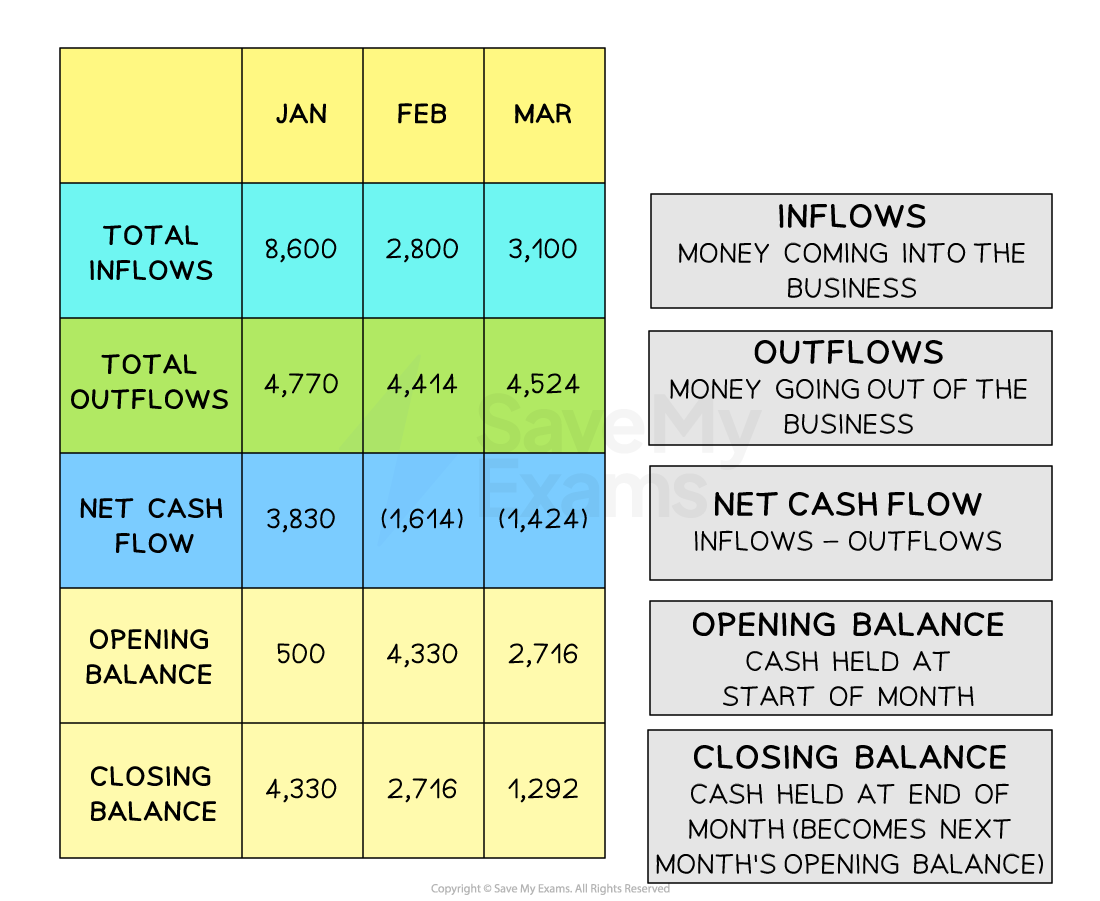
Steps in constructing a cash-flow forecast
The business starts with an opening balance of £500 in January
Total inflows for January are £8,600
Total outflows are expected to be £4,770
The Net Cash-flow is expected to be £3,830 (£8,600 - £4,770)
January’s closing balance is expected to be £4,330 (£500 + £3,830)
Each closing balance becomes the opening balance for the next month
As the closing balance for January is £4,330, the opening balance for February is therefore £4,330
The calculation process starts again in February, and every month onwards
Net cash flow + opening balance = closing balance
Overall, despite negative net cash flow between February and May, this businesses closing balance is expected to remain positive during the period, suggesting it does not expect to suffer cash flow problems
The importance of cash-flow forecasts
By analysing cash flow over time, businesses can better plan and allocate financial resources
E.g. Problematic months can be identified early and sources of additional finance put in place to ease the cash-flow
Cash flow forecasts are useful in the following situations
Starting up a business: identifying how much cash is needed in the first few months
Running an existing business: recognising where a fall in sales may require use of an overdraft facility
Supporting applications for borrowing: determining the size of loan or overdraft needed, when and for how long it is needed and by when it is likely to be fully repaid
Managing transactions: identifying how much or how little cash is deposited at the bank can determine when bills should be paid
Calculating and interpreting cash-flow forecasts
Calculating and interpreting cash-flow forecasts
It is important for a business to know how to calculate and interpret a cash-flow forecast
Example of a start-up 3 month cash-flow forecast (£s)
| Jan | Feb | Mar |
|---|---|---|---|
Inflows | |||
Cash received from sales | 4,600 | 5,100 | 3,100 |
Total inflows | 4,600 | 5,100 | 3,100 |
Outflows | |||
Inventory/stock | 1,500 | 850 | 900 |
Wages | 2,200 | 2,200 | 2,200 |
Utilities | 840 | 840 | 840 |
Total outflows | 4,540 | 3,890 | 3940 |
Net cash flow | 60 | 1,210 | (840) |
Opening balance | 500 | 560 | 1770 |
Closing balance | 560 | 1,770 | 930 |
Cash-flow forecast analysis
Overall, this cash flow forecast supports a decision for the business to arrange an overdraft facility with their bank
As sales increase in January and February, inflows are greater than outflows, and the business has a positive cash flow
This changes in March as the level of sales falls and the net cash flow turns negative
An overdraft facility will help them survive if their closing balance drops below zero in the next month or two
January
The opening balance of £500 has been introduced by the owner
The business is expected to achieve sales of £4,600
Total outflows are expected to be £4,540
The Net Cash Flow is expected to be £60 (£4,600 - £4,540)
January’s closing balance is expected to be £560 (£60 + £500)
February
The closing balance from January becomes the opening balance for February
Sales of £5,100 are expected to be the business total inflows
Total outflows are expected to be £3,890
The net cash flow is expected to be £1,210 (£5,100 - £3,890)
The closing balance is expected to be £1,770 (£1,210 + £560)
March
The closing balance from February becomes the opening balance for March
The business expects to achieve sales of £3,100 as its total inflows
Total outflows are expected to be £3,940
The net cash flow is expected to be -£840 (£3,100 - £3,940)
The closing balance is expected to be £930 (-£840 + £1,770)