Electrolysis of Molten Compounds
Electrolysis of Molten Compounds
Electrolysis of Molten Compounds
A binary ionic compound is one consisting of just two elements joined together by ionic bonding
When these compounds undergo electrolysis they always produce their corresponding elements
To predict the products made at each electrode, first identify the ions
The positive ion will migrate towards the cathode and the negative ion will migrate towards the anode
Therefore, the cathode product will always be the metal, and the product formed at the anode will always be the non-metal
Example: Electrolysis of molten lead(II) bromide
Method:
Add lead(II) bromide into a beaker and heat it so it will turn molten, allowing ions to be free to move and conduct an electric charge
Add two graphite rods as the electrodes and connect this to a power pack or battery
Turn on the power pack or battery and allow electrolysis to take place
Negative bromide ions move to the positive electrode (anode) and each loses one electron to form bromine molecules. There is bubbling at the anode as brown bromine gas is given off
Positive lead ions move to the negative electrode (cathode) and gain electrons to form a grey lead metal which deposits on the surface of the electrode
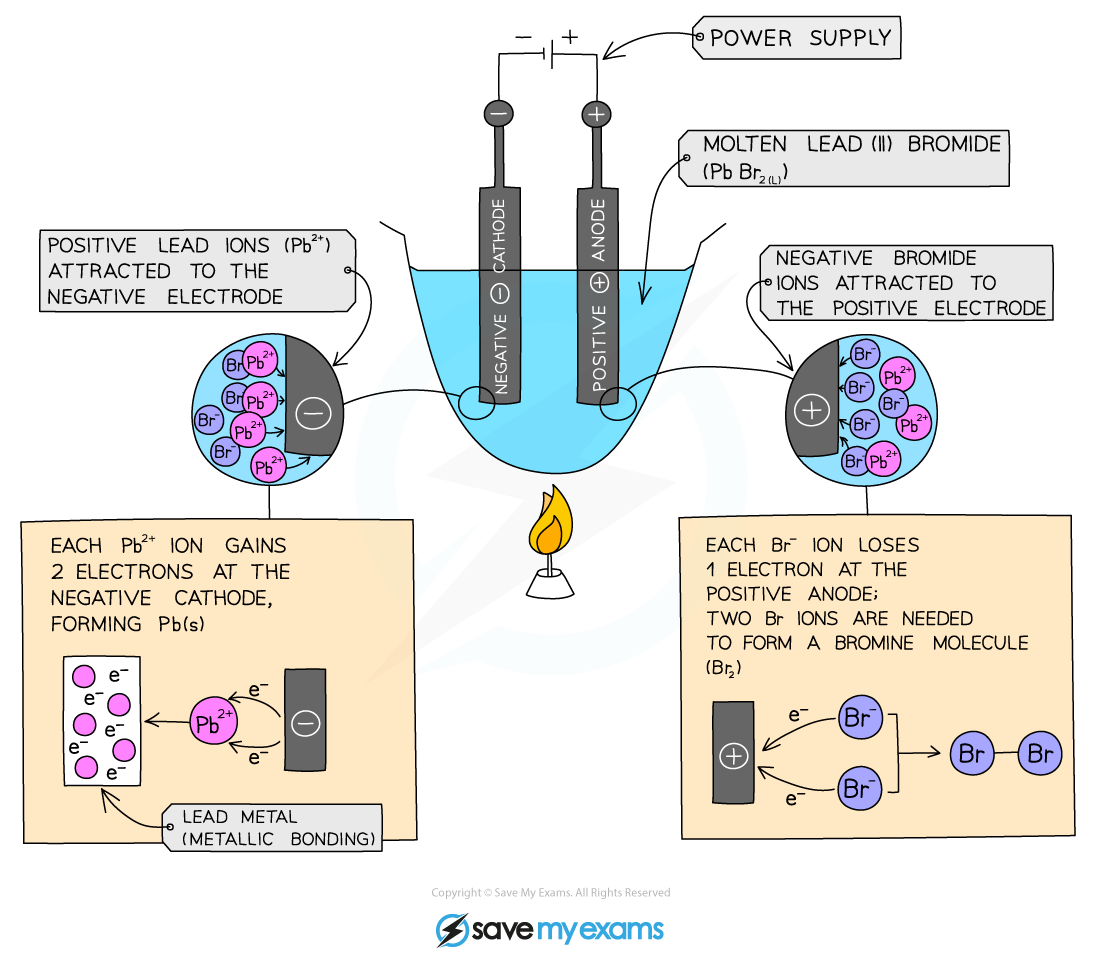
Diagram showing the electrolysis of lead(II) bromide