Electrolysis Principles
Electrolysis: General Principles
Electrolysis: General Principles
When an electric current is passed through a molten ionic compound the compound decomposes or breaks down
The process also occurs for aqueous solutions of ionic compounds
Covalent compounds cannot conduct electricity hence they do not undergo electrolysis
Ionic compounds in the solid state cannot conduct electricity either since they have no free ions that can move and carry the charge
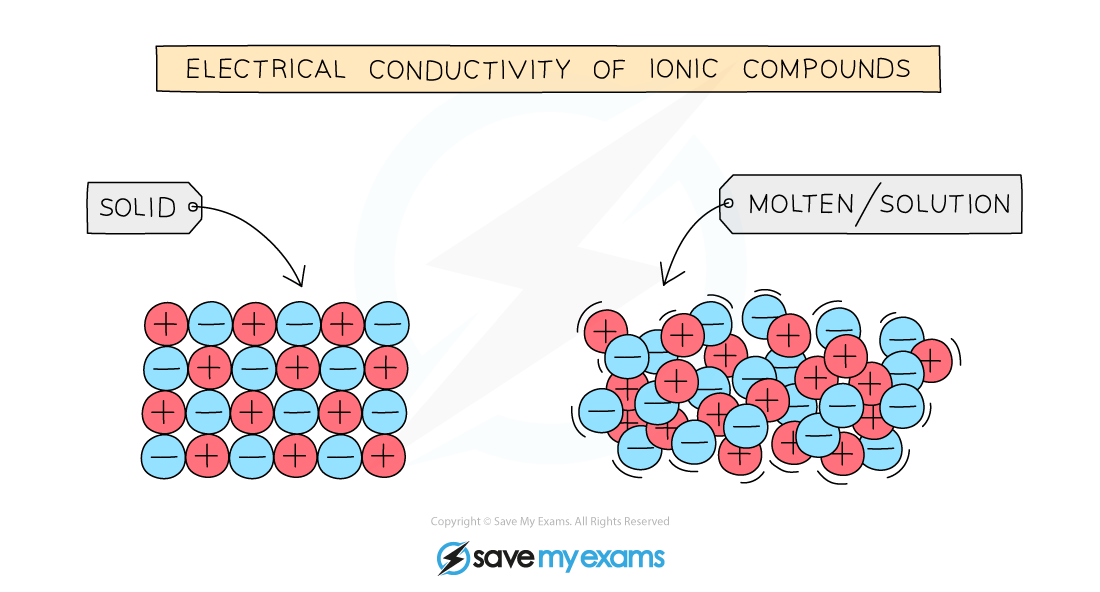
Particles in ionic compounds are in fixed position in the solid state but can move around when molten or in solution
Key terms used in a simple electrolytic cell
Electrode is a rod of metal or graphite through which an electric current flows into or out of an electrolyte
Electrolyte is the ionic compound in a molten or dissolved solution that conducts the electricity
Anode is the positive electrode of an electrolysis cell
Anion is a negatively charged ion which is attracted to the anode
Cathode is the negative electrode of an electrolysis cell
Cation is a positively charged ion which is attracted to the cathode

The basic set-up of an electrolytic cell
Metals and hydrogen form positively charged ions and so either a metal or hydrogen gas is formed at the cathode
Non-metals form negatively charged ions and so non-metals (except hydrogen) are formed at the anode
Electrolysis: Charge Transfer
Electrolysis: Charge Transfer
During electrolysis, current needs to flow around the circuit
In order for this to occur, charge must be transferred around the circuit (current is a measure of the rate of flow of charge) by charge carriers
The power supply provides the cathode with a supply of electrons, causing it to become negatively charged
Positive ions (cations) in the electrolyte move towards the cathode where they gain electrons
Negative ions (anions) in the electrolyte move towards the anode where they lose electrons
The electrons move from the anode back towards the power supply
So, in a complete circuit:
Electrons are the charge carriers in the external circuit
Ions are the charge carriers in the electrolyte
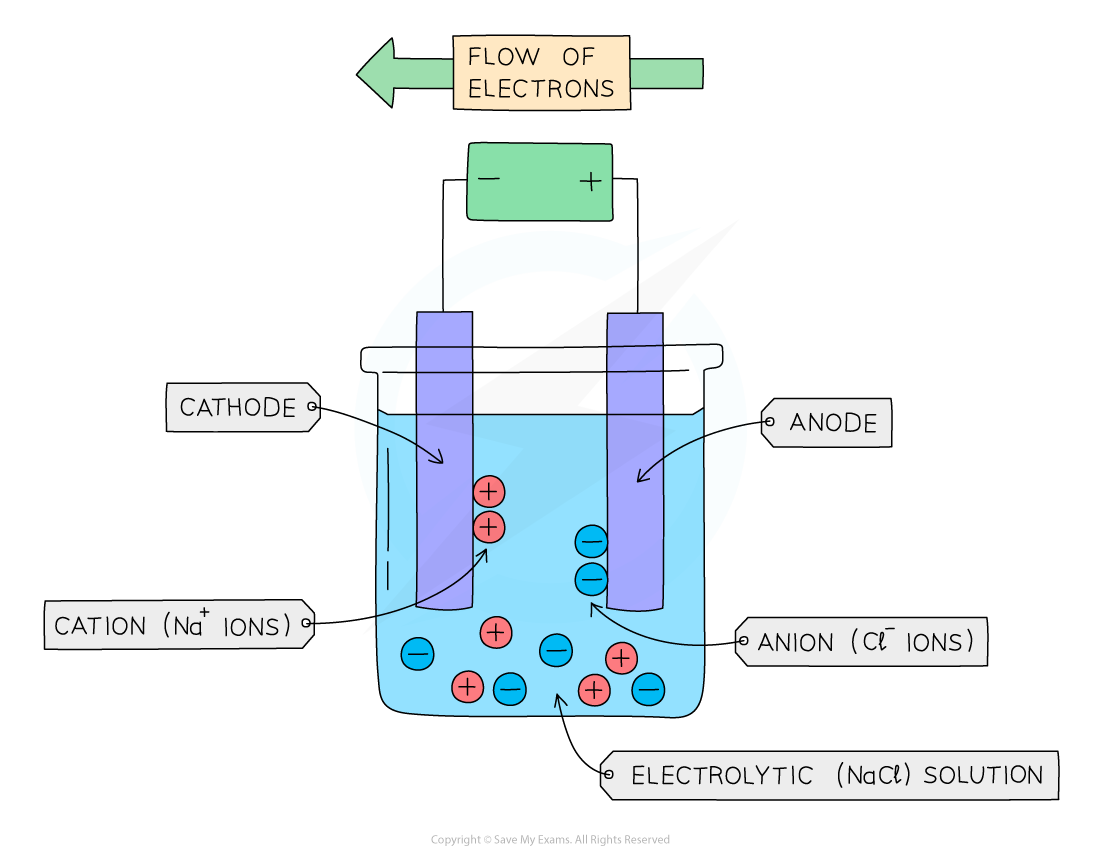
Diagram showing the direction of movement of electrons and ions in the electrolysis of NaCl