StudyDeck

Causes and Consequences of International Differences

Exam code: 2281
Written by: Ashika|Reviewed by: Caroline Carroll|Updated 2 July 2026

Key international differences

Key international differences

  • Economic development is the sustainable increase in living standards for a country, typically characterised by increases in life span, education levels, and income

  • Countries are all at different points of development and economists distinguish between them using different criteria

    • E.g., HDI has five categories of development based on the HDI score

      • Low human development (<0.550)

      • Medium human development (0.550–0.699)

      • High human development (0.700–0.799)

      • Very high human development (>0.800) 

Causes of differences in development

  • There are numerous reasons for these differences
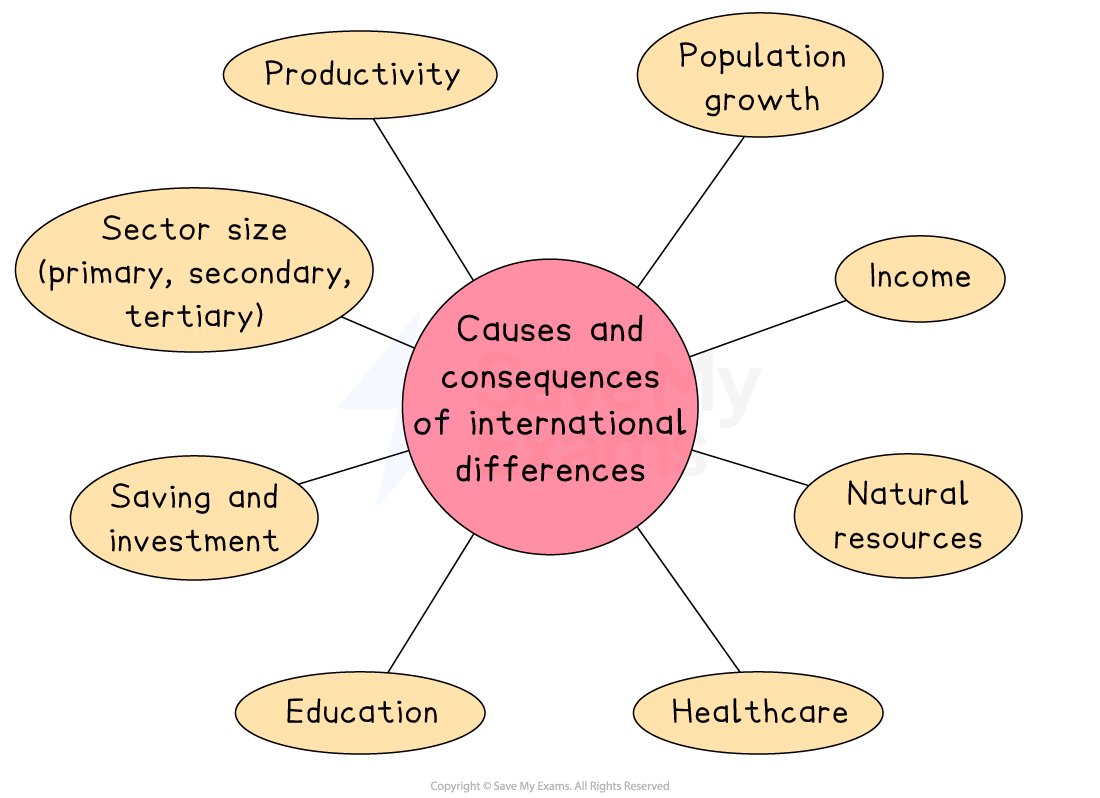
Diagram showing causes and consequences of international differences, including productivity, population growth, income, sector size, and healthcare.

Factor

Explanation

Differences in income

  • Countries with a higher GDP per head tend to be more developed

  • Even with high GDP per head, there may be significant inequality in the distribution of income, resulting in poor living standards for many  

Differences in productivity

  • Differences in skills result in difference in productivity

  • Higher levels of productivity are rewarded with higher wages, which leads to a better standard of living

Differences in population growth

  • More densely populated countries or cities face more challenges

  • A larger population can mean higher tax revenues for the government but at the same time, government expenditure on services is spread across more people

  • Poorer economies are characterised by less government spending per head

Differences in economic sector sizes

  • Economies with a larger proportion of secondary and tertiary activity tend to be more developed due to the wages associated with each sector

  • Primary sector workers are usually paid low wages due to the unskilled nature of the job and the fact that raw materials often generate the lowest profits in the production chain

  • Secondary sector workers add value to the raw materials and these products sell for higher profits. Therefore wages tend to be higher than primary sector wages

  • Tertiary sector workers are paid the highest. Their jobs often require highly valued skills that take years to acquire and the products they sell or services they provide can be complex and expensive e.g. artificial intelligence coders

Differences in saving and investment

  • Higher savings result in higher investment and economic growth. It is believed that as economies develop, savings increase

  • Increased savings → increased investment → higher capital stock → higher economic growth → increased savings

  • If the dependency ratio is high it means there is less money available for savings and investment

Differences in education

  • These directly influence the level of skill in an economy

  • Improved skills results in higher productivity and wages

Differences in healthcare

  • The level of health directly impacts productivity of labour

  • Productivity influences output and income

  • Developed economies tend to have healthy workforces

  • The less developed the economy, the more sickness and disease there are

Natural resources

  • Countries with abundant natural resources (such as oil, minerals, fertile land, or water) can use them to produce goods for export, earn income and support economic growth

  • Natural resources can create jobs in primary industries and provide raw materials for the secondary sector