Introduction to Exchange Rates
Foreign Exchange Rates (Forex)
Foreign Exchange Rates (Forex)
An exchange rate is the price of one currency in terms of another e.g. £1 = €1.18
International currencies are essentially products that can be bought and sold on the foreign exchange market (forex)
The Central Bank of a country controls the exchange rate system that is used in determining the value of a nation's currency
Two of the main exchange rate systems are
A floating exchange rate
A fixed exchange rate
1. A floating exchange rate system
Different currencies can be bought and sold, just like any other product
The forces of demand and supply determine the rate at which one currency exchanges for another
As with any market, if there is excess demand for the currency on the forex market, then prices rise (the currency appreciates)
If there is an excess supply of the currency on the forex market, then prices fall (the currency depreciates)
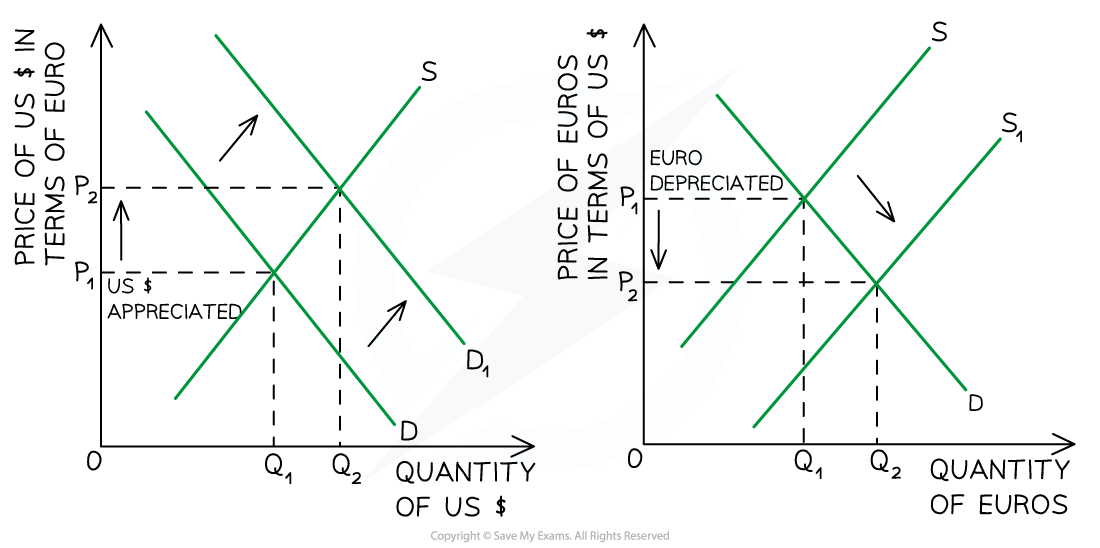
Diagram analysis
The Euro/US$ market is shown by two market diagrams - one for the USD market on the left and one for the Euro market on the right
The initial exchange rate equilibrium is found at P1Q1 in both markets
When Europeans visit the USA, they demand US$ and supply Euros
The increased demand for the US$ shifts the demand curve to the right which results in the value of the $ appreciating from P1 → P2 in the USD market and a new market equilibrium forms at P2Q2
The increased supply of the Euro shifts the supply curve to the right which results in the value of the Euro depreciating from P1 → P2 and a new market equilibrium forms at P2Q2
2. A fixed exchange rate system
A system in which the country’s Central Bank intervenes in the currency market to fix (peg) the exchange rate in relation to another currency e.g US$
When they want their currency to appreciate, they buy it on forex markets using their foreign reserves, thus increasing its demand
When they want their currency to depreciate, they sell it on forex markets, thus increasing its supply
Sometimes the peg is at parity e.g. 1 Brunei Dollar = 1 Singapore Dollar
Often the peg is not at parity e.g. Hong Kong has pegged its currency to the US$ at a rate of HK$ 7.75 = US$ 1
A revaluation occurs if the Central Bank decides to change the peg and increase the strength of its currency
A devaluation occurs if the Central Bank decides to change the peg and decrease the strength of its currency
Evaluating Exchange Rate Systems
Evaluating Exchange Rate Systems
Each exchange rate system has advantages and disadvantages attached
An Evaluation of a Floating Exchange Rate Mechanism
Advantages | Disadvantages |
|---|---|
|
|
|
|
|
|
|
|
An Evaluation of a Fixed Exchange Rate Mechanism
Advantages | Disadvantages |
|---|---|
|
|
|
|