Floating Exchange Rates
Key exchange rate definitions
Key exchange rate definitions
A floating exchange rate is one that is determined by the forces of demand and supply in the foreign exchange market, without direct government or central bank control
Appreciation occurs when the value of a currency rises compared to another currency in a floating system (e.g. £1 = $1.25 → £1 = $1.35)
A depreciation occurs when the value of a currency falls compared to another currency in a floating system (e.g. £1 = $1.25 → £1 = $1.10)
Determination of the foreign exchange rate
Determination of the foreign exchange rate
Different currencies can be bought and sold, just like any other product
The equilibrium exchange rate is where the quantity of a currency demanded equals the quantity supplied
At this rate, the market is in balance — there is no shortage or surplus of the currency
If demand increases or supply decreases, the currency appreciates
If demand decreases or supply increases, the currency depreciates
Demand for a currency comes from:
Foreigners buying the country’s exports
Tourists visiting the country
Foreign investors buying assets, shares or property
Speculators who expect the currency to appreciate
The supply of a currency increases when:
Citizens import more foreign goods and services
Tourists travel abroad and need foreign currency
Investors send money abroad
Speculators sell the currency expecting it to fall in value
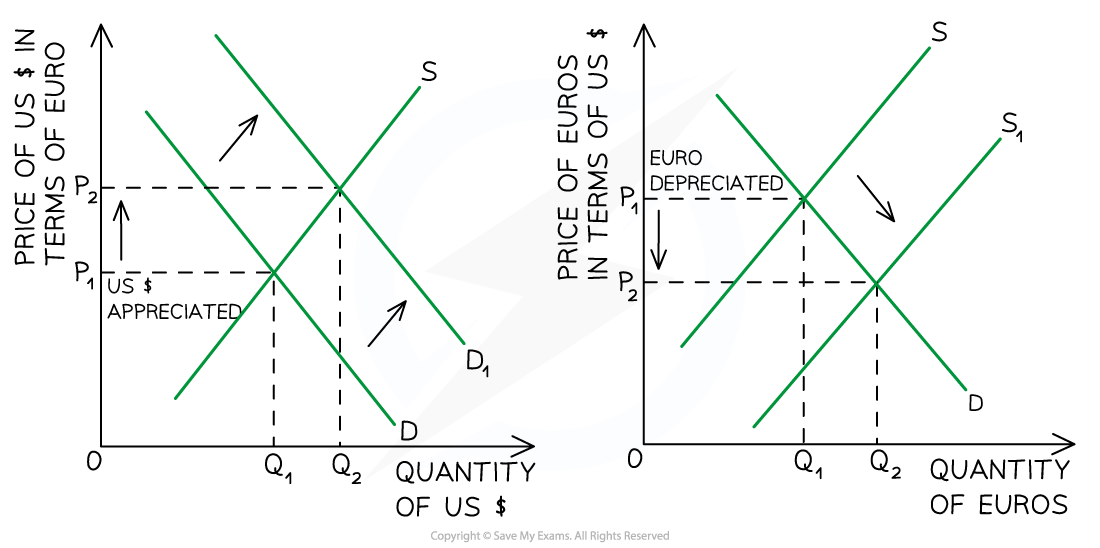
Diagram analysis
The Euro/US$ market is shown by two market diagrams - one for the USD market on the left and one for the Euro market on the right
The initial exchange rate equilibrium is found at P1Q1 in both markets
When Europeans visit the USA, they demand US$ and supply Euros
The increased demand for the US$ shifts the demand curve to the right, which results in the value of the $ appreciating from P1 → P2 in the USD market and a new market equilibrium forms at P2Q2
The increased supply of the Euro shifts the supply curve to the right which results in the value of the Euro depreciating from P1 → P2 and a new market equilibrium forms at P2Q2
Causes of foreign exchange rate fluctuations
Causes of foreign exchange rate fluctuations
Several factors cause exchange rates to change. Three of the most common include:
Cause | Explanation |
|---|---|
Changes in demand for exports and imports |
|
Changes in interest rates |
|
Speculation |
|