Classification of different industries
Specification link
This page covers section 9.1.1 of the CIE O Level specification.
9.1.1 - Classification of different industries: primary, secondary, tertiary and quaternary.
Introduction: Employment sectors
Introduction: Employment sectors
A country's economy is the system by which resources, goods, land and labour are arranged
All countries face constant challenges to the development, growth and stability of their economies
A country's political system and type of economy will affect the path that a country follows to grow its industries and labour markets
The country's economy directly affects life within that country by:
Influencing what jobs people can have
The food people can afford to buy
The homes people can live in
The way a country's workforce is divided up between the sectors is called a country's employment structure
Employment is divided into 4 sectors, with each representing different types of industries
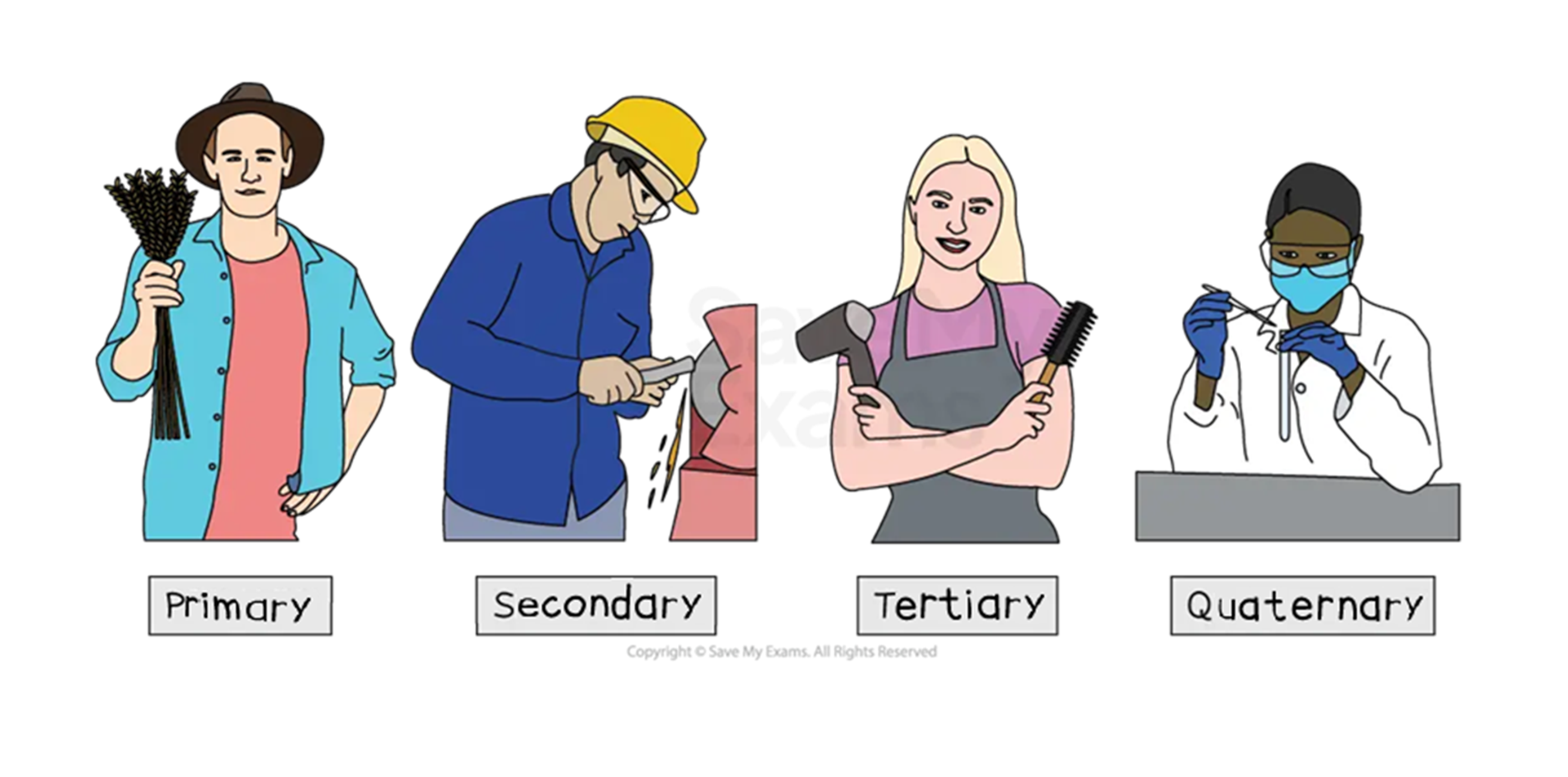
The four sectors of industry
Primary industry
Primary industry
The primary sector is concerned with the extraction of raw materials from land, sea or air
Examples include farming, mining, forestry and fishing
Low income countries (LICs) are primarily focused on the primary sector, with most people employed in agriculture and the production of food
Over the past 20 years, employment in primary sector industries has been declining globally
It is in the least developed nations where the majority of the workforce is employed in the primary sector
This is partly due to fewer students attending school and a lack of infrastructure to support manufacturing or service provision
There are still important primary sectors in some high-income countries, like Norway (oil and forestry) and Australia (wine production).
Secondary industry
Secondary industry
The secondary sector is concerned with the processing of raw materials and components
Examples include oil refinement and the manufacture of goods such as vehicles
In middle-income countries (MICs), better technology means fewer workers are needed in farming, and more people can work in factories
Over the last few decades the number of workers employed in manufacturing has risen
Many high-income country (HIC) businesses have relocated their production facilities to take advantage of the lower average wage rates in these economies
Tertiary industry
Tertiary industry
The tertiary sector is concerned with the provision of a wide range services for consumers and other businesses, such as leisure, banking or hospitality
It includes a sub-sector called the quaternary sector, which is concerned with the provision of knowledge-focused services related to IT technology, consultancy or research
In the past few years, the tertiary and quaternary sectors have grown in medium income countries
Many businesses are now focusing on providing consumer services
In high income countries, the proportion of the workforce employed in the service sector is high and this is increasing the focus on the quaternary sector
High-income countries support the expansion of these sectors by using their wealth to finance higher-level training and education
Quaternary industry
Quaternary industry
The quaternary sector, or knowledge economy, builds on the tertiary sector (service sector)
It provides specialised services focused on information- and knowledge-based industries
This sector includes IT, research, consulting, and other intellectual activities
It supports and develops service industries, especially digital and tech services
The quaternary sector relies on specialised knowledge and skills, not physical inputs
Examples include
Computing
Research and development (R&D)
Education
Project management, etc.