Globalisation
Specification link
This page covers section 9.2.1, 9.2.2 and 9.2.3 of the CIE O Level specification.
9.2.1 - What is meant by globalisation?
9.2.2 - The key features of globalisation.
9.2.3 - The impacts of globalisation on trade, transport, culture, communications and technology.
Definition of globalisation
Definition of globalisation
Globalisation is where the world has become more interconnected through the processes of economics, culture, politics, trade and tourism
Globalisation is nothing new; trade between people, businesses and countries has always existed
Whereas trade would have taken weeks, months or even years in the past, modern transport and communications have made trading and interaction almost instantaneous
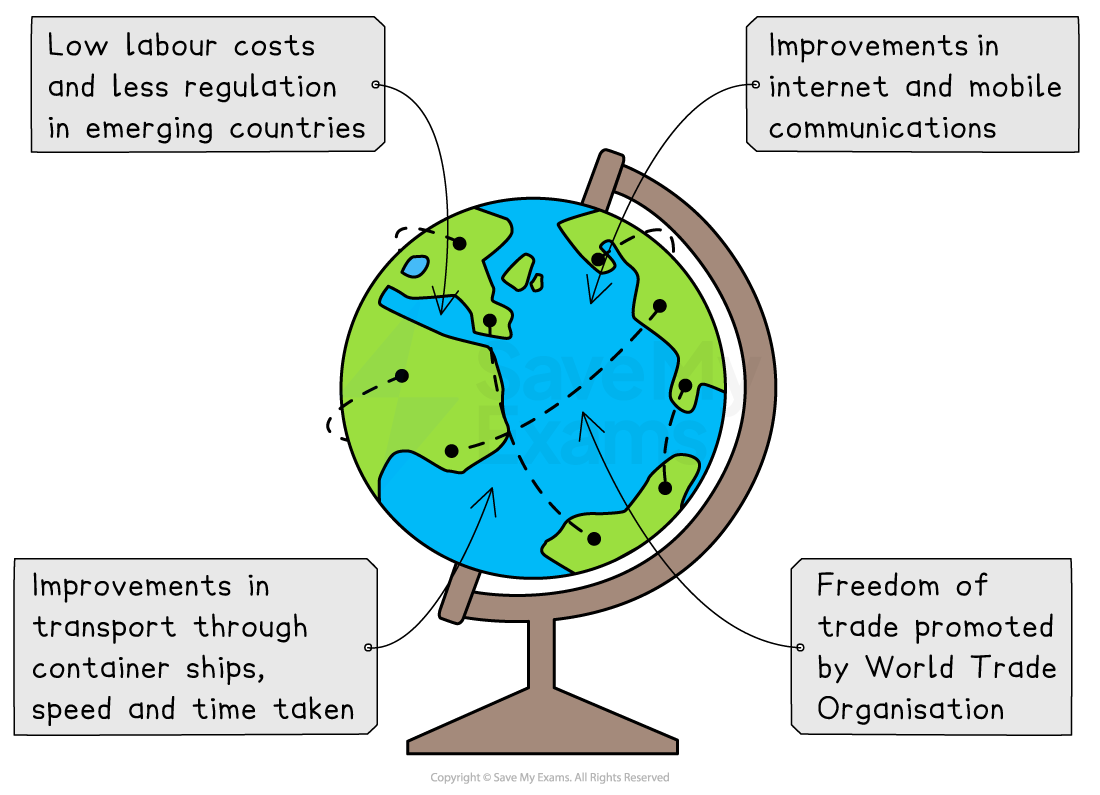
Flows to places and populations are the result of four significant developments:
Appearance of large transnational corporations (TNCs)
Growth of regional economics and trading blocs
Development of modern transport networks
Advances in IT and communications, particularly the WWW and the internet
Key features of globalisation
Key features of globalisation
Globalisation reduces the effect of political borders of countries
It makes them more interdependent
Global cities have developed, which are the focus of the world economy
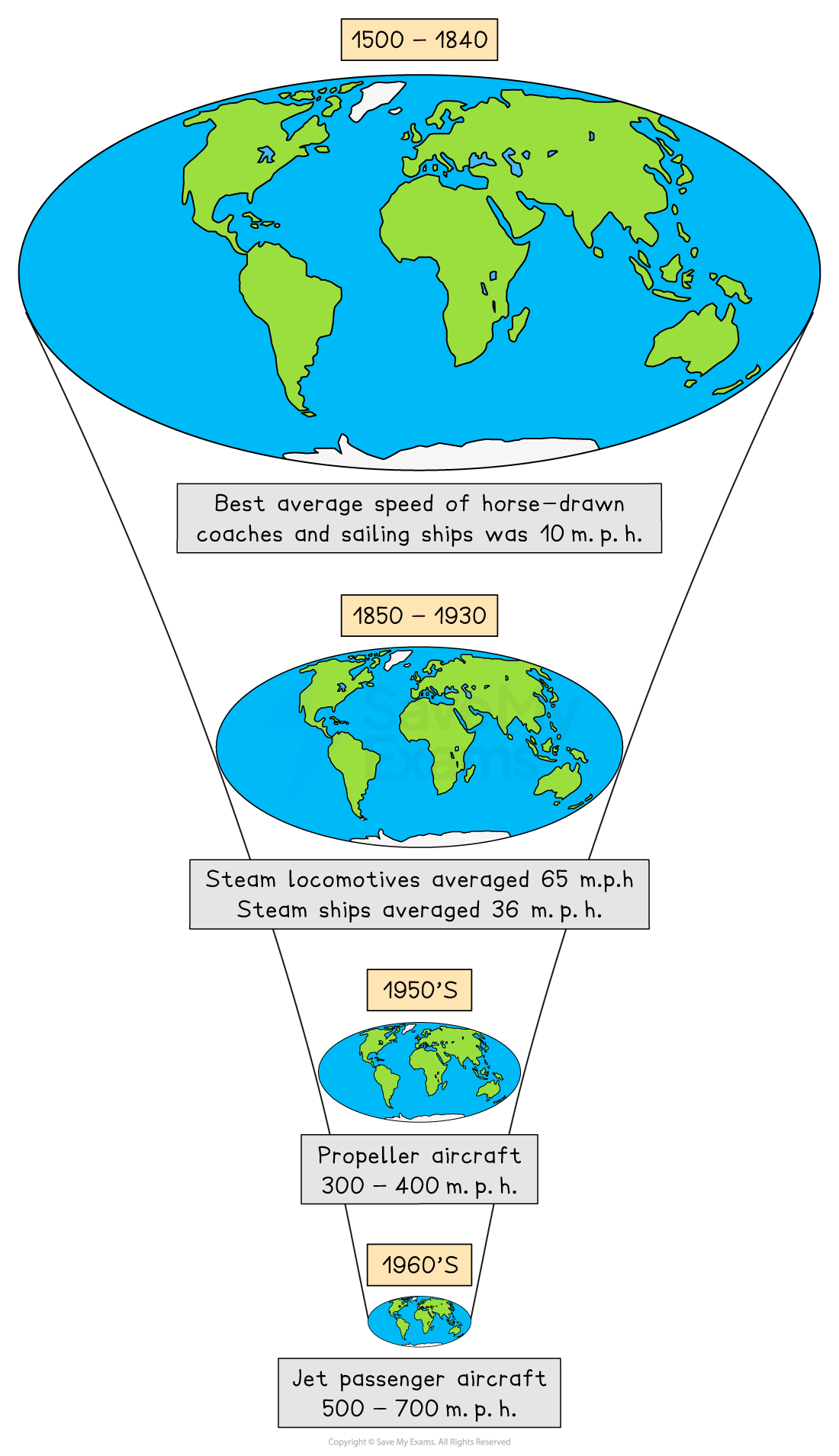
The improvements and developments in communication and transport have made globalisation what it is today—a shrinking world
Overall, connections around the globe are:
Faster – faster speeds for talking, travel, money exchange, etc.
Deeper – connecting lives with faraway places
Longer – connecting links between places are further apart
Impacts of globalisation
Impacts of globalisation
Globalisation has a wide variety of impacts, both positive and negative
Communications
Mobile phones and the internet have transformed global communication
As of 2024, more than 60% of the world's population has access to the internet
Instant communication lets businesses work on different continents
Rapid communication allows businesses to hire skilled workers from around the world, which leads to more business innovation
Faster communication has also made it easier for people to get news from around the world
This makes it easier to respond to disasters and brings attention to global problems like climate change
Culture
Today's world features international institutions with hundreds of member nations, such as the Olympic Games
More people speak English as a second language
Globalisation makes it easier for people from different cultures to share arts, sports, languages, and other things
Businesses operate in different regions, taking into account the cultures of their consumers and employees
People from different cultures can share their thoughts and improve global understanding when they interact with each other
However, some people see globalisation as a threat to local cultures because Western practices often replace traditional ones, which can damage cultural diversity
Trade
Globalisation has opened up new markets, which has helped trade and business grow
In the 1800s, advances in technology made transportation cheaper, which led to more foreign trade
The end of the World War II in 1945 saw global trade rebound
To help keep up the benefits of a connected world economy, the International Monetary Fund (IMF) and the World Bank were set up to encourage economic growth and cooperation
Today, more than half of the world's total economic output comes from goods that are exported and imported across foreign borders
Transport
By making global travel faster and cheaper, trains, steamships, and jet planes allowed more people to experience different cultures and countries in the 19th and 20th centuries
The 'shrinking world' connects markets on a scale never seen before, boosting trade
The expanding number of global goods requires complex logistical infrastructure
Modern international trade requires a complicated supply chain
Every nation's roads and trains must connect to the global airport and shipyard network
As economies grow, more goods and services are created and sold, and transport networks need more energy, increasing carbon emissions
Shipping and haulage emit 60% of world emissions
Businesses must invest more in ethical supply chains and sustainable transportation to meet legal requirements and environmentally conscientious customers
Technology
Technological innovations like steamships and the internet have fuelled globalisation, which in turn drives more technological advancement
Our growing reliance on global connectivity makes communication essential for economic activity
Infrastructure like satellites and fibre optic cables have further improved communication
These technological advances can enhance growth and improve quality of life worldwide
For instance, governments, private companies, and multilateral organisations collaborated to produce effective vaccines for COVID-19
However, manufacturing processes and the use of fossil fuels for energy contribute to air and water pollution, impacting human health and ecosystems
GPS and weather monitoring are made possible by the increasing number of satellites in low earth orbit.
E-waste contains toxic materials that can leach into the soil and water because technology becomes quickly outdated and electronic devices are improperly discarded
Satellite construction and launch have a large carbon footprint, and low-earth-orbit satellites pollute the night sky and harm wildlife