Growth of tourism as an industry
Specification link
This page covers sections 9.3.1 and 9.3.2 of the CIE O Level specification.
9.3.1 - The factors that have led to the growth of tourism as an industry.
9.3.2 - The Butler model and its strengths and limitations.
Factors leading to the growth of tourism
Factors leading to the growth of tourism
Tourism is one aspect of globalisation
It is defined as time spent away from the home environment for leisure, business or professional reasons
Over the last 50 years, mass tourism has expanded into a major global industry
In 2024, the global tourism industry contributed $10.9 trillion to the global economy, accounting for 10% of global GDP
International visitor spending in 2024 was $1.9 trillion
The tourism sector accounts for 357 million jobs worldwide
Europe remains the region with the greatest number of tourist arrivals, with France being the top destination
Approximately, 53% of inbound tourism is for leisure (holiday); the second reason is for visiting friends and relatives
The main reasons for the increase in tourism are as follows:
Improvements in transport
The development of low-cost airlines, such as easyJet and Ryanair, has led to cheaper and faster air travel
Expansion of high-speed rail networks (e.g. TGV in France, Shinkansen in Japan)
Larger cruise ships make international travel more accessible.
There has been an improvement in road networks and an increase in the ownership of private cars
Economic factors
Increased disposable incomes: typically, both couples work, which boosts the amount of money coming into the home, especially in emerging economies (China, Brazil)
Better pay and leave benefits in many countries: most workers now work less than 40 hours a week and have paid annual leave
Globalisation has expanded middle-class populations, creating new tourist markets
Technological developments
Online booking platforms such as Booking.com and Airbnb have experienced significant growth
Instant access to information via smartphones and the internet
Technology lets tourists share their experiences and influence others (social media effect)
Social and cultural change
More people are becoming aware of and interested in different cultures and environments
People now value experiences more than material goods
Specialist tourism is growing, including eco-tourism, adventure tourism, and medical tourism
Political factors
There are more open borders and fewer visa restrictions in many regions
Political stability in many regions has created new travel destinations
International agreements make travel easier, like the Schengen Area in Europe
Marketing and media
National tourist boards launch global marketing campaigns
Popular culture, like films and television, often highlight specific locations, such as New Zealand in 'The Lord of the Rings'
Demographic factors
The population is ageing and has the means and leisure to travel, a trend known as 'grey tourism'
Young travellers taking gap years and backpacking
There is an increasing trend of family mobility and multi-generational travel
Environmental factors
More people are showing interest in natural landscapes and wildlife tourism
Awareness of sustainable travel options
Physical landscapes such as:
Tropical islands with beaches, warm waters, coral reefs, palm trees, etc.
Mountains for hiking, walking and climbing
Coastal bays, headlands and cliffs, etc.
What is the Butler model?
What is the Butler model?
Richard W. Butler proposed the Butler Model in 1980 to describe the life cycle of tourist resorts
It shows us how tourism changes over time and how destinations can handle their growth
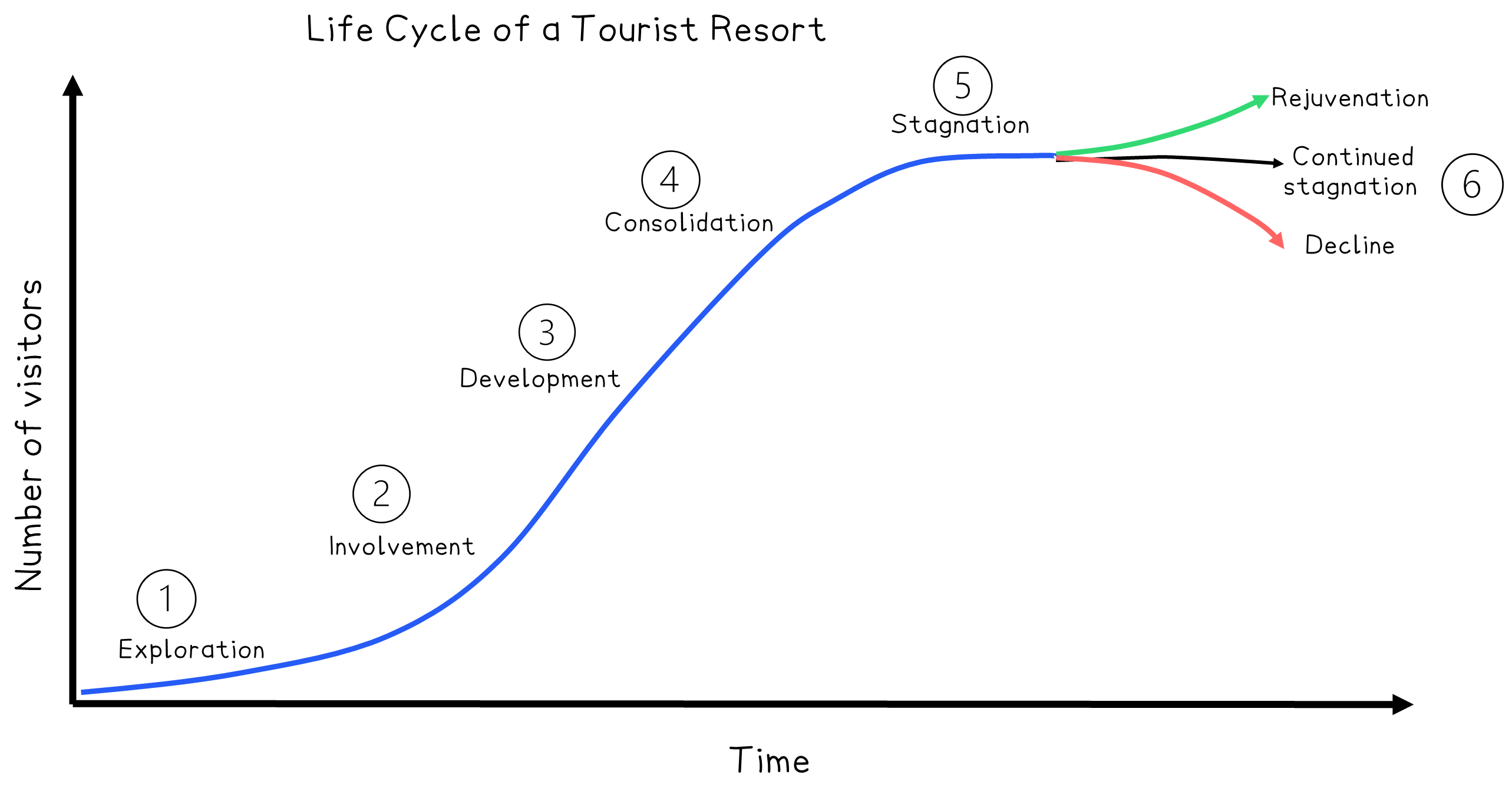
Stages of the model
1. Exploration
Small numbers of adventurous tourists discover a location
There are limited tourist facilities, and the impact is minimal
2. Involvement
Local people offer basic services like homestays and guiding
Interest is growing through word of mouth
3. Development
Larger companies invest in the area
Significant tourism infrastructure develops (hotels, transport)
The number of tourists increases rapidly
4. Consolidation
Tourism becomes the dominant economic activity
The destination gains a strong reputation; however, negative impacts such as pollution and congestion begin to emerge
5. Stagnation
Visitor numbers peak
The environment and local culture may suffer
The resort loses appeal due to overcrowding and loss of authenticity
6. Rejuvenation, continued stagnation or decline
Rejuvenation: The destination reinvents itself by promoting eco-tourism and heritage tourism, attracting new markets
Continued stagnation: The destination invests the minimum amount in infrastructure and services and fails to adapt to changing preferences
Decline: Tourists go elsewhere, businesses close and the area deteriorates
Strengths and limitations of the Butler model
Strengths and limitations of the Butler model
Strengths of the Butler Model
The Butler Model offers a clear visual representation of how tourism evolves.
The Butler Model helps with planning and management by encouraging proactive rejuvenation.
The Butler Model is flexible, as it can be applied to a wide range of destinations
Limitations of the Butler Model
This model is simple — real-world development rarely follows clear stages
It does not consider global shocks like pandemics and terrorism that can suddenly change trends
All destinations eventually decline or rejuvenate, but some remain stagnant or stay stable for long periods
External factors such as climate change, political change, and economic crises are not well represented
Using the Butler Model to promote sustainable tourism
This approach allows planners to spot stagnation and put sustainable strategies in place early
Control the number of visitors (the carrying capacity)
Develop sustainable transport and lodging options
Help local communities so that tourism benefits everyone
Protect natural and cultural heritage
Recognises the need for constant innovation to prevent stagnation and decline
Is the model still relevant today?
Yes, but there are some conditions
New forms of tourism, such as digital nomadism and remote eco-tourism, make tourist life cycles more complex
The model offers valuable insights for long-term planning, particularly in cities facing overtourism, such as Venice and Barcelona
In the digital age, tourist destinations can quickly rise and fall, with stages compressing or repeating unpredictably
Sustainability is now more important than when the model was first introduced