Threats to the tropical rainforest
Specification link
This page covers section 3.4.1 , 3.4.2 and 3.4.3 of the CIE O Level specification .
3.4.1 - The threats to tropical rainforest ecosystems, for example, deforestation, resource exploitation, logging, road and railway building, cattle ranching, hydroelectric power, farming, settlements.
3.4.2 - The impacts of the destruction and deforestation of tropical rainforest ecosystems.
3.4.3 - An evaluation of the strategies and techniques used to manage the tropical rainforest ecosystem; including sustainable
The main threats to the tropical rainforest
The main threats to the tropical rainforest
There are six main human causes of deforestation
Wildfires are a natural cause of deforestation:
However, the frequency and severity of wildfires have increased this has been linked to human-induced climate change
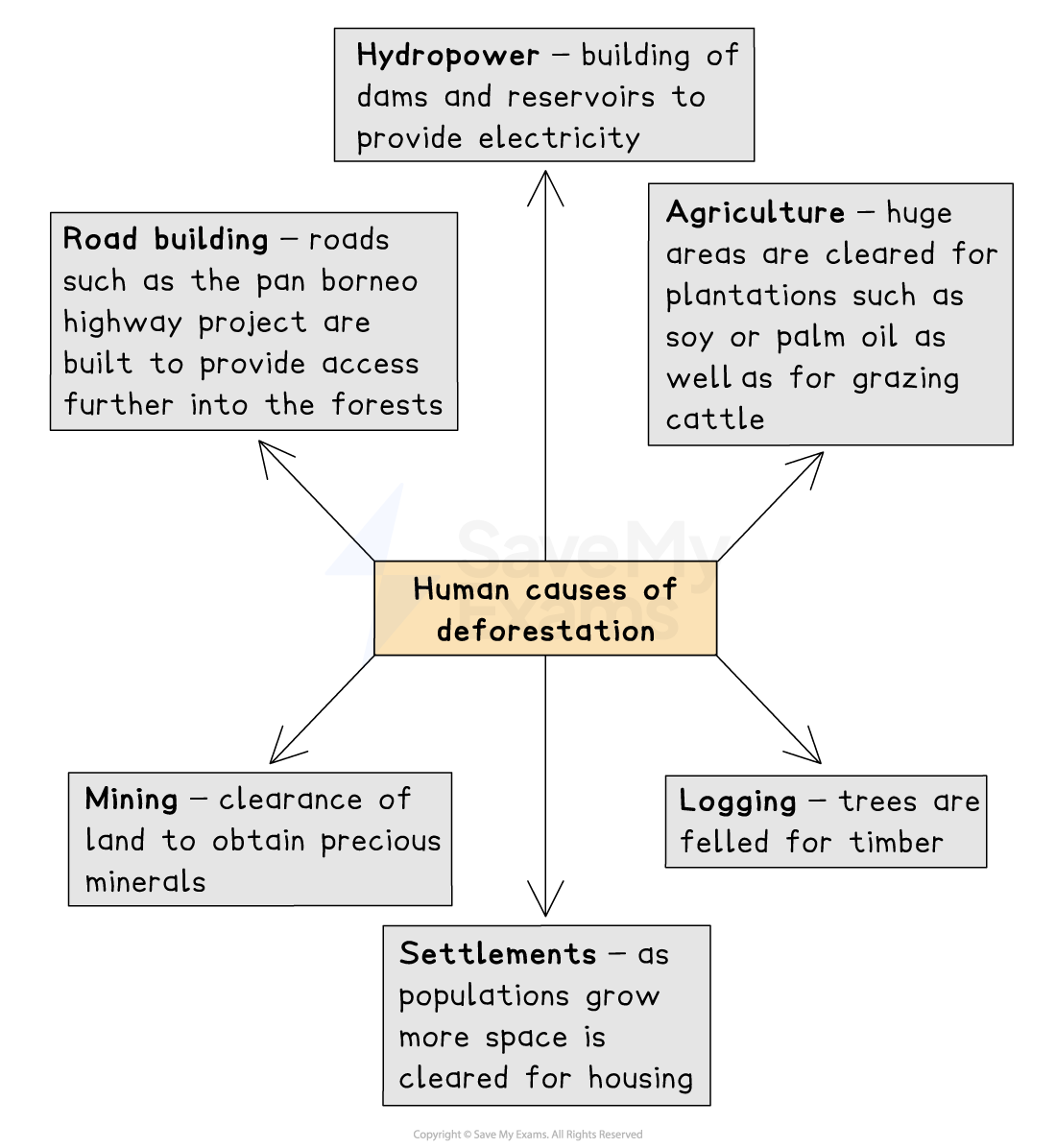
Destruction of the tropical rainforest
Destruction of the tropical rainforest
Environmental impacts of deforestation
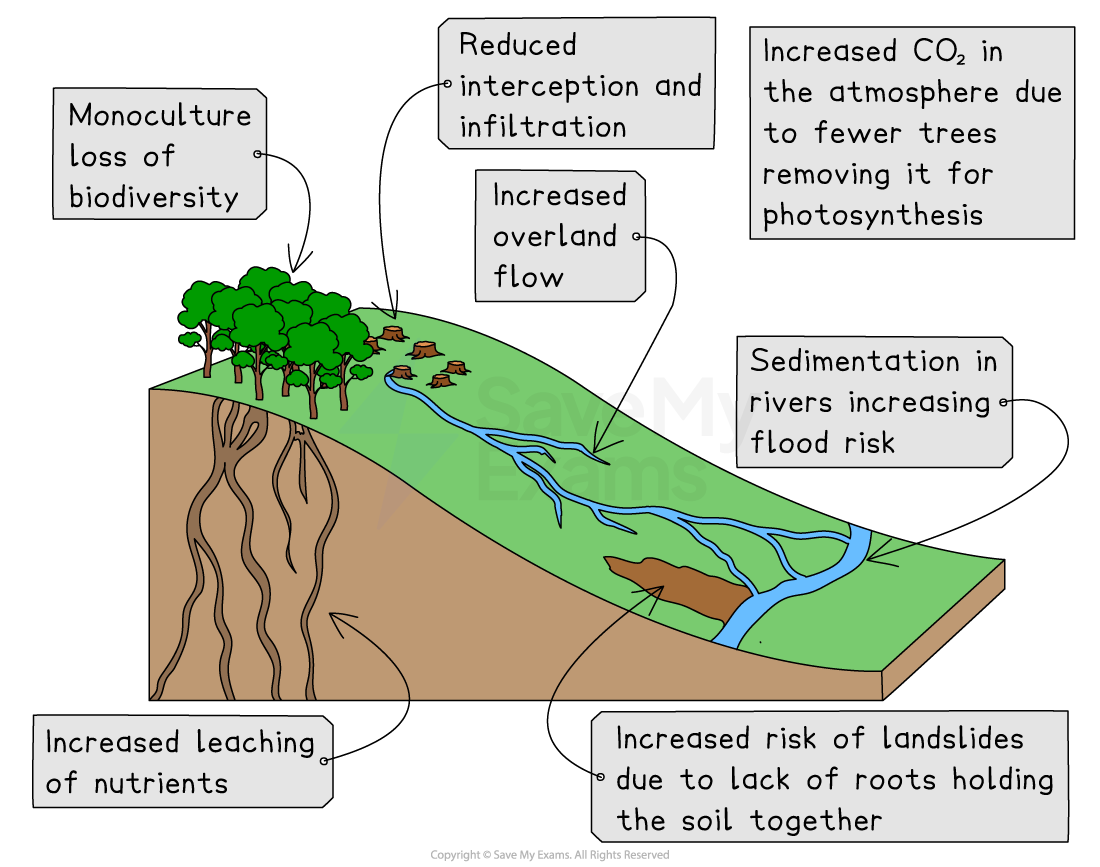
Many of the impacts of deforestation are environmental, including:
Areas that have been deforested are planted with monoculture, which reduces biodiversity
Interception and infiltration decrease which reduces evapotranspiration and as a result precipitation decreases
This also increases overland flow which leads to soil erosion and sedimentation of the rivers
Sediment builds up on riverbeds reducing their capacity and increasing the flood risk
Lack of interception increases the leaching of nutrients
Fewer trees increase the amount of CO₂ in the atmosphere, adding to the enhanced greenhouse effect
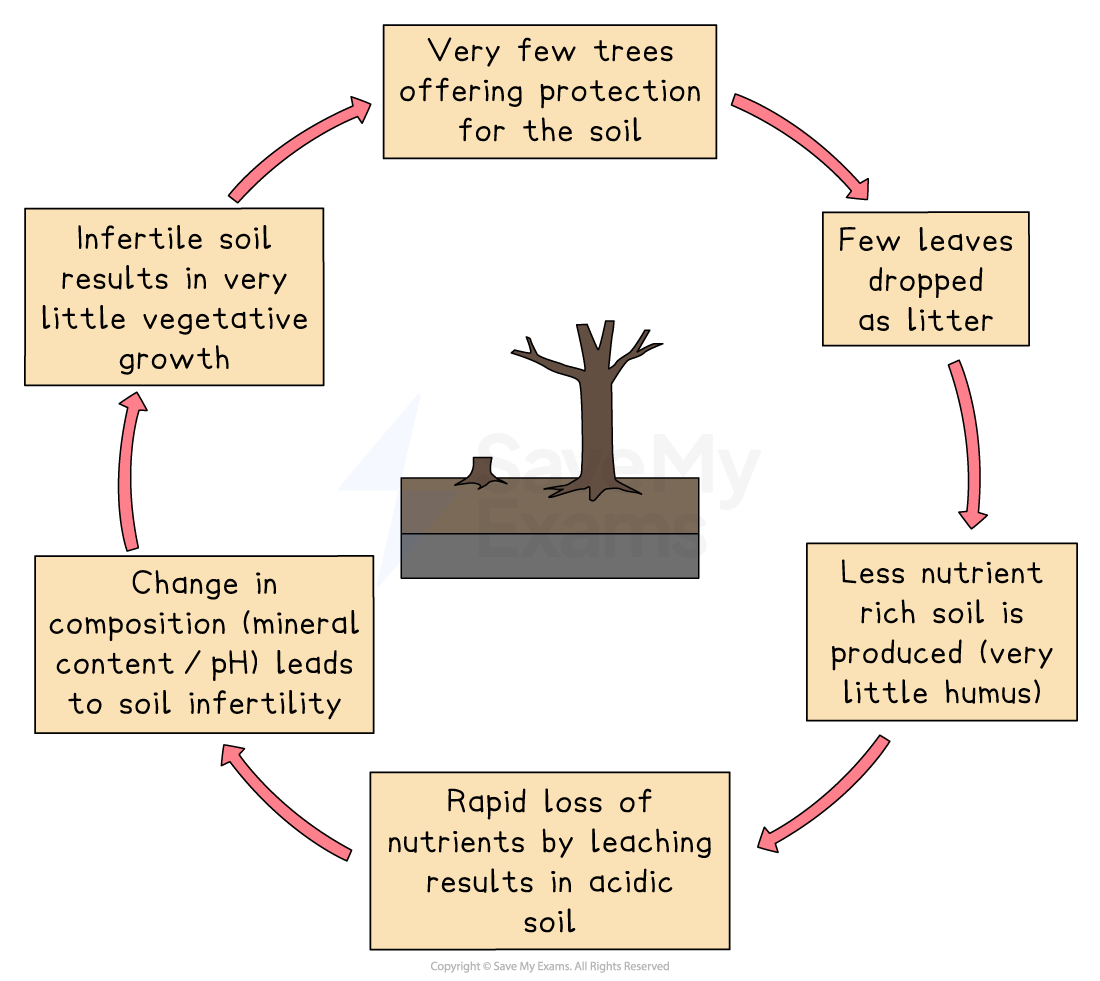
Soils become less fertile and drier
They may turn reddish brown due to increased iron oxide
Impact on the nutrient cycle
The majority of nutrients in the tropical rainforest are held in the biomass
When trees and vegetation are cleared by deforestation, the main store of nutrients is removed
Social impacts of deforestation
Indigenous communities have less land to sustain their traditional way of life. This means:
Land does not get the opportunity to recover
Less food is available
Improved quality of life for some people due to increased income and jobs
Indigenous communities may give up their way of life, leading to a loss of culture and traditions
Increased risk of landslides which can destroy homes and block roads
Loss of potential medicines
Increased risk of flooding settlements
Economic impacts of deforestation
More jobs available in mining, forestry, agriculture and HEP
Increased income for the country through the export of goods from the forest – minerals, timber, crops
Almost a quarter of Brazil's GDP comes from activities in the deforested areas of the Amazon
Managing the tropical rainforest
Managing the tropical rainforest
Concerns about the rapid deforestation of tropical rainforests have led to a range of sustainable management strategies
Strategies can be on an international, national or local level
International strategies
UN Forum on Forests was established in 2000 and is committed to the management, conservation and sustainable development of all types of forests
The UN Sustainable Development Goals include the sustainable management of forests
International treaties protect certain areas such as the Central Amazon Conservation Complex (CACC), which is a World Heritage Site. This means hunting, logging, fishing and access are limited
Trade restrictions on endangered species and timber have been imposed
The Convention on International Trade in Endangered Species of Wild Fauna and Flora (CITES) aims to ensure that international trade in specimens of wild animals and plants does not threaten the survival of the species
The International Tropical Timber Agreement (ITTA) promotes sustainable forest management and restricts the trade in rainforest hardwood timber
The Forest Stewardship Council (FSC) approves wood from sustainable sources
Debt reduction – countries are relieved of some of the debt in return for protecting rainforests
Debt-for-nature swap. In 2010 the USA converted US$13.5 million of debt from Brazil into a fund to support the protection of the rainforest
International organisations such as Greenpeace and WWF monitor deforestation
National strategies
Brazil's Forestry code requires landowners to maintain a proportion of their land as forests. However, the amount they need to maintain was reduced from 80% to 50% in 2012
The DETER satellite was launched in 2004. It:
Started by sending reports every two weeks to rangers
In 2011 began sending daily reports, meaning that patrols could target areas of suspicious activity but it only detects areas over 250 m2 so people clearing simply reduce the size of the area they clear
It was estimated in some areas this led to a 60% decrease in large-scale deforestation
There are 68 national parks in Brazil. These are protected areas where the aim is to conserve the ecosystem
The reforestation project is a part of the Amazonia Sustainable Landscapes Project. It aims to:
Restore 30,000 hectares of land to the forest by 2023, which will involve planting 73 million trees.
The Amazon Region Protected Areas (APRA) resulted in a 68% increase in protected areas and Indigenous territories from 2004 to 2012
Selective logging is where trees to be felled are selected, felled and removed, causing the least possible damage to surrounding trees
This reduces damage to the forest structure and helps to maintain biodiversity
Afforestation to plant new trees replacing those which have been felled
Local strategies
Agroforestry combines agriculture with forestry, which means some trees remain, which:
Decreases deforestation
Provides shade as well as increases infiltration and interception, which reduces soil erosion
Provides organic matter from the trees and adds nutrients to the soil
Increases biodiversity due to the variety of plants grown
Education of people involved in the exploitation and management of the rainforest
There are small-scale projects like the Marajo Project, which preserves almost 90,000 hectares of Amazon forest. It includes:
A tree nursery to grow saplings to be planted in areas which have been cleared
The new trees help to bind the soil, reducing soil erosion and increasing infiltration
Agroforestry is encouraged, reducing the need to over-cultivate and clear areas. It includes:
A cooperative to support 49 local producers growing açai berries
Building of natural fish tanks to improve food security
School-based agricultural education and scholarships
Ecotourism is becoming widespread. It includes:
A focus on the natural environment
Low impact on the environment – using materials from the local area and buildings to blend in with the environment
Supporting local communities – using locally grown food and employing local people
Education – to inform tourists about the local environment and wildlife
Gaining income which can be used for conservation
Ecotourism rewards the local community for maintaining the rainforest rather than for cutting it down