Processes and Features of Earthquakes & Volcanoes
Specification link
This page covers section 4.2.1, 4.2.2 ,4.2.3 , 4.2.4, 4.2.5 and 4.2.6 of the CIE O Level specification .
4.2.1 - The processes experienced at each type of plate boundary which cause earthquakes and volcanic eruptions.
4.2.2 - The main characteristics of earthquakes: focus, epicentre, seismic waves.
4.2.3 - Types of volcano: strato-volcano (composite cone), shield, cinder cone.
4.2.4 - The classification of volcanoes as active, dormant, or extinct.
4.2.5 - The main features of volcanoes: crater, vent, magma, magma chamber, secondary cone.
4.2.6 - Volcanic hazards: lava flows, ash falls, lahars, pyroclastic flows, tephra, volcanic rocks, toxic gases; the significance of speed, size, frequency, and spread.
Plate boundary processes
Plate boundary processes
Different processes happen at each type of plate boundary
These processes can lead to earthquakes and the formation of volcanoes
As the plates move, earthquakes can occur at any of the boundaries
Volcanoes only form at constructive (divergent) and destructive (convergent) boundaries
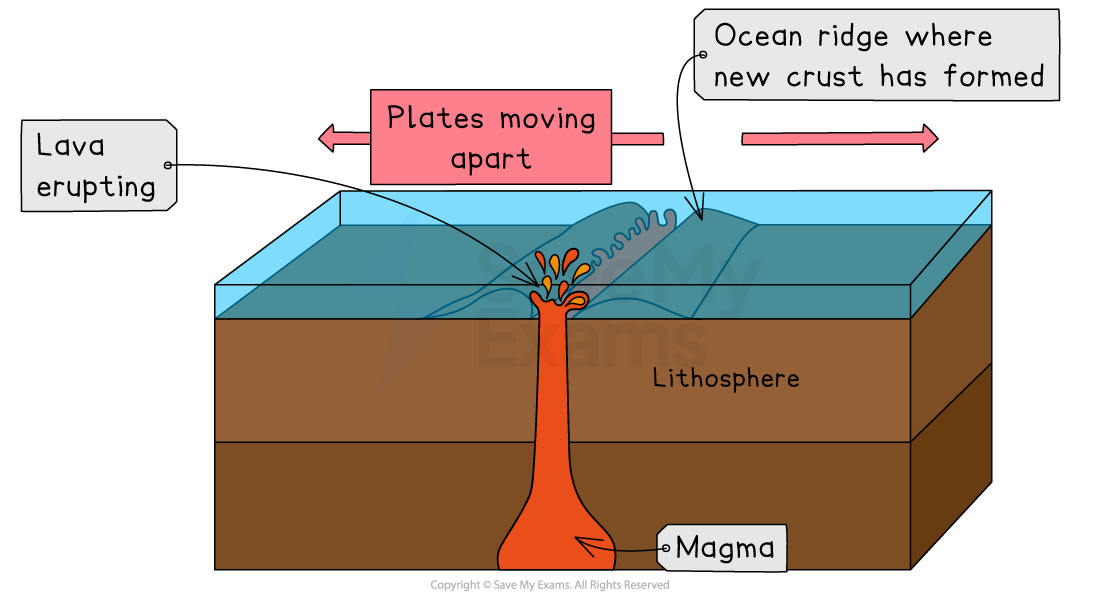
Constructive (divergent) plate boundary
At the constructive (divergent) boundary, the plates are moving apart
As they move apart, magma rises to fill the gap
This leads to the formation of volcanoes and eruptions
The Mid-Atlantic Ridge is an example of a constructive plate boundary
Both volcanic eruptions and earthquakes can occur at this type of plate boundary
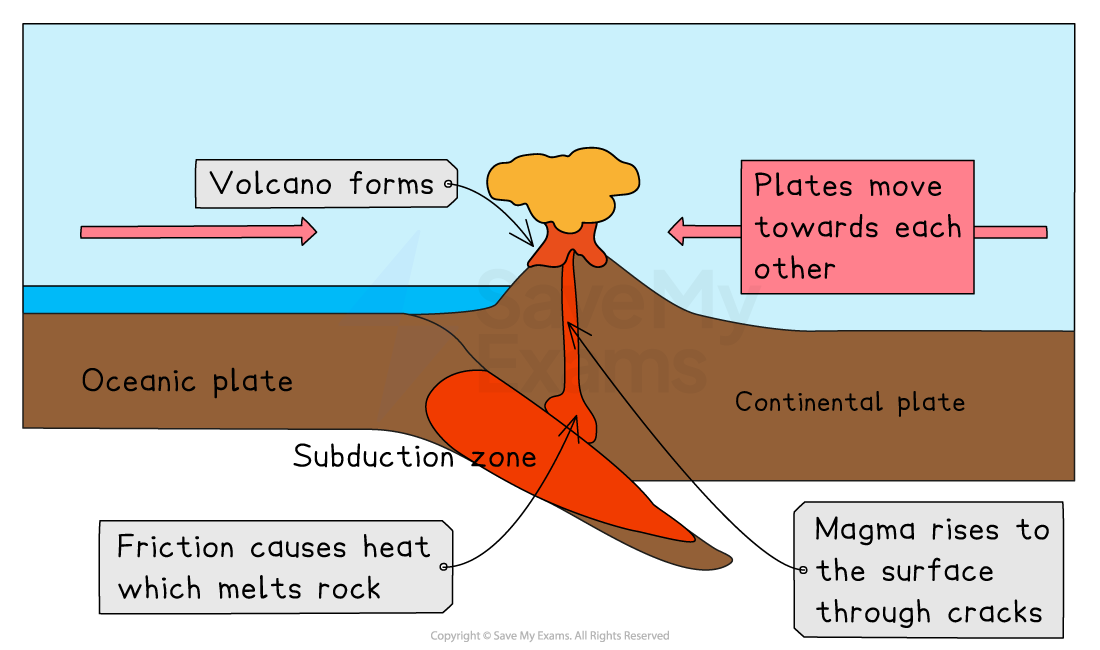
Destructive (convergent) plate boundary
At a destructive (convergent) plate boundary, the plates are moving together
The denser, heavier oceanic plate subducts under the lighter, less dense continental plate
This leads to friction and heat, which melts the crust and forms magma
Magma rises to the surface through cracks in the crust
It erupts on the surface as lava and forms a volcano
The boundary between the Nazca plate and the South American plate is an example
Both volcanic eruptions and earthquakes occur at this type of plate boundary
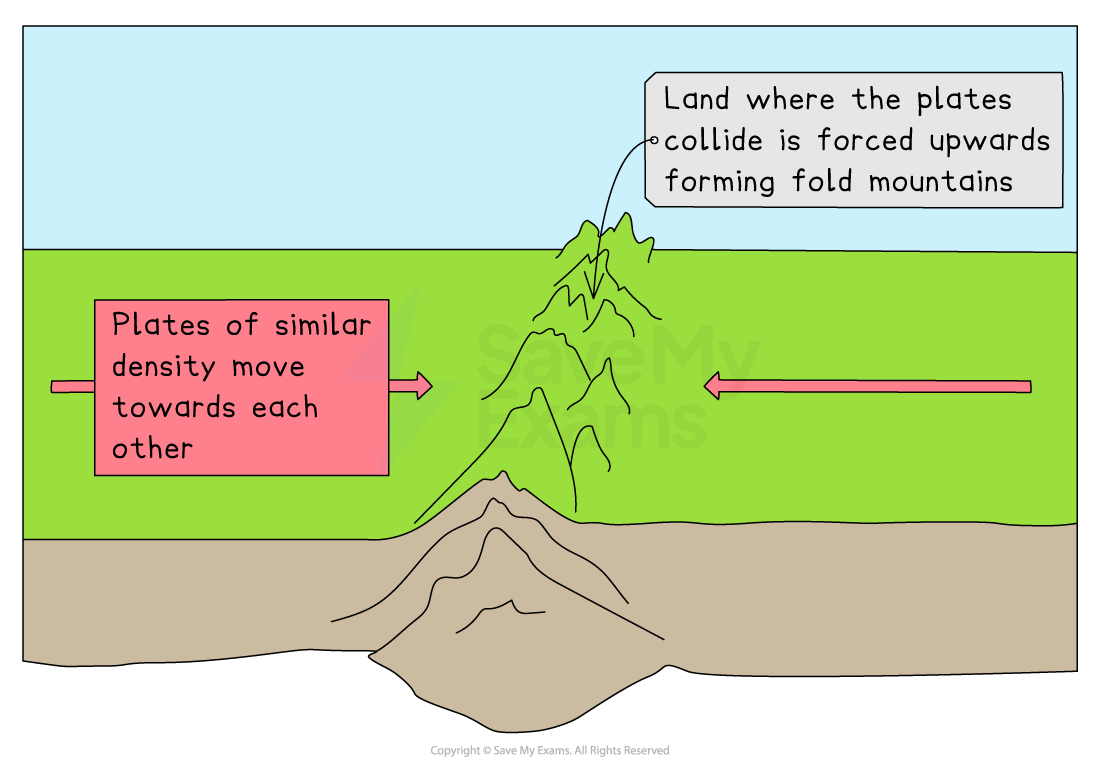
Collision boundary
At a collision boundary, two continental plates of similar density move towards each other
Neither is dense enough to subduct, so the land is pushed upwards
This process forms fold mountains such as the Himalayas
Earthquakes are the main hazard at this type of plate boundary
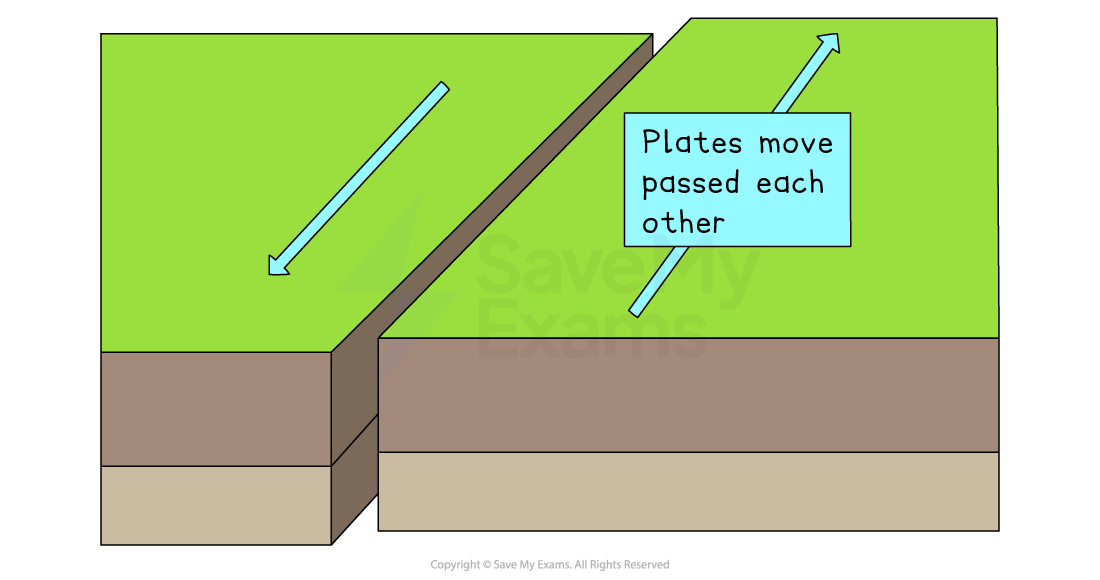
Conservative (transform) boundary
At a conservative (transform) boundary, the plates move past each other in opposite directions or in the same direction at different speeds
Earthquakes are the only hazard at this type of boundary
Earthquake characteristics
Earthquake characteristics
An earthquake is the sudden, violent shaking of the ground
Earthquakes are the result of pressure building when tectonic plates move
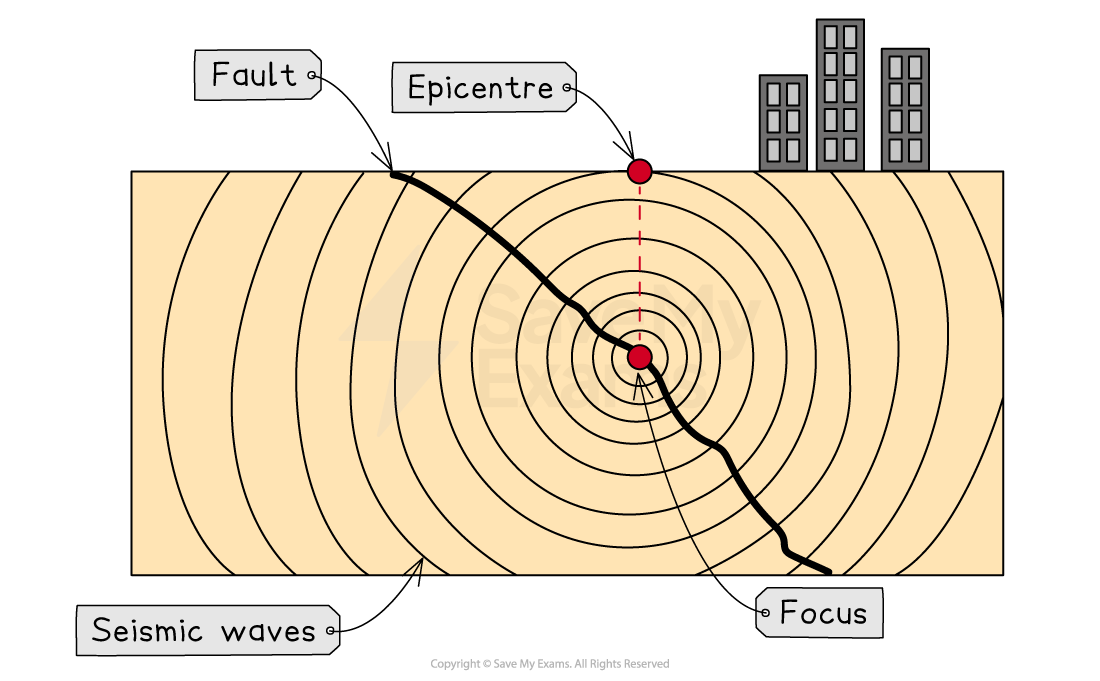
The epicentre is the point on the Earth's surface directly above the focus
The focus is the point at which the earthquake starts below the Earth's surface
The magnitude (amount of energy released) by earthquakes is measured on the Moment Magnitude Scale, which replaced the Richter scale
The damage caused by earthquakes is measured on the Mercalli Scale
Earthquake sequence
The sequence of an earthquake is the same regardless of the boundary at which it happens:
As the tectonic plates move, they can get stuck
Pressure builds as the plates continue to try to move
Eventually, the plates jolt free and the pressure is released as energy
The point at which the earthquake starts is the focus
The epicentre is the point directly above the focus on the earth's surface
The energy passes through the Earth's crust as waves, which is the earthquake
Earthquakes can also happen as a result of human activity, such as drilling into the crust or mining
At a divergent (constructive) plate boundary, earthquakes tend to be weaker as the plates are moving apart
Earthquakes tend to be stronger at convergent (destructive), collision and conservative (transform) plate boundaries
Types and classification of volcano
Types and classification of volcano
Types of volcano
There are three main types of volcanoes:
Composite (strato-volcano)
Shield volcano
Cinder volcano
The type of volcano which forms depends on the type of lava which erupts
Composite (strato-volcano)
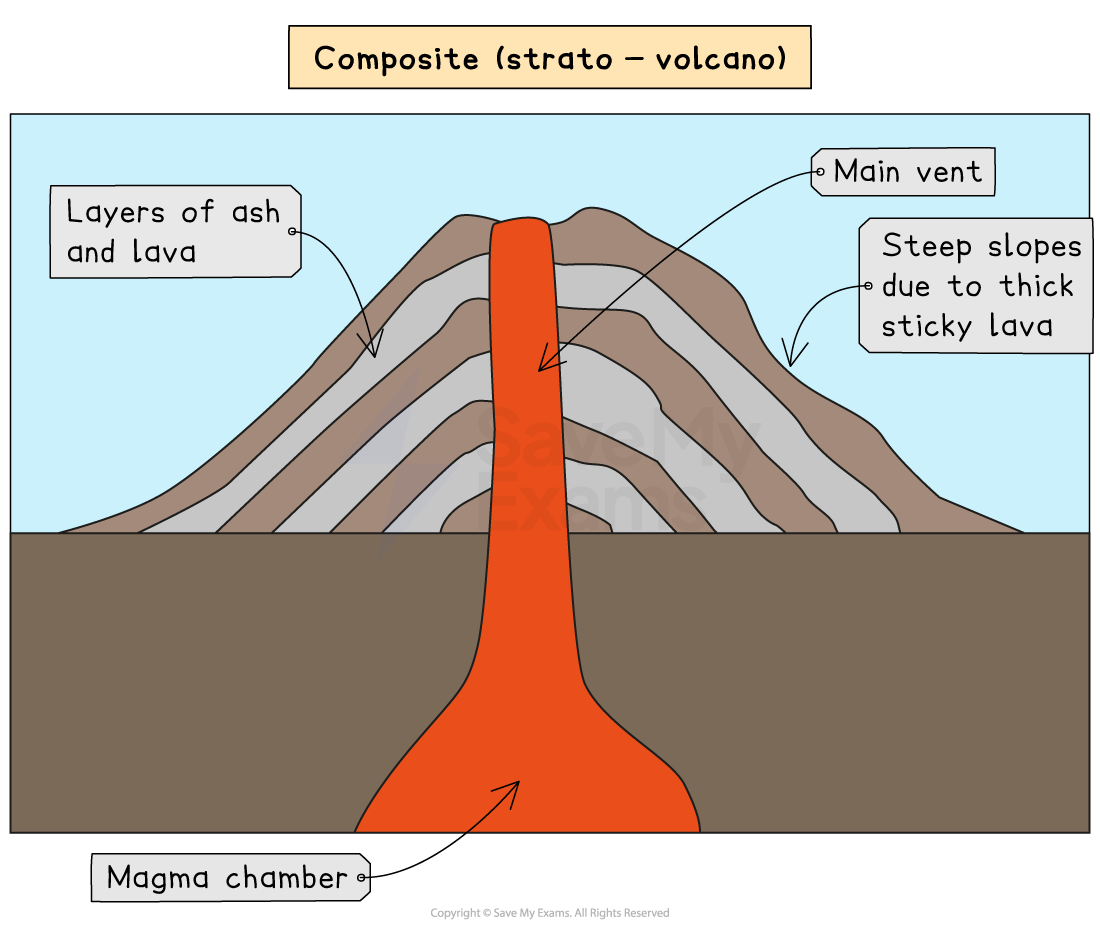
Composite volcanoes, also known as strato-volcano, have:
steep-sides
sticky (viscous) lava
more explosive eruptions
alternating layers of ash and lava
They tend to form on convergent (destructive) plate boundaries
Shield volcanoes
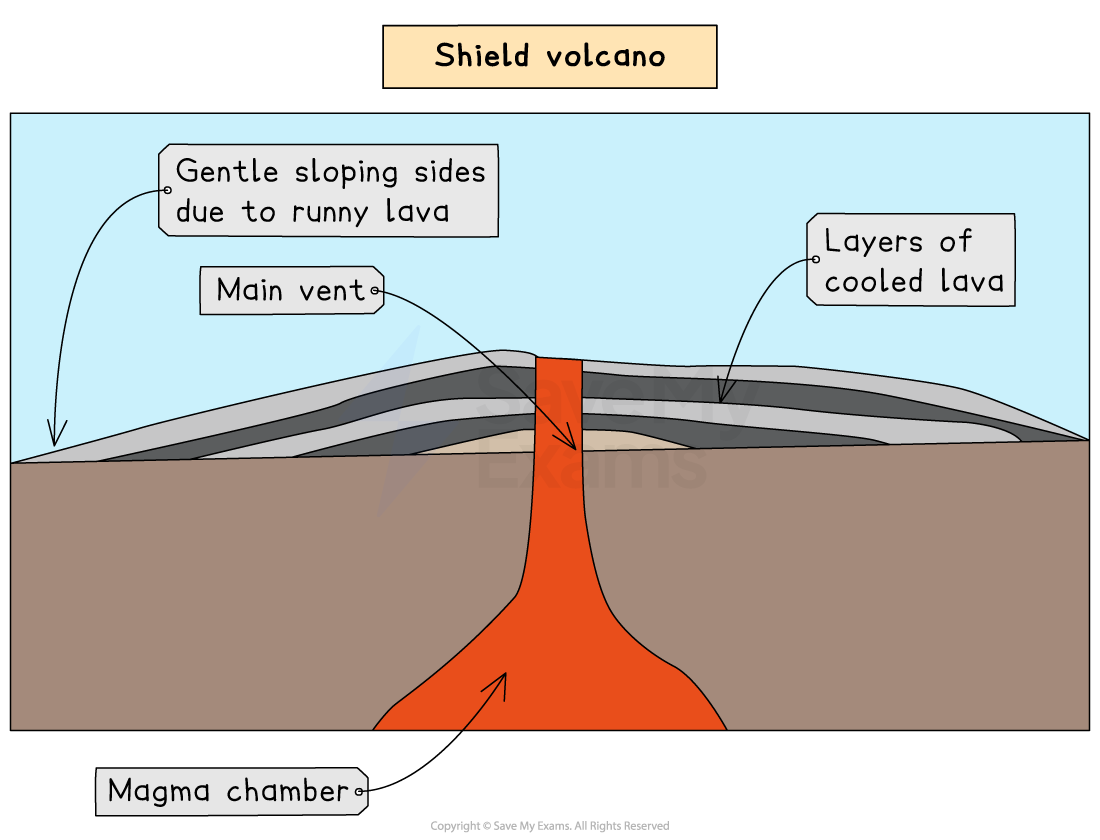
Shield volcanoes have:
gently sloping sides
runny/thin lava
less explosive—gentle eruptions
frequent eruptions
They tend to form on divergent (constructive) plate boundaries or hot spots
Cinder volcano
Cinder volcanoes are:
circular and cone-shaped
usually less than 1000 feet high
composed of hardened ash, tephra and lava, which is forcefully ejected from the volcano and cools whilst in the air, falling as cinder fragments
Classification of volcanoes
Volcanoes may be active, dormant or extinct
Active
The volcano has recently erupted and is likely to erupt again
Dormant
Has not erupted for many years but there is evidence of a magma reservoir
Extinct
Shows no evidence of eruption in historic times and there is no evidence of a magma reservoir
Main features of volcanoes
Main features of volcanoes
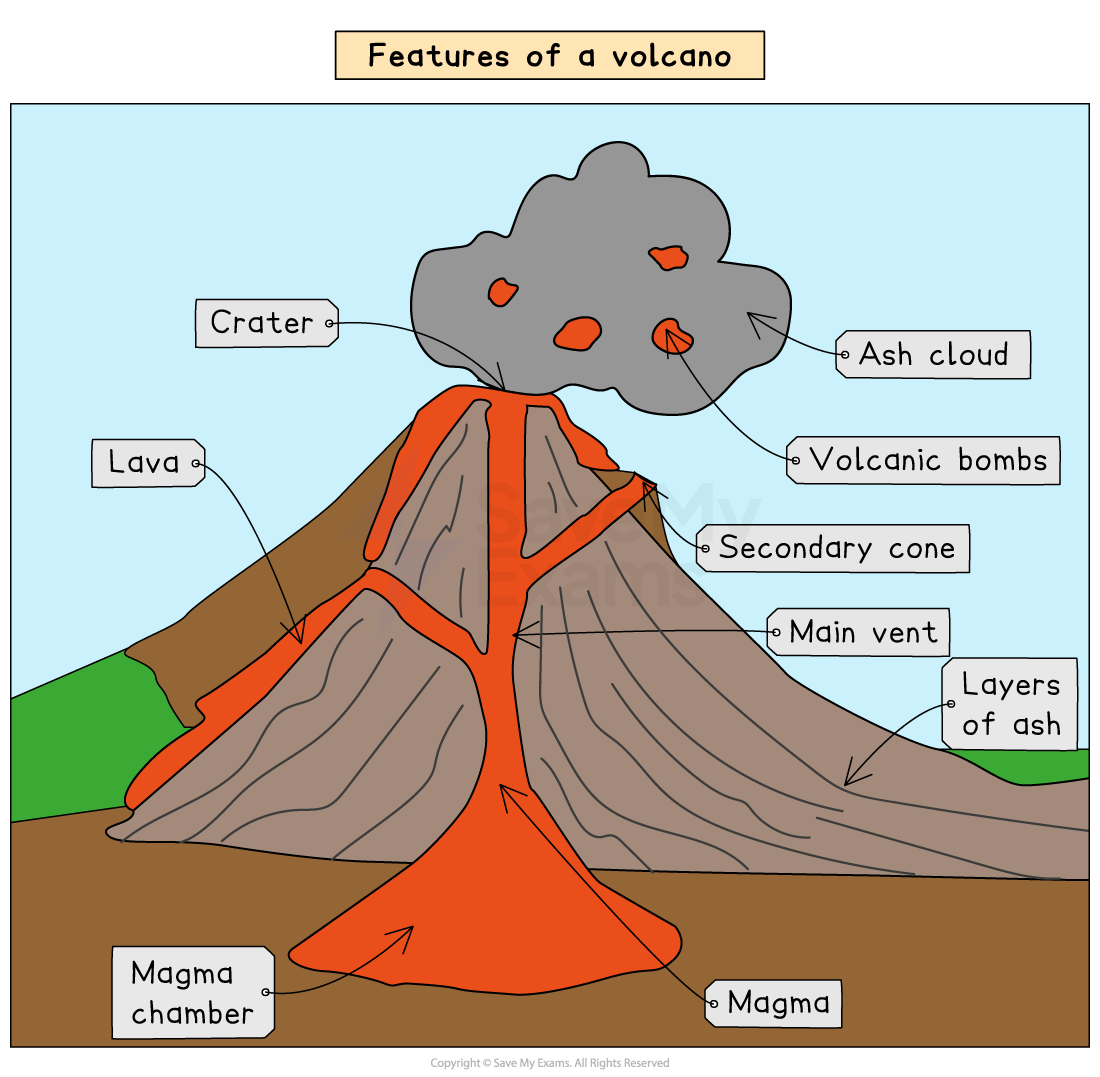
A volcano forms when magma erupts onto the Earth's surface as lava through a vent in the Earth's crust
When magma erupts onto the surface, it is called lava
The magnitude of a volcanic eruption is measured on the Volcanic Explosivity Index (VEI)
The scale is open-ended but the highest in recorded human history was an 7 (Tambora 1815)
Volcanic hazards
Volcanic hazards
Volcanic eruptions may include a range of features
Some of these hazards are localised or can have a global impact
Tephra
Tephra refers to all the material that is ejected during an eruption, including ash and volcanic rocks
Ash is pulverised solid lava which measures less than 2 mm in diameter
Ash is ejected into the atmosphere and can travel thousands of kilometres
The ash fall can cover large areas, disrupting transportation, damaging infrastructure and affecting animal/human health
Volcanic rocks are fragments of molten rock which are ejected from the volcano
These are between 60 mm and 5 m in diameter
Pyroclastic flow
Pyroclastic flow is fast-moving, very hot clouds of poisonous gases mixed with ash
Average speeds of about 100 km/h but can move at up to 700 km/h
Can cover large areas and lead to total destruction
Lahars
Lahars occur when volcanoes erupt and snow and ice on the peak melt
The meltwater combines with the ash
This creates fast-moving mudflows or lahars
The lahars can cover large areas, destroying infrastructure, buildings and crops
Lava flows
When magma erupts to the surface, it is known as lava
The lava can be thin and runny or thick and slow-moving
This depends on the composition of the magma
Lava can cover extensive areas leading to the destruction of buildings and infrastructure
Earthquakes
These are caused by magma rising to the surface through the vents in the volcano
This increases pressure on the Earth's crust, leading to earth tremors
Toxic gases
Gases released during an eruption include carbon dioxide, sulphur dioxide and hydrogen sulphide
The gases can travel long distances depending on the wind patterns
They pose a health hazard to humans and animals