Detailed Specific Example: Türkiye-Syria
Specification link
This page covers section 4.4.3 of the CIE O Level specification.
4.4.3 - One detailed specific example to include:
The causes and impacts of an earthquake on a named country/area
The responses to the earthquake
The strategies and techniques used to manage the impacts of earthquakes
Background
Türkiye and Syria, though sharing a border, are at different levels of development.
Türkiye:
is a middle-income country (MIC)
has a reasonably well-developed infrastructure
has trained and equipped emergency services
Syria:
is a low-income country (LIC)
is in the midst of a continuing civil war
has a severely damaged infrastructure and economy
has limited ability to respond to a disaster
Causes of the Türkiye-Syria earthquake
Causes of the Türkiye-Syria earthquake
The 2023 Türkiye-Syria earthquake happened due to movement along the East Anatolian Fault
This is an example of a transform boundary
Arabian Plate moves north, pushing the small Anatolian Plate westward
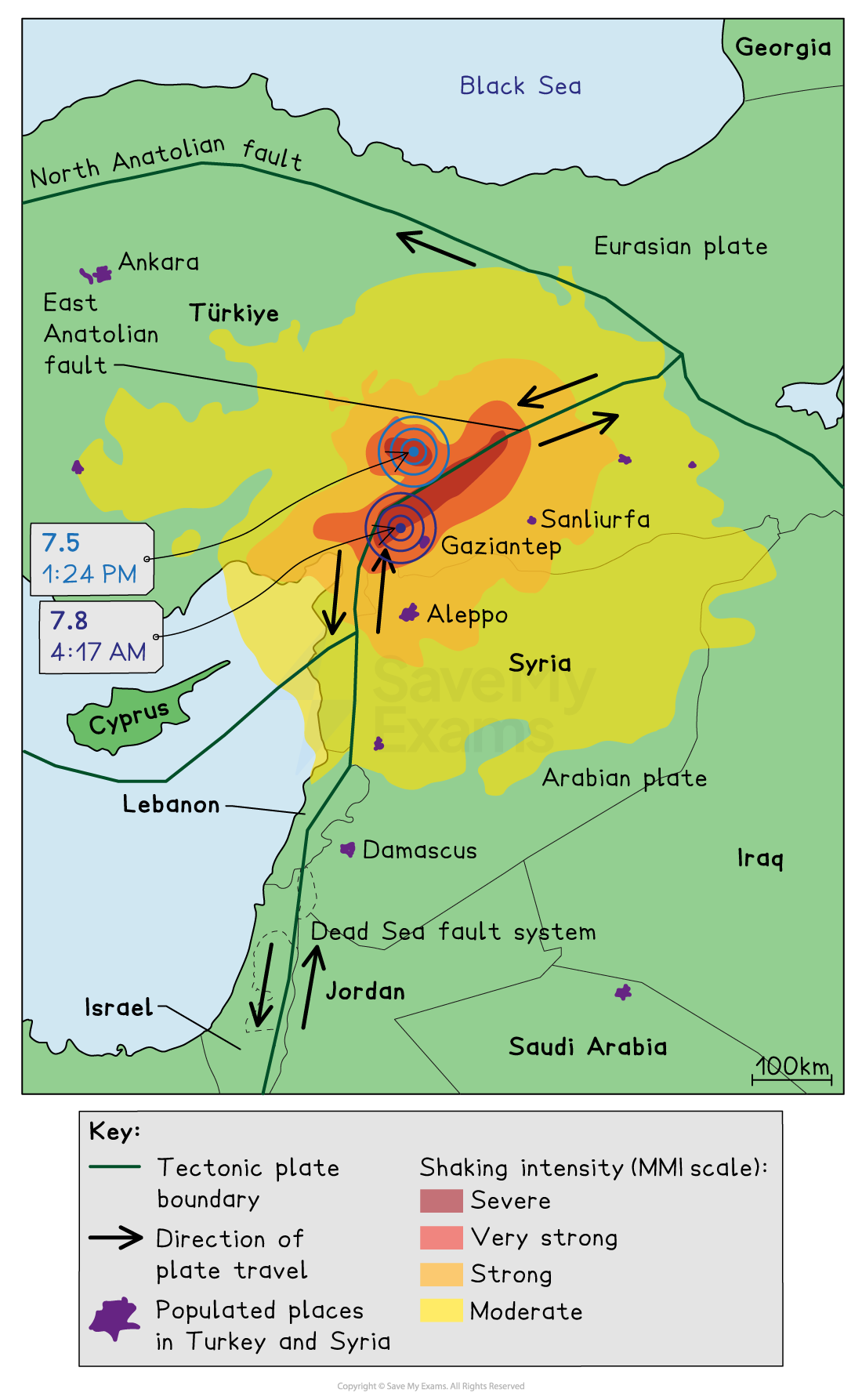
Built-up pressure was released in a magnitude 7.8 earthquake
The earthquake occurred in the early hours of the morning on February 6, 2023
The shallow depth meant more intense shaking and destruction
A magnitude 7.5 aftershock followed nine hours later
This increased the damage
Many additional buildings damaged in the first earthquake collapsed
The region hadn’t experienced a major earthquake since 1822, meaning accumulated pressure that had built up was high
Impacts of the Türkiye-Syria earthquake
Impacts of the Türkiye-Syria earthquake
Primary Impacts
Widespread destruction in Türkiye and Syria
Over 35,000 deaths were reported in the first week, later rising to over 56,000
In Türkiye, over 100,000 people were injured
Millions of people were left homeless due to collapsed buildings
In Türkiye, the cities of Antakya, Gaziantep and Kahramanmaraş suffered severe damage
Over 300,000 buildings were damaged or destroyed across Türkiye
An estimated 1.5 million people were made homeless
In Syria, the towns of Aleppo and Idlib were most affected
An estimated 10,600 buildings were destroyed in Syria (there is no exact figure due to the ongoing conflict)
Approximately 2 million people end up living in camps and shelters due as a result of the earthquake and conflict
Damage to infrastructure, including roads, hospitals, and electricity networks
The estimated economic loss was between $50 and $85 billion
Secondary Impacts
Fires caused by broken gas pipes and electrical faults
Landslides triggered by the quake
Food and water shortages due to damaged supply chains
Food prices increased in some cases by over 20%
Increased spread of disease in makeshift camps
By June 2023, over 40,000 cases of cholera had been recorded in Syria
Respiratory infections increased due to the conditions people were living in
Many hospital buildings and health centres had collapsed, meaning treating survivors was difficult
Harsh winter conditions worsened survival chances for trapped victims
Rescue efforts in Syria were slowed by ongoing civil war and damaged infrastructure
Approximately 18 million people needed assistance
Responses to the Türkiye-Syria earthquake
Responses to the Türkiye-Syria earthquake
Immediate Responses
Local people searched for survivors
Approximately 250,000 volunteers from Türkiye joined rescue efforts
Specialised equipment and sniffer dogs were used in Türkiye to locate survivors buried in the rubble
International rescue teams and aid arrived after a few days
The UN appeal aimed to help over 10 million people in Türkiye and Syria
Shelter, food, and medical supplies were provided
Access to affected areas in Syria was difficult due to the ongoing conflict
In Türkiye, Hatay's airport was badly damaged, which affected aid getting to the area
The last survivors were pulled from the rubble nine days after the earthquake
Long-Term Responses
Reconstruction efforts were planned but delayed by the scale of damage
Improving building standards to reduce future risks in Türkiye
Financial aid and international support were pledged for rebuilding
Psychological and medical support for survivors
Strategies to reduce the impacts of earthquakes in Türkiye-Syria
Strategies to reduce the impacts of earthquakes in Türkiye-Syria
Stricter building regulations were implemented to prevent future collapses
The government in Türkiye were criticised due to the failure to enforce stricter building codes after the 1999 Izmit earthquake
Education on earthquake preparedness to increase survival chances
Financing of $1 billion from the World Bank to support Türkiye's recovery
Development of early warning systems to give people time to react
Strengthening infrastructure (e.g. roads, hospitals) to withstand tremors
More efficient disaster response plans for faster aid delivery
International cooperation for disaster relief in conflict-affected areas like Syria