Antibiotic-Resistant Bacteria & Selection
Antibiotic-Resistant Bacteria & Selectionvideo
Antibiotic-Resistant Bacteria & Selection
While natural selection in most species occurs over many years, in species with short generation times it can take place very quickly
The development of antibiotic resistance in bacteria is an example of natural selection that occurs over easily observable time frames
E.g. methicillin-resistant staphylococcus aureus, or MRSA, are resistant to the antibiotic methicillin
The development of antibiotic resistance can be explained as follows:
Variation exists in a bacterial population; some have an allele that provides resistance to an antibiotic while others do not
This allele will have arisen due to random mutation
Bacteria reproduce, resulting in many individuals, not all of which will survive
The bacteria compete for survival
The bacteria with alleles for antibiotic resistance are more likely to survive when exposed to the antibiotic, and these surviving individuals are more likely to reproduce
The reproducing bacteria pass on the allele for antibiotic resistance to their offspring
Over many generations, the number of antibiotic resistant bacteria in the population increases
This may only take a few hours if the bacteria are reproducing quickly
Antibiotic resistance diagram
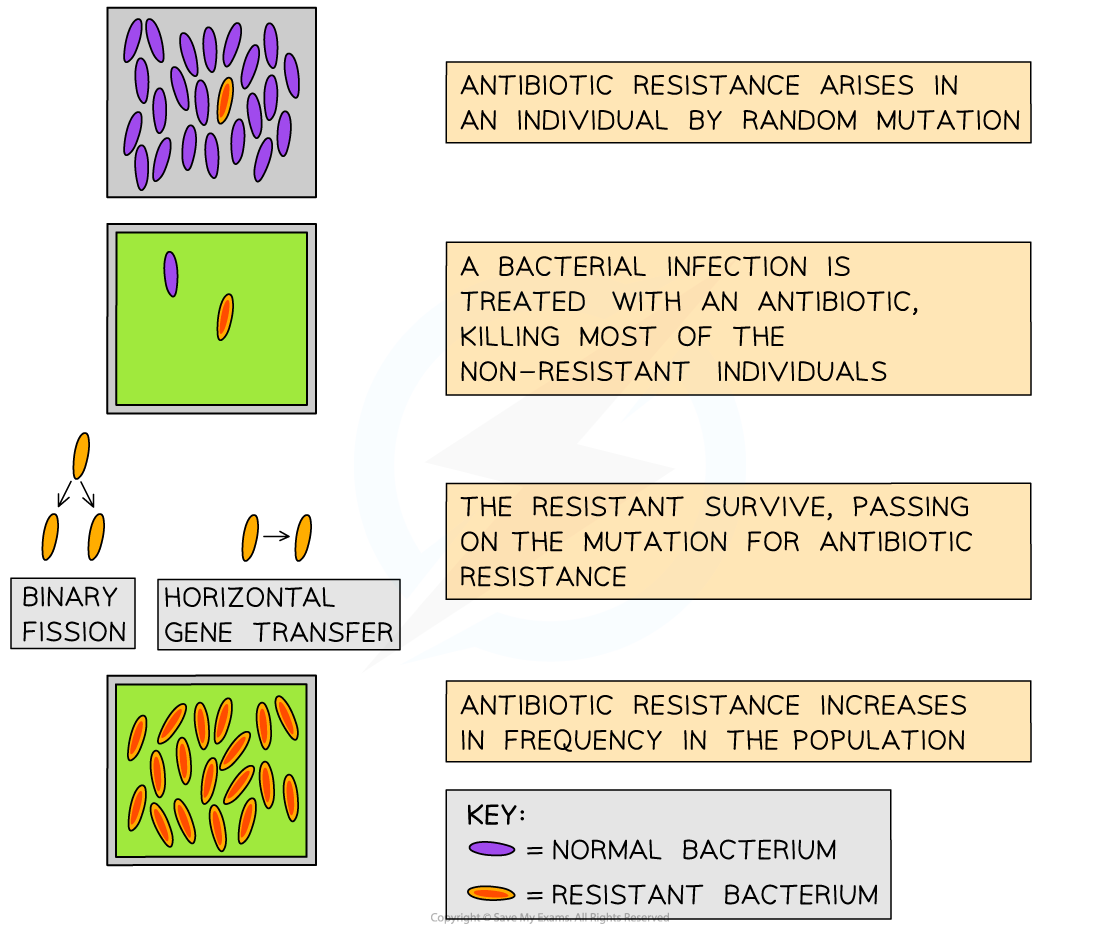
The development of antibiotic resistance is an example of natural selection