Natural Selection
Natural Selectionvideo
Natural Selection
The process of natural selection results in populations that are well adapted to survive in their environments as follows:
Genetic variation exists between individuals in a population
This occurs due to events such as mutation and meiosis
When organisms reproduce, they produce more offspring than the environment is able to support
Because not every individual can survive, there is competition for food and other resources
Individuals with characteristics that are advantageous in their environment have a higher chance of survival and so are more likely to reproduce
The alleles that code for advantageous characteristics are passed on to offspring
The allele that codes for the advantageous characteristics becomes more common in each subsequent generation, and the inherited features of the population evolve, or change, over time
This theory of natural selection was first put forward by Charles Darwin and is also known as ‘survival of the fittest’
Examples of natural selection
Snail shell colour may evolve by natural selection as follows:
Within the population of snails there is variation in shell colour
Snail shell colour may be black, grey, or white
The white phenotype in this example is a new allele that has arisen due to random mutation
More snails are present in the environment than are able to survive
There is competition and struggle for survival
Snails with advantageous features are more likely to survive and reproduce; here the white shell phenotype appears to be advantageous, so the white shelled individuals survive and reproduce
E.g. the snails may live in an environment where the surrounding ground is pale in colour, e.g. in a garden with white paving slabs, so they are camouflaged and are less likely to be eaten by predators
The allele for white shells is passed on to offspring more frequently than the alleles for black or grey shells
The allele for white shells becomes more common in the next generation, and this continues to occur over many generations until the majority of snails in the population have white shells
Natural selection example diagram
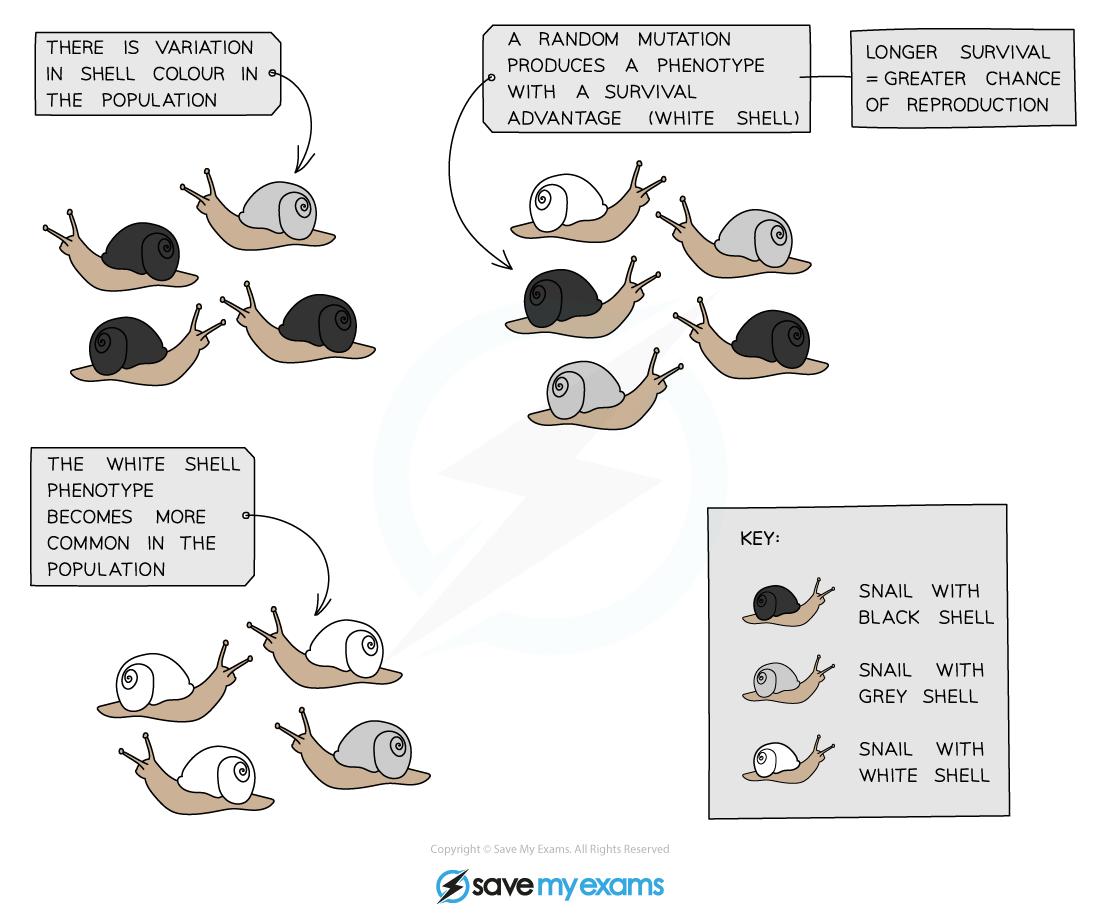
The inherited features of a population evolve over time due to natural selection
The evolution of body colour in moths is another commonly given example of natural selection
Natural selection peppered moth diagram
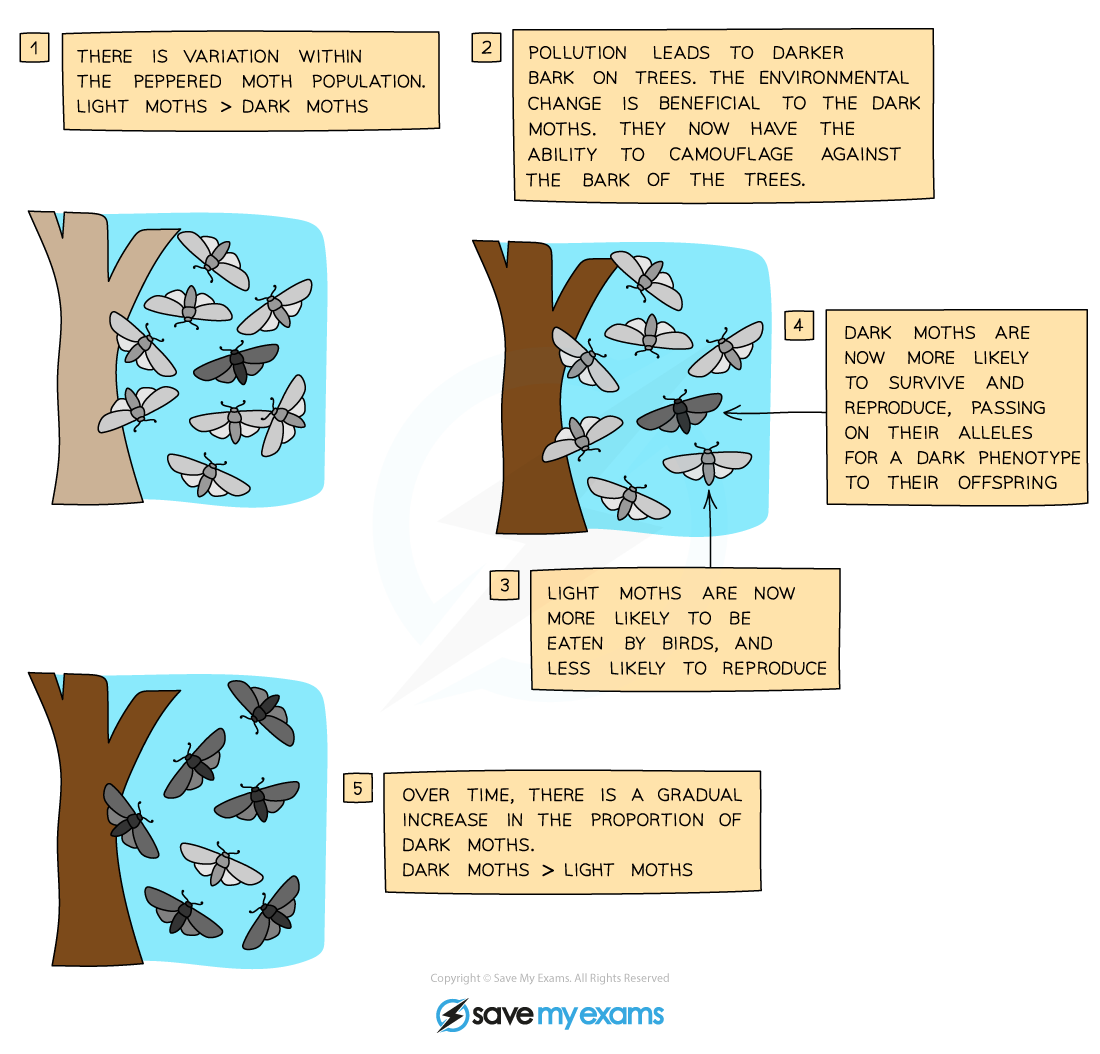
Another good example of natural selection is the evolution of the peppered moths