Hierarchical Structures
Organisational charts
Organisational charts
An organisational chart is a visual representation of the reporting relationships, roles and responsibilities of employees in an organisation
Businesses must determine what the best structure is for them so as to effectively implement ideas and achieve their objectives
They should consider how the structure may affect the management and effectiveness of operations and communications
A well-designed organisational structure helps to promote clarity, efficiency and accountability
An organisational chart

Chain of command
Chain of command
The chain of command is the formal line of authority that flows downward from the top management to lower-level employees
It defines who reports to whom and who is responsible for making decisions
The chain of command helps to establish a clear communication channel and helps to maintain accountability within the organisation
Span of control
Span of control
Span of control refers to the number of employees that a manager or supervisor can effectively manage
It is based on the principle that a manager can only effectively manage a limited number of employees
A narrower span of control means that there are more layers of management
A wider span of control means that there are fewer layers of management
Tall and flat structures
Tall and flat structures
The chain of command and span of control are closely linked
A long chain of command usually results in a narrow span of control
This is known as a tall organisational structure
A short chain of command usually results in a wide span of control
This is known as a flat organisational structure
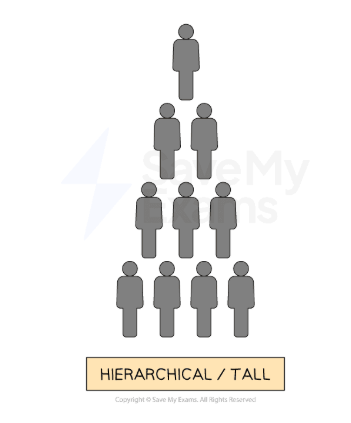
Characteristics of tall structures
Multiple levels of management
A long chain of command and narrow span of control
Common in large organisations with complex operations
E.g. government agencies and universities
A tall structure
Evaluating tall structures
Advantages | Disadvantages |
|---|---|
|
|
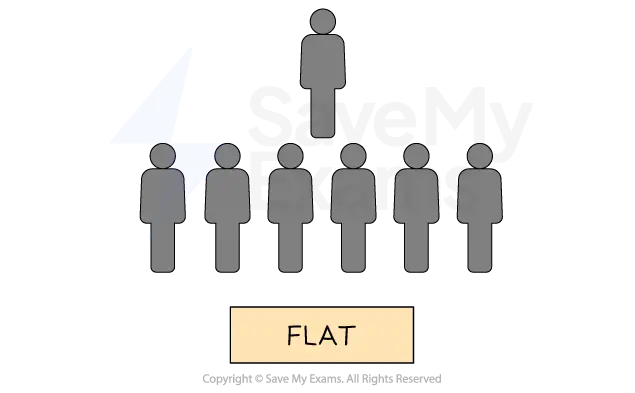
Characteristics of flat structures
Fewer levels of management
A short chain of command and wide span of control
Common in small organisations or start-ups
E.g. technology start-ups and small businesses
A flat structure
Evaluating flat structures
Advantages | Disadvantages |
|---|---|
|
|