Methods of Motivation
Financial methods of motivation
Financial methods of motivation
Financial incentives are rewards or payments given to employees in return for their labour or improved performance
The different theories of human motivation offer varying perspectives on the role of money in motivating staff
Herzberg's theory says that money is not generally a motivator, but the lack of it leads to dissatisfaction
Maslow's theory suggests people move through levels of needs that motivate them
Lower-order needs are closely linked to financial rewards, whilst higher-order needs are rarely linked to pay
Physiological and safety needs can be partially met by providing adequate pay
Love and Belonging needs are often met by encouraging aspects such as teamwork
Financial methods of motivation
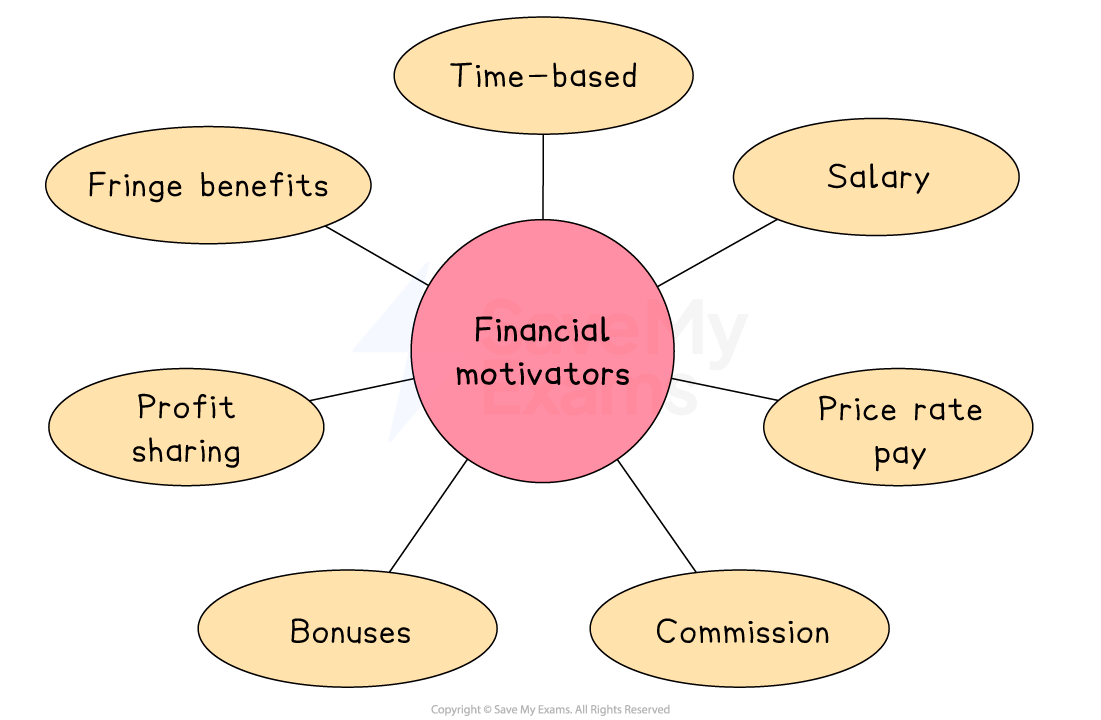
Incentive type | Explanation |
|---|---|
Time based |
|
Salary |
|
Piece rate pay |
|
Commission |
|
Bonus |
|
Profit sharing |
|
Fringe benefits |
|
Non-financial methods of motivation
Non-financial methods of motivation
Non-financial incentives are rewards that are not directly related to money
These incentives may be intangible and include methods that lead to recognition, praise, job satisfaction or improved work-life balance
Types of non-financial Incentives
Praise/employee of the month
Many workers respond well to praise or to recognition programs inside the workplace.
Meaningful praise can increase productivity
Job enrichment
Involves adding more challenging or meaningful tasks to a job
Staff feel more motivated and engaged, leading to improved productivity
Job rotation
Involves moving staff between broadly similar but varied roles in the business
Exposes staff to new challenges and experiences, which can increase motivation, understanding and skill
Teamworking
Teamwork may involve workers completing tasks together
Teamwork can increase motivation in the workplace, as each member of staff has a role and a shared goal
Training
Involves staff improving or learning new skills and abilities
This can make employees feel valued, more productive and likely to remain with the business
Promotion opportunities
Employees offered promotion will feel recognised, have a higher status and will be given more challenging tasks/responsibilities to perform
These benefits are closely linked to the views of both Maslow and Herzberg
Recommending motivation methods
Recommending motivation methods
When recommending a method of motivation for employees in a business, managers must recognise that individuals are motivated in different ways
Factors affecting the choice of motivation method
The context of the business
What type of business is it? E.g. manufacturing or sales
The budget available
How many workers does the organisation have?
Does the business currently use any methods of motivation?
What is the nature of the work carried out by employees on a daily basis?
The balance of the compensation package
Ideally it should include both financial and non-financial
It should be adaptable and reflect the changing needs of staff