Locating Agents & Rf Values
Locating Agentsvideo
Locating Agents
For chromatography to be useful the chemist needs to be able to see the components move up the paper, which is not the case for colourless substances such as amino acids or sugars
Locating agents are substances which react with the sample and produce a coloured product which is then visible
The chromatogram is treated with the agent after the chromatography run has been carried out, making the sample runs visible to the naked eye
Retention Factor (Rf) Values
Retention Factor (Rf) Values
These values are used to identify the components of mixtures
The Rf value of a particular compound is always the same
Calculating the Rf value allows chemists to identify unknown substances because it can be compared with Rf values of known substances under the same conditions
Calculation
The formula to calculate the retention factor is:
The Rf value is a ratio and therefore has no units
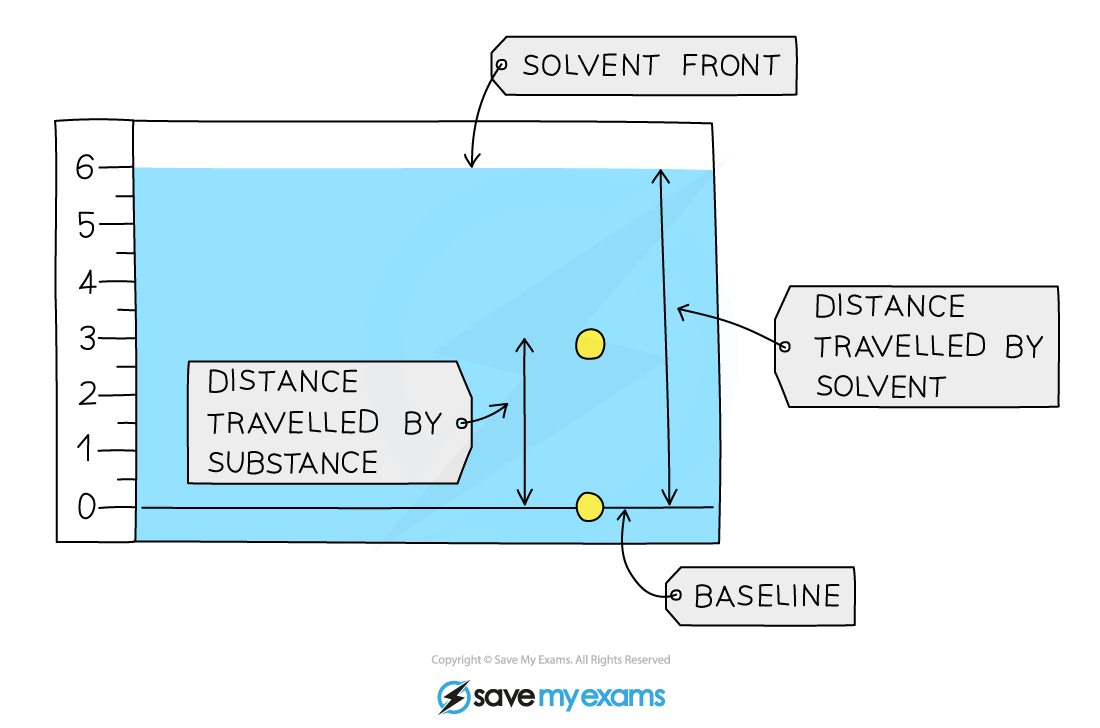
Using Rf values to identify components of a mixture