Empirical Formulae & Formulae of Ionic Compounds
Empirical Formulae
Empirical Formulae
The molecular formula is the formula that shows the number and type of each atom in a molecule
E.g. the molecular formula of ethanoic acid is C2H4O2
The empirical formula is the simplest whole number ratio of the atoms of each element present in one molecule or formula unit of the compound
E.g. the empirical formula of ethanoic acid is CH2O
Organic molecules, such as ethanoic acid, often have different empirical and molecular formulae
The formula of an ionic compound is always an empirical formula
Deducing Formulae of Ionic Compoundsvideo
Deducing Formulae of Ionic Compounds
The formulae of these compounds can be calculated if you know the charge on the ions
The Periodic Table can help work out the charge on many elements:
Group I elements form ions with a 1+ charge
Group II elements form ions with a 2+ charge
Group III elements form ions with a 3+ charge
Group V elements form ions with a 3- charge
Group VI elements form ions with a 2- charge
Group VII elements form ions with a 1- charge
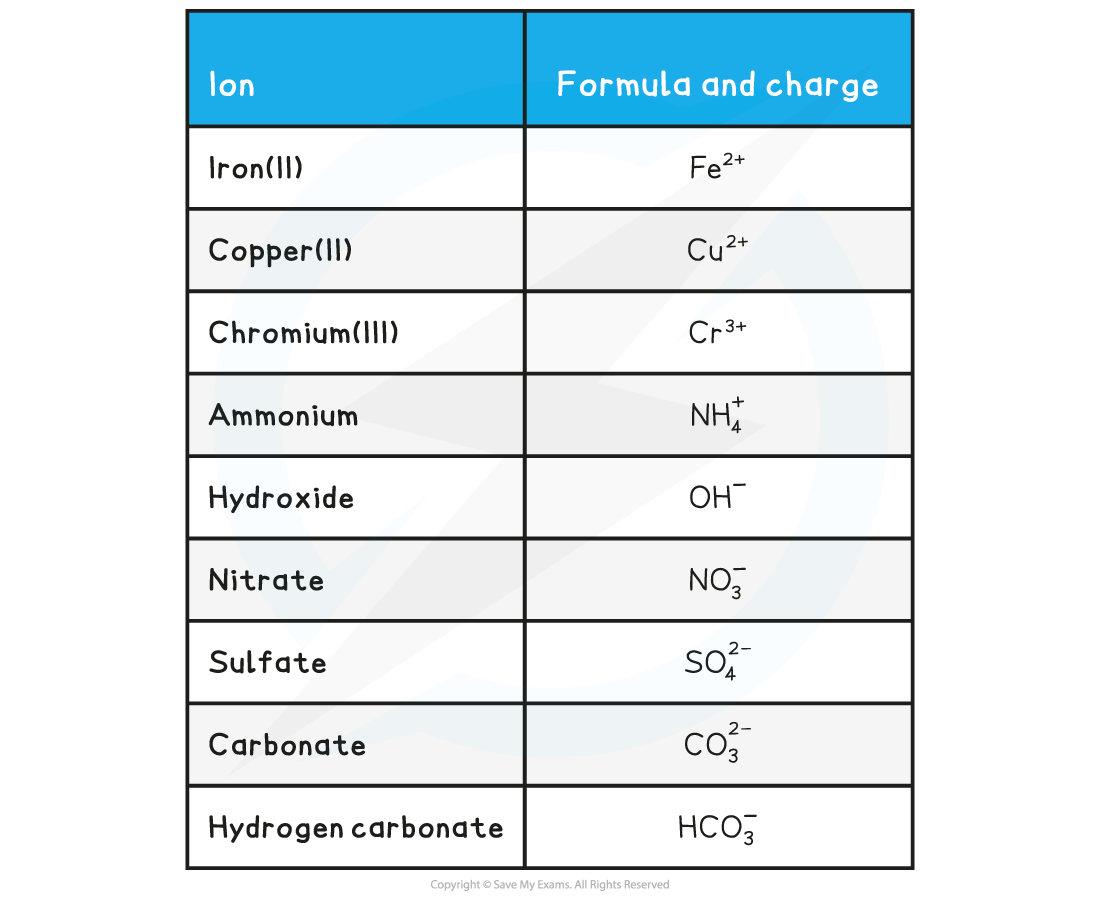
Below are some other common ions and their charges
Note that a Roman numeral next to the element tells you the charge on the ion, e.g. copper(II) ions have a charge 2+
There are several common compound ions included in the table
Some chemists call these polyatomic ions
Common Ions & Their Charges Table
The overall sum of the charges of an ionic compound should be 0
You therefore need to work out the ratio of the ions to ensure this is the case
When you write the formula of a compound ion it is necessary to use brackets around the compound ion where more than one of that ion is needed in the formula
For example copper(II) hydroxide is Cu(OH)2