Ar & Mr
Relative Massesvideo
Relative Masses
Relative Atomic Mass
The symbol for the relative atomic mass is Ar
The relative atomic mass for each element can be found in the Periodic Table along with the atomic number
The relative atomic mass is shown underneath the atomic symbol and is larger than the atomic number (except for hydrogen where they are the same)
Atoms are too small to accurately weigh but scientists needed a way to compare the masses of atoms
The carbon-12 is used as the standard atom and has a fixed mass of 12 units
It is against this atom which the masses of all other atoms are compared
Relative atomic mass (Ar) can therefore be defined as:
The average mass of the isotopes of an element compared to 1/12th of the mass of an atom of 12C
The relative atomic mass of carbon is 12
The relative atomic mass of magnesium is 24 which means that magnesium is twice as heavy as carbon
The relative atomic mass of hydrogen is 1 which means it has one twelfth the mass of one carbon-12 atom
Relative molecular (formula) mass
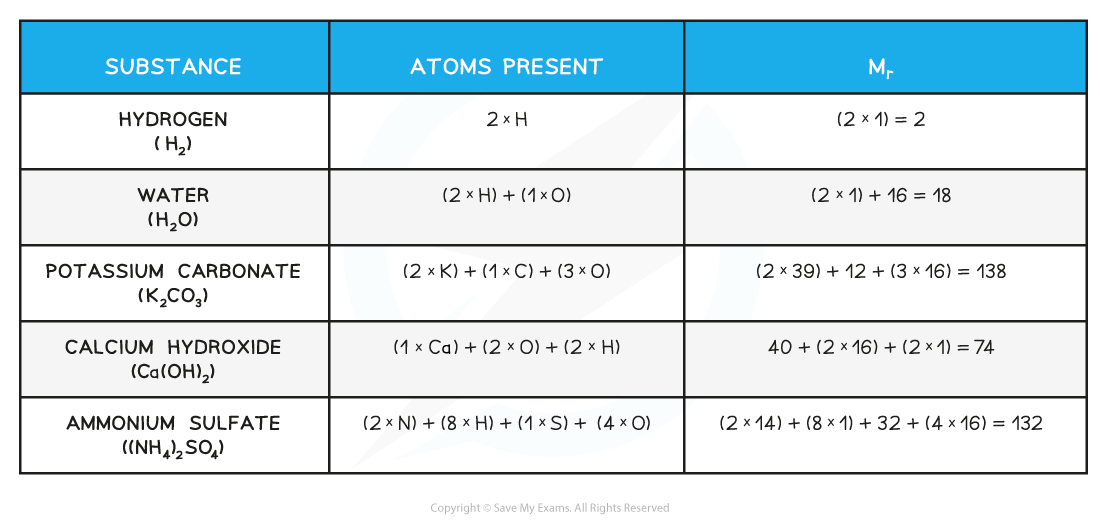
The symbol for the relative molecular mass is Mr and it refers to the total mass of the molecule
To calculate the Mr of a substance, you have to add up the relative atomic masses of all the atoms present in the formula
Relative formula mass is used when referring to the total mass of an ionic compound
Relative Formula Mass Calculations Table
Reacting masses
The Law of Conservation of mass tells us that mass cannot be created or destroyed
In a chemical reaction, the total mass of reactants equals the total mass of the products
We can use this, along with relative atomic/formula masses to perform calculations to identify the quantities of reactants or products involved in a chemical reaction
Example:
2Ca + O2 → 2CaO
Relative atomic masses: Ca = 40; O = 16
Using the balanced symbol equation shows that 2 x 40 = 80 units of mass of calcium react with 2 x 16 = 32 units of mass of oxygen to form 2 x (40 + 16) = 112 units of mass of CaO:
2Ca + O2 → 2CaO
80 + 32 = 112
The ratio of the mass of calcium and oxygen reacting will always be the same, regardless of the units
E.g. 80 g of calcium will react with 32 g of oxygen to form 112 g of calcium oxide
Or, 40 tonnes of calcium will react in excess oxygen to form 56 tonnes of calcium oxide