Empirical & Molecular Formula
Calculating Empirical & Molecular Formulaevideo
Calculating Empirical & Molecular Formulae
Calculating Empirical Formula
The empirical formula is the simplest whole number ratio of the atoms of each element present in one molecule or formula unit of the compound
E.g. the empirical formula of ethanoic acid is CH2O
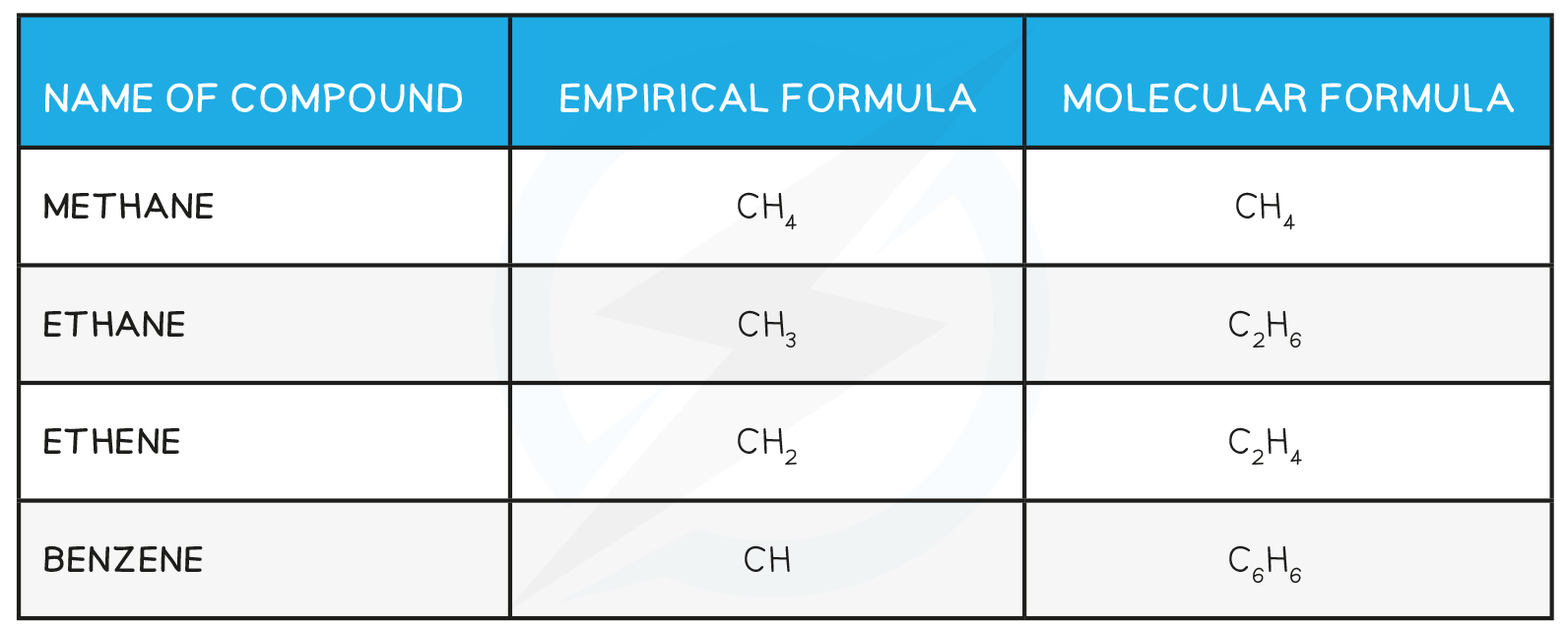
Organic molecules often have different empirical and molecular formulae
The formula of an ionic compound is always an empirical formula
Calculating Molecular Formula
Molecular formula gives the actual numbers of atoms of each element present in the formula of the compound
To calculate the molecular formula:
Step 1: Find the relative formula mass of the empirical formula
Step 2: Use the following equation:
Step 3: Multiply the number of each element present in the empirical formula by the number from step 2 to find the molecular formula
Table showing the Relationship between Empirical and Molecular Formula
Deducing formulae of hydrated salts
The formula of hydrated salts can be determined experimentally by weighing a sample of the hydrated salt, heating it until the water of crystallisation has been driven off, then reweighing the now anhydrous salt
From the results, you can determine the mass of anhydrous salt and the mass of the water of crystallisation
Applying a similar approach to deducing empirical formulae, the formula of the hydrated salt can be calculated