Molar Gas Volume
Molar Gas Volumevideo
Molar Gas Volume
Avogadro’s Law states that at the same conditions of temperature and pressure, equal amounts of gases occupy the same volume of space
At room temperature and pressure, the volume occupied by one mole of any gas was found to be 24 dm3 or 24,000 cm3
This is known as the molar gas volume at RTP
RTP stands for “room temperature and pressure” and the conditions are 20 ºC and 1 atmosphere (atm)
From the molar gas volume the following formula triangle can be derived:
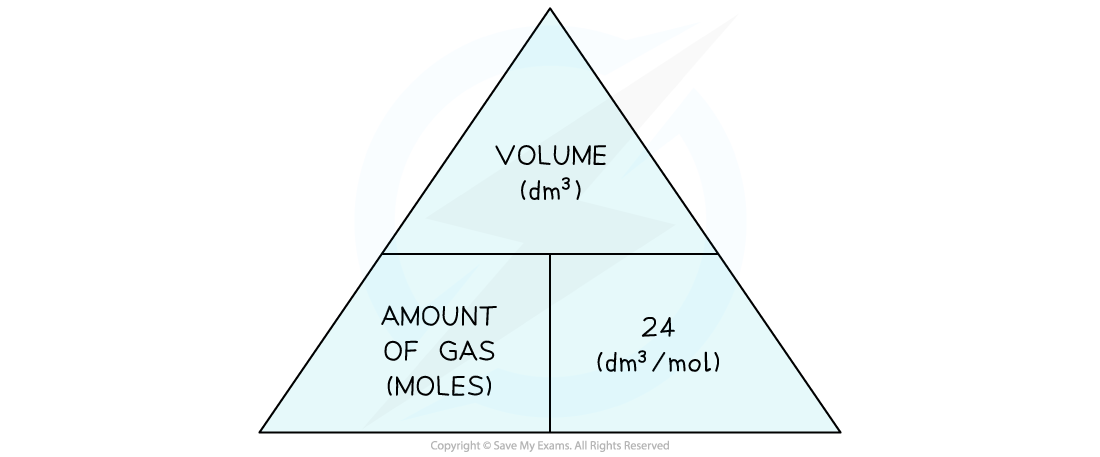
Formula triangle showing the relationship between moles of gas, volume in dm3 and the molar volume
If the volume is given in cm3 instead of dm3, then divide by 24,000 instead of 24:
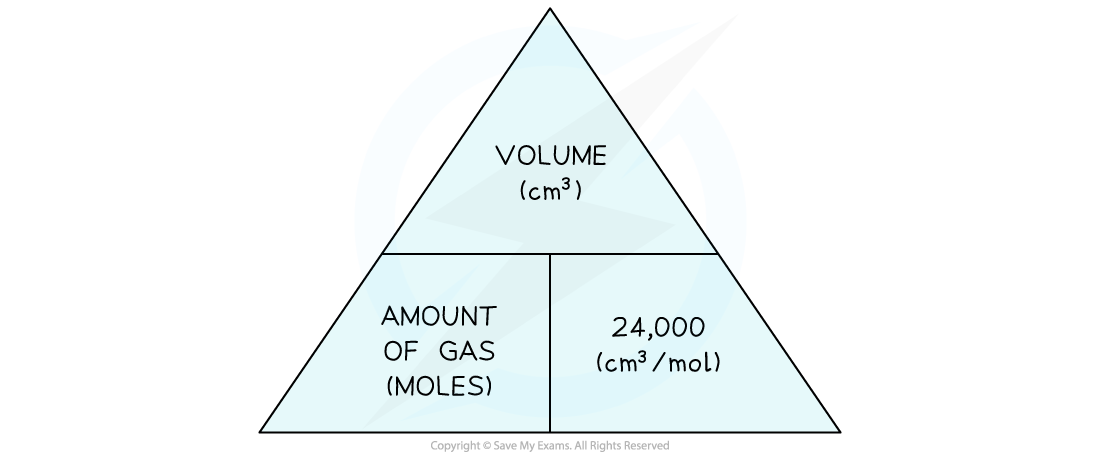
Formula triangle showing the relationship between moles of gas, volume in cm3 and the molar volume
The formula can be used to calculate the number of moles of gases from a given volume or vice versa
Simply cover the one you want and the triangle tells you what to do
To find the volume of a gas
Volume = Moles x Molar Volume
Examples of Converting Moles into Volumes Table
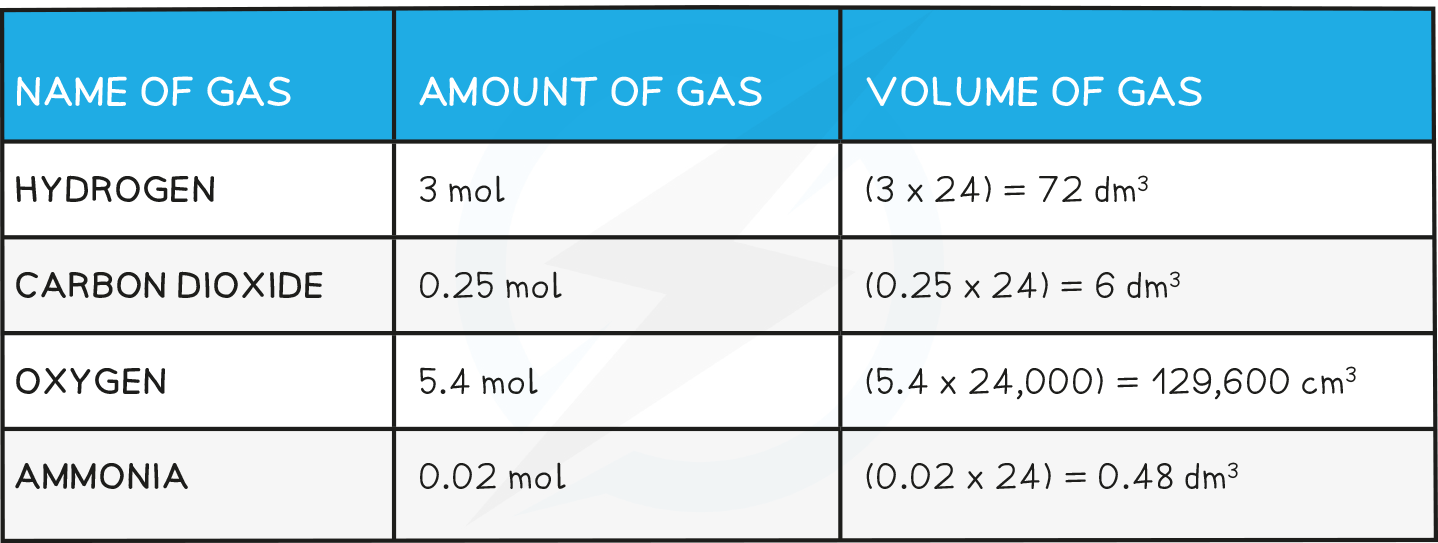
To find the moles of a gas
Moles = Volume ÷ Molar Volume
Examples of Converting Volumes into Moles Table
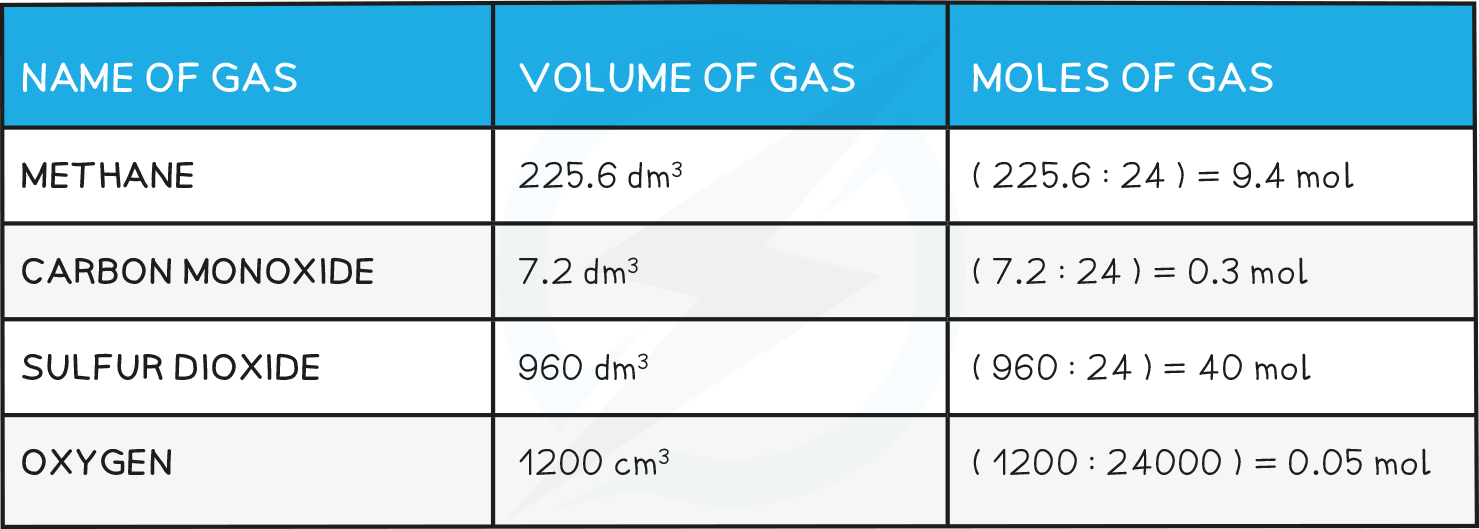
Calculating Gas Volumes
Calculating Gas Volumes
You may be asked to calculate the volume of a gas from a given amount stated in grams instead of moles
To answer these type of questions you must first convert grams to moles and then calculate the volume.
A second style of gas calculation involves calculating the volumes of gaseous reactants and products from a balanced equation and a given volume of a gaseous reactant or product
These problems are straightforward as you are applying Avogadro's Law, so the moles ( and coefficients) in equations are in the same ratio as the gas volumes