Reversible Reactions
Reversible Reactionsvideo
Reversible Reactions
Reversible reactions
Some reactions go to completion, where the reactants are used up to form the product molecules and the reaction stops when all of the reactants are used up
In reversible reactions, the product molecules can themselves react with each other or decompose and form the reactant molecules again
It is said that the reaction can occur in both directions: the forward reaction (which forms the products) and the reverse reaction(which forms the reactants)
Chemical equations for reversible reactions
When writing chemical equations for reversible reactions, two arrows are used to indicate the forward and reverse reactions
Each one is drawn with just half an arrowhead – the top one points to the right, and the bottom one points to the left: ⇌
Example
The reaction for the Haber process which is the production of ammonia from hydrogen and nitrogen:
N2 + 3H2 ⇌ 2NH3
Hydrated and anhydrous salts
Hydrated salts are salts that contain water of crystallisation which affects their molecular shape and colour
Water of crystallisation is the water that is stoichiometrically included in the structure of some salts during the crystallisation process
A common example is copper(II) sulfate which crystallises forming the salt copper(II) sulfate pentahydrate, CuSO4.5H2O
Water of crystallisation is indicated with a dot written in between the salt molecule and the surrounding water molecules
Anhydrous salts are those that have lost their water of crystallisation, usually by heating, in which the salt becomes dehydrated
Dehydration of hydrated cobalt(II) chloride:
hydrated cobalt(II) chloride ⇌ anhydrous cobalt(II) chloride + water
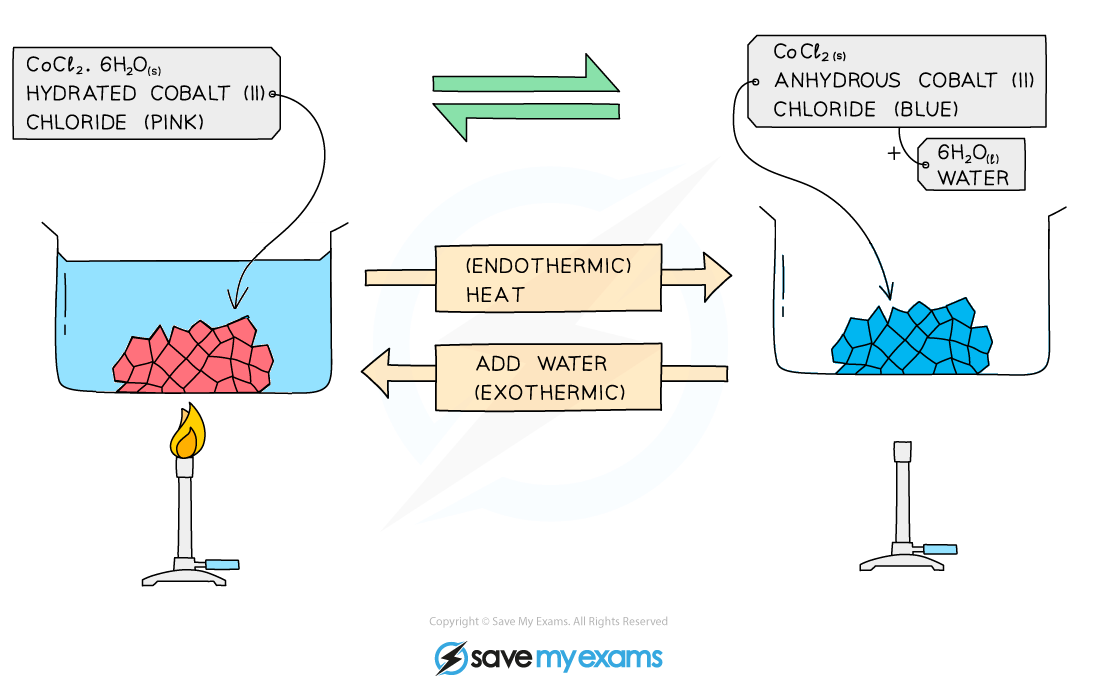
Diagram showing the dehydration of hydrated cobalt(II) chloride
Hydration of cobalt(II) chloride
When anhydrous blue cobalt(II) chloride crystals are added to water they turn pink and the reaction is reversible
When the cobalt(II) chloride crystals are heated in a test tube, the pink crystals turn back to the blue colour again as the water of crystallisation is lost
The form of cobalt(II) chloride in the crystals that are pink is known as hydrated cobalt(II) chloride because it contains water of crystallisation
When hydrated cobalt(II) chloride is heated, it loses its water of crystallisation and turns into anhydrous cobalt(II) chloride:
CoCl2.6H2O (s) ⇌ CoCl2 (s) + 6H2O (l)