The Haber Process
The Haber Processvideo
The Haber Process
Ammonia is manufactured in an exothermic reaction called the Haber process which occurs in five stages:
Stage 1: H2 and N2 are obtained from methane in natural gas and the air respectively and are pumped into the compressor through pipe
Stage 2: The gases are compressed to about 200 atmospheres (20,000 kPa) inside the compressor
Stage 3: The pressurised gases are pumped into a tank containing layers of catalytic iron beds at a temperature of 450 °C. Some of the hydrogen and nitrogen react to form ammonia:
N2 (g) + 3H2 (g) ⇌ 2NH3 (g)
Stage 4: Unreacted H2 and N2 and the product ammonia pass into a cooling tank. The ammonia is liquefied and removed to pressurised storage vessels
Stage 5: The unreacted H2 and N2 gases are recycled back into the system and start over again
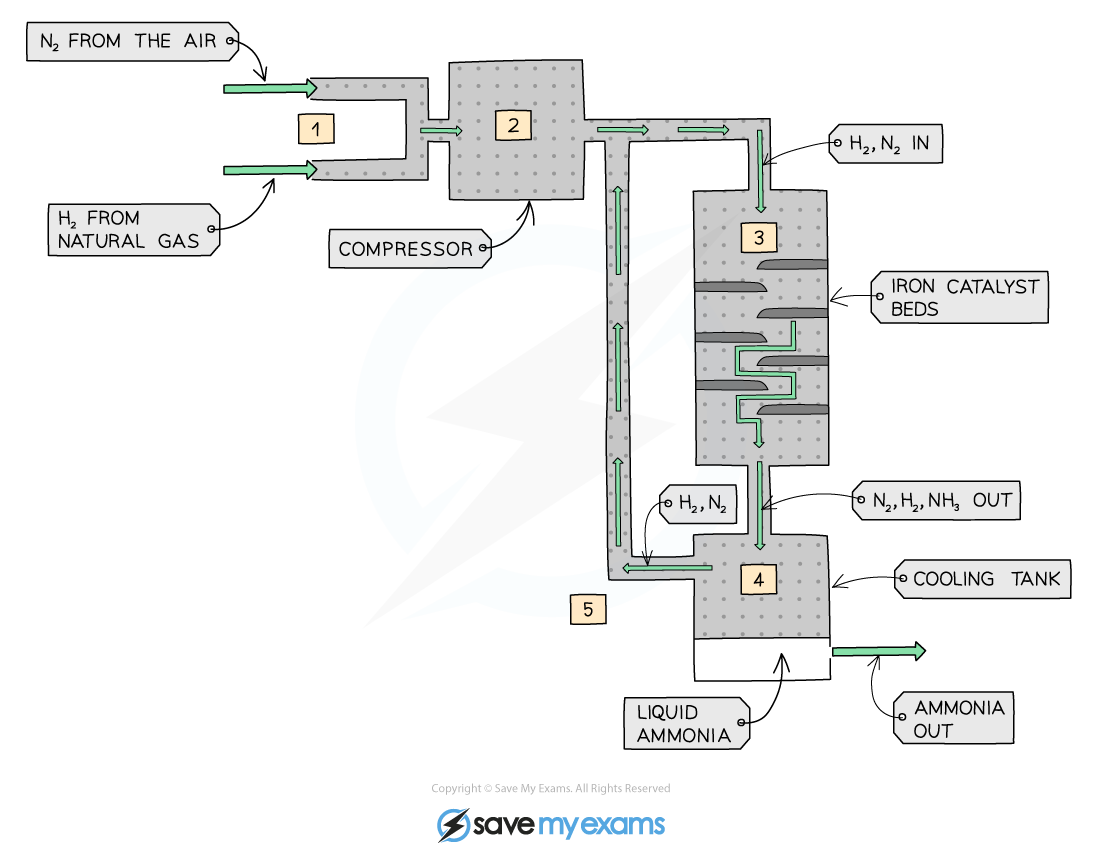
The production of ammonia by the Haber process
Explaining the Conditions in the Haber Process
Explaining the Conditions in the Haber Process
Reaction conditions such as temperature and pressure affect the rate of a reaction
If the reaction is reversible then the position of equilibrium is also affected by changes in these conditions and often we must consider a trade-off between the rate of reaction and product yield
The graph below illustrates the effects of changing temperature and pressure on the yield of ammonia obtained
By following any of the curved lines on the graph it can be seen that as the pressure increases, so too does the yield at any given temperature
By following any vertical line upwards from the x-axis, the graph shows that as the temperature decreases, the yield actually increases
The actual conditions used must be chosen depending on a number of economical, chemical and practical considerations
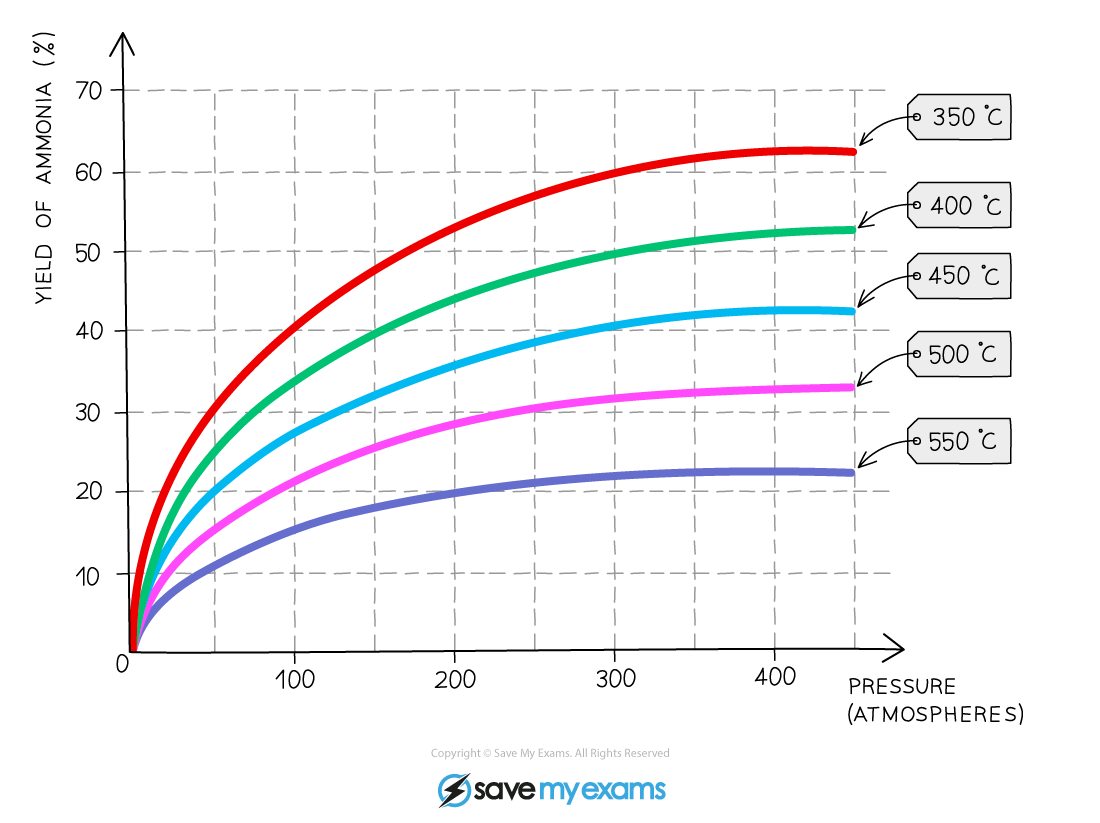
The yield of ammonia produced changes with changes made to temperature and pressure
Economic Considerations
Like all industries, companies that manufacture and sell chemical goods do so to make a profit
Part of the industrial process is the economic decision on how and where to design and implement a manufacturing site
The availability and cost of raw materials is a major consideration which must be studied well before any decisions are taken
In the Haber Process the raw materials are readily available and inexpensive to purify:
Nitrogen - from the air
Hydrogen- from methane in natural gas
If the cost of extraction of raw materials is too high or they are unavailable then the process is no longer economically viable
Many industrial processes require huge amounts of heat and pressure which is very expensive to maintain
Production energy costs are also a factor to be considered carefully and alongside the raw materials issue
Temperature: 450 ºC
A higher temperature would favour the reverse reaction as it is endothermic (takes in heat) so a higher yield of reactants would be made
If a lower temperature is used it favours the forward reaction as it is exothermic (releases heat) so a higher yield of products will be made
However at a lower temperature the rate of reaction is very slow
So 450 ºC is a compromise temperature between having a lower yield of products but being made more quickly
Pressure: 200 atm
A lower pressure would favour the reverse reaction as the system will try to increase the pressure by creating more molecules (4 molecules of gaseous reactants) so a higher yield of reactants will be made
A higher pressure would favour the forward reaction as it will try to decrease the pressure by creating less molecules (2 molecules of gaseous products) so a higher yield of products will be made
However high pressures can be dangerous and very expensive equipment is needed
So 200 atm is a compromise pressure between a lower yield of products being made safely and economically
Catalyst: Iron
The presence of a catalyst does not affect the position of equilibrium but it does increase the rate at which equilibrium is reached
This is because the catalyst increases the rate of both the forward and backward reactions by the same amount (by providing an alternative pathway requiring lower activation energy)
As a result, the concentration of reactants and products is nevertheless the same at equilibrium as it would be without the catalyst.
So a catalyst is used as it helps the reaction reach equilibrium quicker
It allows for an acceptable yield to be achieved at a lower temperature by lowering the activation energy required
Without it the process would have to be carried out at an even higher temperature, increasing costs and decreasing yield as the higher temperature decomposes more of the NH3 molecules